Kirjailija
Frédéric Bastiat
Kirjat ja teokset yhdessä paikassa: 259 kirjaa, julkaisuja vuosilta 1850-2026, suosituimpien joukossa Harmonies of Political Economies. Vertaile teosten hintoja ja tarkista saatavuus suomalaisista kirjakaupoista.
Mukana myös kirjoitusasut: Frederic Bastiat, Fréderic Bastiat
259 kirjaa
Kirjojen julkaisuhaarukka 1850-2026.
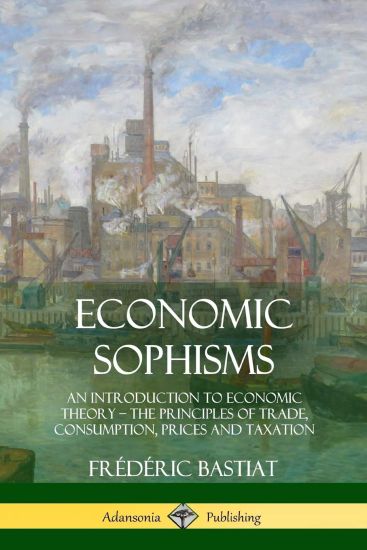
Reproduction of the original: Economic Sophisms by Frederic Bastiat
Essays on Political Economy is a collection of political science essays by Frederic Bastiat.
Frederic Bastian's classic, written in 1850, defines the law as "collective organization of the individual right to lawful defense."and then shows how this same law has been perverted, "annihilating the justice that it was supposed to maintain, aiding] the unscrupulous who wish, without risk, to exploit the liberty and property of others. Given the prevalence of governmental intervention in the developed world, Frederic Bastian's analysis is as relevant today as it was almost 170 years ago, a must-read for all wishing to see behind the rhetoric into the heart of today's global problems.
Essai Sur La Filature Mécanique Du Lin
Alfred Renouard; Frédéric Bastiat
Hachette Livre - BNF
2019
pokkari
Claude-Fr d ric Bastiat (29 June 1801 - 24 December 1850) was a French economist and writer who was a prominent member of the French Liberal School.Bastiat developed the economic concept of opportunity cost and introduced the parable of the broken window. He was also a Freemason and member of the French National Assembly.As an advocate of classical economics and the economics of Adam Smith, his views favored a free market and influenced the Austrian School.Bastiat's most famous work is The Law, originally published as a pamphlet in 1850. It defines a just system of laws and then demonstrates how such law facilitates a free society.In The Law, he wrote that everyone has a right to protect "his person, his liberty, and his property." The state should be only a "substitution of a common force for individual forces" to defend this right. "Justice" (defense of one's life, liberty and property) has precise limits, but if government power extends further into philanthropic endeavors, then government becomes so limitless that it can grow endlessly. The resulting statism is "based on this triple hypothesis: the total inertness of mankind, the omnipotence of the law, and the infallibility of the legislator." The public then becomes socially engineered by the legislator and must bend to the legislators' will "like the clay to the potter" Socialism, like the ancient ideas from which it springs, confuses the distinction between government and society. As a result of this, every time we object to a thing being done by government, the socialists conclude that we object to its being done at all. We disapprove of state education. Then the socialists say that we are opposed to any education. We object to a state religion. Then the socialists say that we want no religion at all. We object to a state-enforced equality. Then they say that we are against equality. And so on, and so on. It is as if the socialists were to accuse us of not wanting persons to eat because we do not want the state to raise grain. I do not dispute their right to invent social combinations, to advertise them, to advocate them, and to try them upon themselves, at their own expense and risk. But I do dispute their right to impose these plans upon us by law - by force - and to compel us to pay for them with our taxes.Bastiat posits that the law becomes perverted when it punishes one's right to self-defense (of his life, liberty and property) in favor of another's right to "legalized plunder," which he defines as "if the law takes from some persons what belongs to them, and gives it to other persons to whom it does not belong. See if the law benefits one citizen at the expense of another by doing what the citizen himself cannot do without committing a crime," in which he includes the tax support of "protective tariffs, subsidies, guaranteed profits, guaranteed jobs, relief and welfare schemes, public education, progressive taxation, free credit, and public works." Bastiat was thus against redistribution. (wikipedia.org)
Nesta obra publicada em 1849, Fr d ric Bastiat analisa os fen menos econ micos n o s por causa de suas conseq ncias imediatas, mas tamb m por suas consequ ncias longo prazo. Os cap tulos contidos nesta obra tratam de quest es que compuseram o debate pol tico e econ mico durante o segundo s culo XIX (e que at hoje s o bem atuais): uma discuss o entre liberdade e protecionismo; exporta o de produ o agr cola, cria o de uma base industrial e o papel paternalista do Estado.
Claude-Fr d ric Bastiat (29 June 1801 - 24 December 1850) was a French economist and writer who was a prominent member of the French Liberal School.Bastiat developed the economic concept of opportunity cost and introduced the parable of the broken window. He was also a Freemason and member of the French National Assembly.As an advocate of classical economics and the economics of Adam Smith, his views favored a free market and influenced the Austrian School.Bastiat's most famous work is The Law, originally published as a pamphlet in 1850. It defines a just system of laws and then demonstrates how such law facilitates a free society.In The Law, he wrote that everyone has a right to protect "his person, his liberty, and his property." The state should be only a "substitution of a common force for individual forces" to defend this right. "Justice" (defense of one's life, liberty and property) has precise limits, but if government power extends further into philanthropic endeavors, then government becomes so limitless that it can grow endlessly. The resulting statism is "based on this triple hypothesis: the total inertness of mankind, the omnipotence of the law, and the infallibility of the legislator." The public then becomes socially engineered by the legislator and must bend to the legislators' will "like the clay to the potter" Socialism, like the ancient ideas from which it springs, confuses the distinction between government and society. As a result of this, every time we object to a thing being done by government, the socialists conclude that we object to its being done at all. We disapprove of state education. Then the socialists say that we are opposed to any education. We object to a state religion. Then the socialists say that we want no religion at all. We object to a state-enforced equality. Then they say that we are against equality. And so on, and so on. It is as if the socialists were to accuse us of not wanting persons to eat because we do not want the state to raise grain. I do not dispute their right to invent social combinations, to advertise them, to advocate them, and to try them upon themselves, at their own expense and risk. But I do dispute their right to impose these plans upon us by law - by force - and to compel us to pay for them with our taxes.Bastiat posits that the law becomes perverted when it punishes one's right to self-defense (of his life, liberty and property) in favor of another's right to "legalized plunder," which he defines as "if the law takes from some persons what belongs to them, and gives it to other persons to whom it does not belong. See if the law benefits one citizen at the expense of another by doing what the citizen himself cannot do without committing a crime," in which he includes the tax support of "protective tariffs, subsidies, guaranteed profits, guaranteed jobs, relief and welfare schemes, public education, progressive taxation, free credit, and public works." Bastiat was thus against redistribution. (wikipedia.org)
Fr d ric Bastiat's passionate and witty arguments for free trade and enterprise left a mark upon the fledgling science of economics, with the author stridently dispelling myths and misunderstandings. Setting out to outline principles of economics for the reader, Bastiat does so with a difference: by fiercely debunking misconceptions and falsehoods about the concepts and discoveries which comprised economic thought. Sometimes venturing to humor in demonstrating his points, it is thus that Economic Sophisms escapes the impenetrable dryness for which contemporaries were famous. Together with satirical barbs at flawed thinking by both economic scholars and the popular media of his time, Economic Sophisms also contains anecdotes and examples which serve to illustrate the author's points. A supporter of free trade unhindered by regulations, Bastiat was frustrated with emerging trends in society whereby protectionism and socialist policies were increasingly demanded by the populations of Europe.
Oeuvres complètes. Mises en ordre, rev. annotées d'apres les manuscrits de l'auteur; Volume 7
Frédéric Bastiat
Wentworth Press
2018
pokkari
Trieste Publishing has a massive catalogue of classic book titles. Our aim is to provide readers with the highest quality reproductions of fiction and non-fiction literature that has stood the test of time. The many thousands of books in our collection have been sourced from libraries and private collections around the world.The titles that Trieste Publishing has chosen to be part of the collection have been scanned to simulate the original. Our readers see the books the same way that their first readers did decades or a hundred or more years ago. Books from that period are often spoiled by imperfections that did not exist in the original. Imperfections could be in the form of blurred text, photographs, or missing pages. It is highly unlikely that this would occur with one of our books. Our extensive quality control ensures that the readers of Trieste Publishing's books will be delighted with their purchase. Our staff has thoroughly reviewed every page of all the books in the collection, repairing, or if necessary, rejecting titles that are not of the highest quality. This process ensures that the reader of one of Trieste Publishing's titles receives a volume that faithfully reproduces the original, and to the maximum degree possible, gives them the experience of owning the original work.We pride ourselves on not only creating a pathway to an extensive reservoir of books of the finest quality, but also providing value to every one of our readers. Generally, Trieste books are purchased singly - on demand, however they may also be purchased in bulk. Readers interested in bulk purchases are invited to contact us directly to enquire about our tailored bulk rates.