Kirjojen hintavertailu. Mukana 12 595 353 kirjaa ja 12 kauppaa.

Kirjailija

Frederic S. Mishkin

Kirjat ja teokset yhdessä paikassa: 7 kirjaa, julkaisuja vuosilta 1986-2013, suosituimpien joukossa The Squam Lake Report. Vertaile teosten hintoja ja tarkista saatavuus suomalaisista kirjakaupoista.

Mukana myös kirjoitusasut: Frederic S Mishkin

7 kirjaa

Kirjojen julkaisuhaarukka 1986-2013.

The Squam Lake Report

The Squam Lake Report

Kenneth R. French; Martin N. Baily; John Y. Campbell; John H. Cochrane; Douglas W. Diamond; Darrell Duffie; Anil K. Kashyap; Frederic S. Mishkin; Raghuram G. Rajan; David S. Scharfstein; Robert J. Shiller; Hyun Song Shin; Matthew J. Slaughter; Jeremy C. Stein; René M. Stulz

Princeton University Press
2010
sidottu
In the fall of 2008, fifteen of the world's leading economists--representing the broadest spectrum of economic opinion--gathered at New Hampshire's Squam Lake. Their goal: the mapping of a long-term plan for financial regulation reform. The Squam Lake Report distills the wealth of insights from the ongoing collaboration that began at these meetings and provides a revelatory, unified, and coherent voice for fixing our troubled and damaged financial markets. As an alternative to the patchwork solutions and ideologically charged proposals that have dominated other discussions, the Squam Lake group sets forth a clear nonpartisan plan of action to transform the regulation of financial markets--not just for the current climate--but for generations to come. Arguing that there has been a conflict between financial institutions and society, these diverse experts present sound and transparent prescriptions to reduce this divide. They look at the critical holes in the existing regulatory framework for handling complex financial institutions, retirement savings, and credit default swaps. They offer ideas for new financial instruments designed to recapitalize banks without burdening taxpayers. To lower the risk that large banks will fail, the authors call for higher capital requirements as well as a systemic regulator who is part of the central bank. They collectively analyze where the financial system has failed, and how these weak points should be overhauled. Combining an immense depth of academic, private sector, and public policy experience, The Squam Lake Report contains urgent recommendations that will positively influence everyone's financial well-being--all who care about the world's economic health need to pay attention.

Inflation Targeting

Inflation Targeting

Ben S. Bernanke; Thomas Laubach; Frederic S. Mishkin; Adam S. Posen

Princeton University Press
2001
pokkari
How should governments and central banks use monetary policy to create a healthy economy? Traditionally, policymakers have used such strategies as controlling the growth of the money supply or pegging the exchange rate to a stable currency. In recent years a promising new approach has emerged: publicly announcing and pursuing specific targets for the rate of inflation. This book is the first in-depth study of inflation targeting. Combining penetrating theoretical analysis with detailed empirical studies of countries where inflation targeting has been adopted, the authors show that the strategy has clear advantages over traditional policies. They argue that the U.S. Federal Reserve and the European Central Bank should adopt this strategy, and they make specific proposals for doing so. The book begins by explaining the unique features and advantages of inflation targeting. The authors argue that the simplicity and openness of inflation targeting make it far easier for the public to understand the intent and effects of monetary policy. This strategy also increases policymakers' accountability for inflation performance and can accommodate flexible, even "discretionary," monetary policy actions without sacrificing central banks' credibility. The authors examine how well variants of this approach have worked in nine countries: Germany and Switzerland (which employ a money-focused form of inflation targeting), New Zealand, Canada, the United Kingdom, Sweden, Israel, Spain, and Australia. They show that these countries have typically seen lower inflation, lower inflation expectations, and lower nominal interest rates, and have found that one-time shocks to the price level have less of a "pass-through" effect on inflation. These effects, in turn, are improving the climate for economic growth. The authors warn, however, that the success of inflation targeting depends on operational details, such as how the targets are defined and when they are announced. They also show that inflation targeting is not a panacea that can make inflation perfectly predictable or reduce it without economic costs. Clear, balanced, and authoritative, Inflation Targeting is a groundbreaking study that will have a major impact on the debate over the right monetary strategy for the coming decades. As a unique comparative study of what central banks actually do in different countries around the world, this book will also be invaluable to anyone interested in how economic policy is made.
Monetary Policy Strategy

Monetary Policy Strategy

Frederic S. Mishkin

MIT Press
2009
pokkari
A leading academic authority and policymaker discusses monetary policy strategy from the perspectives of both scholar and practitioner, offering theory, econometric evidence, and extensive case studies.This book by a leading authority on monetary policy offers a unique view of the subject from the perspectives of both scholar and practitioner. Frederic Mishkin is not only an academic expert in the field but also a high-level policymaker. He is especially well positioned to discuss the changes in the conduct of monetary policy in recent years, in particular the turn to inflation targeting. Monetary Policy Strategy describes his work over the last ten years, offering published papers, new introductory material, and a summing up, "Everything You Wanted to Know about Monetary Policy Strategy, But Were Afraid to Ask," which reflects on what we have learned about monetary policy over the last thirty years. Mishkin blends theory, econometric evidence, and extensive case studies of monetary policy in advanced and emerging market and transition economies. Throughout, his focus is on these key areas: the importance of price stability and a nominal anchor; fiscal and financial preconditions for achieving price stability; central bank independence as an additional precondition; central bank accountability; the rationale for inflation targeting; the optimal inflation target; central bank transparency and communication; and the role of asset prices in monetary policy.
The Next Great Globalization

The Next Great Globalization

Frederic S. Mishkin

Princeton University Press
2008
pokkari
Many prominent critics regard the international financial system as the dark side of globalization, threatening disadvantaged nations near and far. But in The Next Great Globalization, eminent economist Frederic Mishkin argues the opposite: that financial globalization today is essential for poor nations to become rich. Mishkin argues that an effectively managed financial globalization promises benefits on the scale of the hugely successful trade and information globalizations of the nineteenth and twentieth centuries. This financial revolution can lift developing nations out of squalor and increase the wealth and stability of emerging and industrialized nations alike. By presenting an unprecedented picture of the potential benefits of financial globalization, and by showing in clear and hard-headed terms how these gains can be realized, Mishkin provides a hopeful vision of the next phase of globalization. Mishkin draws on historical examples to caution that mismanagement of financial globalization, often aided and abetted by rich elites, can wreak havoc in developing countries, but he uses these examples to demonstrate how better policies can help poor nations to open up their economies to the benefits of global investment. According to Mishkin, the international community must provide incentives for developing countries to establish effective property rights, banking regulations, accounting practices, and corporate governance--the institutions necessary to attract and manage global investment. And the West must be a partner in integrating the financial systems of rich and poor countries--to the benefit of both. The Next Great Globalization makes the case that finance will be a driving force in the twenty-first-century economy, and demonstrates how this force can and should be shaped to the benefit of all, especially the disadvantaged nations most in need of growth and prosperity.
MONEY, INTEREST RATES AND INFLATION

MONEY, INTEREST RATES AND INFLATION

Frederic S. Mishkin

Edward Elgar Publishing Ltd
1993
sidottu
Frederic Mishkin's work has been dedicated to understanding the relationship between money, interest rates and inflation, an integral part of the monetary transmission process. The 15 essays in this collection - unabashedly empirical and rigorous - include much of Professor Mishkin's most frequently cited work.Money, Interest Rates and Inflation offers a coherent and informative assessment of how monetary policy affects the economy. In addition, the essays in this collection illustrate how rational expectations econometrics can be used in empirical research on a broad range of topics and issues. The introductory essay provides an overview of Professor Mishkin's work and the unifying themes which have influenced his thought.The book will be of interest to researchers and graduate students in the areas of econometrics, finance and monetary-macroeconomics.
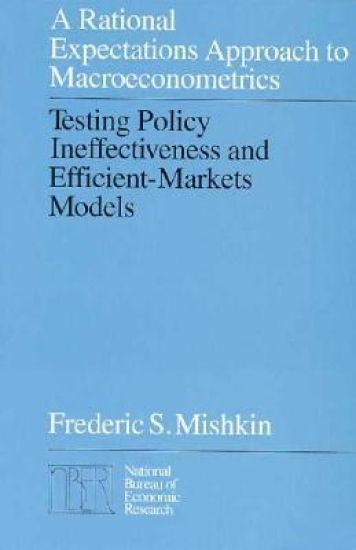
A Rational Expectations Approach to Macroeconometrics

A Rational Expectations Approach to Macroeconometrics

Frederic S. Mishkin

University of Chicago Press
1986
nidottu
A Rational Expectations Approach to Macroeconometrics pursues a rational expectations approach to the estimation of a class of models widely discussed in the macroeconomics and finance literature: those which emphasize the effects from unanticipated, rather than anticipated, movements in variables. In this volume, Fredrick S. Mishkin first theoretically develops and discusses a unified econometric treatment of these models and then shows how to estimate them with an annotated computer program.