Kirjojen hintavertailu. Mukana 12 152 606 kirjaa ja 12 kauppaa.

Kirjailija

Frederic Vivien

Kirjat ja teokset yhdessä paikassa: 4 kirjaa, julkaisuja vuosilta 2000-2013, suosituimpien joukossa A Guide to Algorithm Design. Vertaile teosten hintoja ja tarkista saatavuus suomalaisista kirjakaupoista.

Mukana myös kirjoitusasut: Frédéric Vivien

4 kirjaa

Kirjojen julkaisuhaarukka 2000-2013.

A Guide to Algorithm Design

A Guide to Algorithm Design

Anne Benoit; Yves Robert; Frédéric Vivien

CRC Press Inc
2013
sidottu
Presenting a complementary perspective to standard books on algorithms, A Guide to Algorithm Design: Paradigms, Methods, and Complexity Analysis provides a roadmap for readers to determine the difficulty of an algorithmic problem by finding an optimal solution or proving complexity results. It gives a practical treatment of algorithmic complexity and guides readers in solving algorithmic problems.Divided into three parts, the book offers a comprehensive set of problems with solutions as well as in-depth case studies that demonstrate how to assess the complexity of a new problem. Part I helps readers understand the main design principles and design efficient algorithms.Part II covers polynomial reductions from NP-complete problems and approaches that go beyond NP-completeness.Part III supplies readers with tools and techniques to evaluate problem complexity, including how to determine which instances are polynomial and which are NP-hard.Drawing on the authors’ classroom-tested material, this text takes readers step by step through the concepts and methods for analyzing algorithmic complexity. Through many problems and detailed examples, readers can investigate polynomial-time algorithms and NP-completeness and beyond.

Un Trait d'Union Entre La France Et l'Angleterre

Un Trait d'Union Entre La France Et l'Angleterre

Frédéric Vivien

Hachette Livre - BNF
2013
pokkari
Un trait d'union entre la France et l'Angleterre / par Fred. VivienDate de l'edition originale: 1860Sujet de l'ouvrage: France -- 1852-1870 (Second Empire)Ce livre est la reproduction fidele d'une oeuvre publiee avant 1920 et fait partie d'une collection de livres reimprimes a la demande editee par Hachette Livre, dans le cadre d'un partenariat avec la Bibliotheque nationale de France, offrant l'opportunite d'acceder a des ouvrages anciens et souvent rares issus des fonds patrimoniaux de la BnF.Les oeuvres faisant partie de cette collection ont ete numerisees par la BnF et sont presentes sur Gallica, sa bibliotheque numerique.En entreprenant de redonner vie a ces ouvrages au travers d'une collection de livres reimprimes a la demande, nous leur donnons la possibilite de rencontrer un public elargi et participons a la transmission de connaissances et de savoirs parfois difficilement accessibles.Nous avons cherche a concilier la reproduction fidele d'un livre ancien a partir de sa version numerisee avec le souci d'un confort de lecture optimal. Nous esperons que les ouvrages de cette nouvelle collection vous apporteront entiere satisfaction.Pour plus d'informations, rendez-vous sur www.hachettebnf.fr
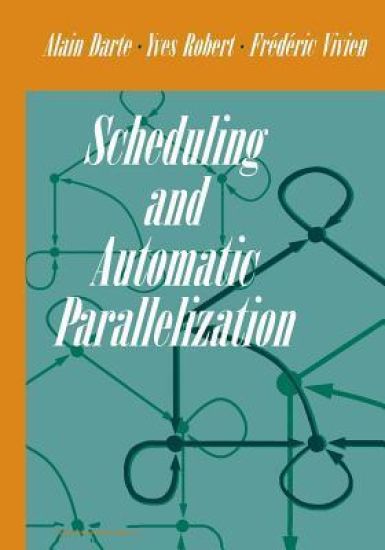
Scheduling and Automatic Parallelization

Scheduling and Automatic Parallelization

Alain Darte; Yves. Robert; Frederic Vivien

Springer-Verlag New York Inc.
2012
nidottu
Readership This book is devoted to the study of compiler transformations that are needed to expose the parallelism hiddenin a program. This book is notan introductory book to parallel processing, nor is it an introductory book to parallelizing compilers. Weassume thatreaders are familiar withthebooks High Performance Compilers for Parallel Computingby Wolfe [121] and Super- compilers for Parallel and Vector Computers by Zima and Chapman [125], and that they want to know more about scheduling transformations. In this book we describe both task graph scheduling and loop nest scheduling. Taskgraphschedulingaims atexecuting tasks linked by prece- dence constraints; it is a run-time activity. Loop nest scheduling aims at ex- ecutingstatementinstances linked bydata dependences;it is a compile-time activity. We are mostly interested in loop nestscheduling,butwe also deal with task graph scheduling for two main reasons: (i) Beautiful algorithms and heuristics have been reported in the literature recently; and (ii) Several graphscheduling, like list scheduling, are the basis techniques used in task ofthe loop transformations implemented in loop nest scheduling. As for loop nest scheduling our goal is to capture in a single place the fantastic developments of the last decade or so. Dozens of loop trans- formations have been introduced (loop interchange, skewing, fusion, dis- tribution, etc.) before a unifying theory emerged. The theory builds upon the pioneering papers of Karp, Miller, and Winograd [65] and of Lam- port [75], and it relies on sophisticated mathematical tools (unimodular transformations, parametric integer linear programming, Hermite decom- position, Smithdecomposition, etc.).
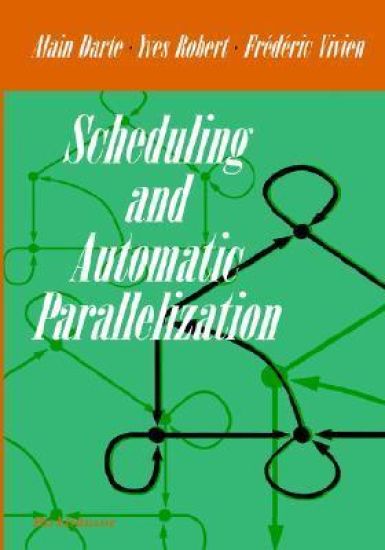
Scheduling and Automatic Parallelization

Scheduling and Automatic Parallelization

Alain Darte; Yves. Robert; Frederic Vivien

Birkhauser Boston Inc
2000
sidottu
Readership This book is devoted to the study of compiler transformations that are needed to expose the parallelism hiddenin a program. This book is notan introductory book to parallel processing, nor is it an introductory book to parallelizing compilers. Weassume thatreaders are familiar withthebooks High Performance Compilers for Parallel Computingby Wolfe [121] and Super- compilers for Parallel and Vector Computers by Zima and Chapman [125], and that they want to know more about scheduling transformations. In this book we describe both task graph scheduling and loop nest scheduling. Taskgraphschedulingaims atexecuting tasks linked by prece- dence constraints; it is a run-time activity. Loop nest scheduling aims at ex- ecutingstatementinstances linked bydata dependences;it is a compile-time activity. We are mostly interested in loop nestscheduling,butwe also deal with task graph scheduling for two main reasons: (i) Beautiful algorithms and heuristics have been reported in the literature recently; and (ii) Several graphscheduling, like list scheduling, are the basis techniques used in task ofthe loop transformations implemented in loop nest scheduling. As for loop nest scheduling our goal is to capture in a single place the fantastic developments of the last decade or so. Dozens of loop trans- formations have been introduced (loop interchange, skewing, fusion, dis- tribution, etc.) before a unifying theory emerged. The theory builds upon the pioneering papers of Karp, Miller, and Winograd [65] and of Lam- port [75], and it relies on sophisticated mathematical tools (unimodular transformations, parametric integer linear programming, Hermite decom- position, Smithdecomposition, etc.).