Kirjojen hintavertailu. Mukana 12 657 676 kirjaa ja 12 kauppaa.
Kirjailija
Frederick Engels
Kirjat ja teokset yhdessä paikassa: 68 kirjaa, julkaisuja vuosilta 2001-2026, suosituimpien joukossa The Essentials of Marx. Vertaile teosten hintoja ja tarkista saatavuus suomalaisista kirjakaupoista.
Friedrich Engels' treatise on family economics and its connection with human history and development is published here in full. Engels examines the primitive tribal societies of the Native Americans, where matriarchal arrangements were relatively commonplace. He proposes that the effects that monogamy and the increasing levels of private property decreased the influence of women in family life and thus the wider society; a process which Engels believed had advanced over thousands of years of advancing human civilization. Engels argues that women were able to bond and work together on a principle of sisterhood; he argues that this occurrence is a form of primitive communism. In the modern day, Engels' arguments in favor of matrilineal heritage in early human societies are generally disregarded. However, anthropologists such as Christopher Knight believe there is merit in Engels' claims, and criticize the prevailing views.
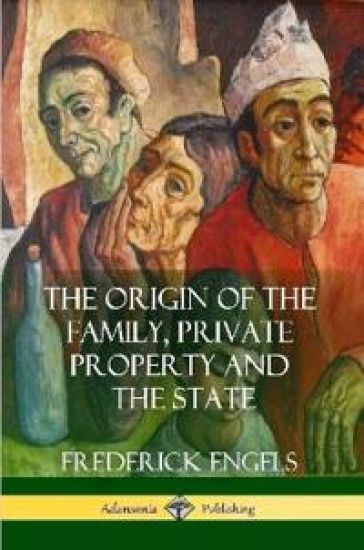
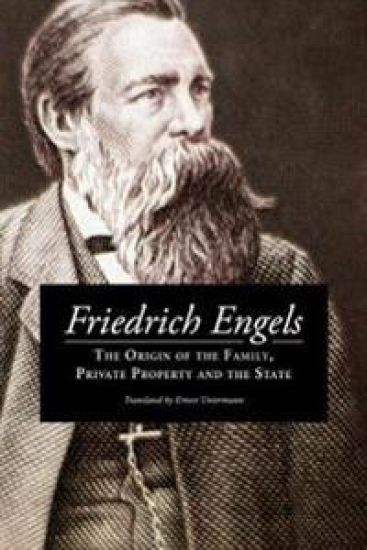
Friedrich Engels' treatise on family economics and its connection with human history and development is published here in full. Engels examines the primitive tribal societies of the Native Americans, where matriarchal arrangements were relatively commonplace. He proposes that the effects that monogamy and the increasing levels of private property decreased the influence of women in family life and thus the wider society; a process which Engels believed had advanced over thousands of years of advancing human civilization. Engels argues that women were able to bond and work together on a principle of sisterhood; he argues that this occurrence is a form of primitive communism. In the modern day, Engels' arguments in favor of matrilineal heritage in early human societies are generally disregarded. However, anthropologists such as Christopher Knight believe there is merit in Engels' claims, and criticize the prevailing views.
Readers will not find a Marxist interpretation of the American Civil War laid out in this volume. Rather, they will observe Marx and Engels working to define their own approach to history and politics while analyzing the American Civil War as it developed into the greatest social revolution that the United States has so far achieved. Radicals and revolutionaries found themselves in a complex political position at the outbreak of the American Civil War of 1861-65. They demanded a war against slavery as an evil in itself and as the root cause of the Confederate rebellion, but the Lincoln administration proclaimed it fought only to preserve the Union and would not interfere with slavery in the states where it already existed. "All knew," in the words of Lincoln's 1864 second inaugural address, that slavery "was somehow the cause of the war," but if, and to what extent, the war would end slavery and transom the country that had grown wealthy from the labor of four million enslaved African Americans remained an open question. By the time the war ended in 1865, the radicals and revolutionaries got their way, thanks in large part to the actions of the enslaved themselves, and the North thus won a war that had also become a revolution against slavery.
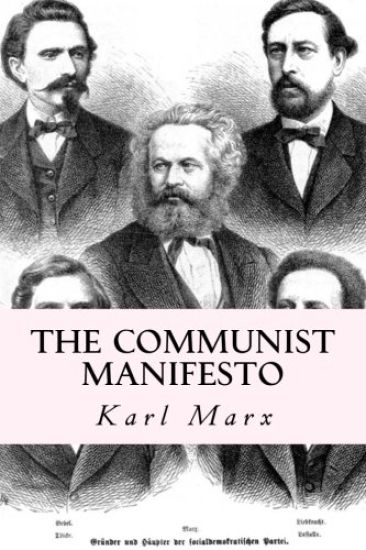
The Communist Manifesto (originally Manifesto of the Communist Party) is an 1848 political pamphlet by German philosophers Karl Marx and Friedrich Engels. Commissioned by the Communist League and originally published in London (in German as Manifest der Kommunistischen Partei) just as the revolutions of 1848 began to erupt, the Manifesto was later recognised as one of the world's most influential political manuscripts. It presents an analytical approach to the class struggle (historical and then-present) and the problems of capitalism and the capitalist mode of production, rather than a prediction of communism's potential future forms.The Communist Manifesto summarises Marx and Engels' theories about the nature of society and politics, that in their own words, "The history of all hitherto existing society is the history of class struggles". It also briefly features their ideas for how the capitalist society of the time would eventually be replaced by socialism.
Socialism, Utopian and Scientific is a political science classic that needs no preface. It ranks with the Communist Manifesto as one of the indispensable books for any one desiring to understand the modern socialist movement. It has been translated into every language where capitalism prevails, and its circulation is more rapid than ever before. The book explains the differences between utopian socialism and scientific socialism, which Marxism considers itself to embody. The book explains that whereas utopian socialism is idealist, reflects the personal opinions of the authors and claims that society can be adapted based on these opinions, scientific socialism derives itself from reality. It focuses on the materialist conception of history, which is based on an analysis over history, and concludes that communism naturally follows capitalism. Engels begins the book by chronicaling the thought of utopian socialists, starting with Saint-Simon. He then proceeds to Fourier and Robert Owen. In Chapter Two, he summarizes dialectics, and then chronicles the thought from the ancient Greeks to Hegel. Chapter Three summarizes dialectics in relation to economic and social struggles, essentially echoing the words of Marx
The Communist Manifesto (originally Manifesto of the Communist Party) is an 1848 political pamphlet by German philosophers Karl Marx and Friedrich Engels. Commissioned by the Communist League and originally published in London (in German as Manifest der Kommunistischen Partei) just as the revolutions of 1848 began to erupt, the Manifesto was later recognised as one of the world's most influential political documents. It presents an analytical approach to the class struggle (historical and then-present) and the problems of capitalism and the capitalist mode of production, rather than a prediction of communism's potential future forms. The Communist Manifesto summarises Marx and Engels' theories about the nature of society and politics, that in their own words, "The history of all hitherto existing society is the history of class struggles". It also briefly features their ideas for how the capitalist society of the time would eventually be replaced by socialism. In 2013, The Communist Manifesto was registered to UNESCO's Memory of the World Programme with the Capital, Volume I. The Communist Manifesto is divided into a preamble and four sections, the last of these a short conclusion. The introduction begins by proclaiming "A spectre is haunting Europe-the spectre of communism. All the powers of old Europe have entered into a holy alliance to exorcise this spectre". Pointing out that parties everywhere-including those in government and those in the opposition-have flung the "branding reproach of communism" at each other, the authors infer from this that the powers-that-be acknowledge communism to be a power in itself. Subsequently, the introduction exhorts Communists to openly publish their views and aims, to "meet this nursery tale of the spectre of communism with a manifesto of the party itself". The first section of the Manifesto, "Bourgeois and Proletarians", elucidates the materialist conception of history, that "the history of all hitherto existing society is the history of class struggles". Societies have always taken the form of an oppressed majority living under the thumb of an oppressive minority. In capitalism, the industrial working class, or proletariat, engage in class struggle against the owners of the means of production, the bourgeoisie. As before, this struggle will end in a revolution that restructures society, or the "common ruin of the contending classes". The bourgeoisie, through the "constant revolutionising of production and] uninterrupted disturbance of all social conditions" have emerged as the supreme class in society, displacing all the old powers of feudalism. The bourgeoisie constantly exploits the proletariat for its labour power, creating profit for themselves and accumulating capital. However, in doing so, the bourgeoisie serves as "its own grave-diggers"; the proletariat inevitably will become conscious of their own potential and rise to power through revolution, overthrowing the bourgeoisie. "Proletarians and Communists", the second section, starts by stating the relationship of conscious communists to the rest of the working class. The communists' party will not oppose other working-class parties, but unlike them, it will express the general will and defend the common interests of the world's proletariat as a whole, independent of all nationalities. The section goes on to defend communism from various objections, including claims that it advocates "free love" or disincentivises people from working. The section ends by outlining a set of short-term demands-among them a progressive income tax; abolition of inheritances and private property; abolition of child labour; free public education; nationalisation of the means of transport and communication; centralisation of credit via a national bank; expansion of publicly owned etc.-the implementation of which would result in the precursor to a stateless and classless society.