

Kirjailija
Frederick Turner
Kirjat ja teokset yhdessä paikassa: 31 kirjaa, julkaisuja vuosilta 1991-2025, suosituimpien joukossa John Muir. Vertaile teosten hintoja ja tarkista saatavuus suomalaisista kirjakaupoista.
31 kirjaa
Kirjojen julkaisuhaarukka 1991-2025.


As we approach the new millenium, the moral, intellectual,and spiritual crisis of our time is visible most plainly in the sickness of the arts. The "postmodern" cultural establishment is philosophically empty and esthetically corrupt. But no one has been able to explain this decline or give a satisfying answer to the question of the proper role of the arts in our society. Now, in The Culture of Hope -- a manifesto for a new vision of culture that is both radical and classical -- Frederick Turner goes beyond the stale dichotomies of Left and Right to take the "third side" in the culture war: the side of art itself.Great art can never be politically correct, Turner reminds us, whether the correction comes from Right or Left, because its sources are deeper than politics. The visionary modernists (Picasso, Joyce, Stravinsky) understood this, but their successors today, as well as their conservative opponents, have forgotten. Turner sharply indicts the bankrupt tribe of venal mediocrities who now infest the arts, citing their naive rejection of morality, their ignorant denial of scientific truth, and their lazy dismissal of the Western cultural heritage. On the other hand, conservatives who call for a return to traditional values seek a socially "safe" vision of art that has never existed and never can.In the past, the arts have flowered when they drew their inspiration from new scientific visions of the cosmos. Thus Turner argues that the revolution in cosmology that is occurring today in the frontier fields of scientific thought will powerfully invigorate the artists of the future. A new esthetic synthesis arising from the unexpected convergence of religion, art, and science will restore a hopeful vision of the cosmos as intelligent, creative, and self-ordering and provide the missing ground for the recovery of classical values in the arts, such as beauty, order, harmony, and meaning. Turner points to new developments in chaos theory, neurobiology, evolution, and environmental science, among other fields, to offer us a guide to the emerging art of the "radical center" which he predicts will shape the culture of the future.

With the roaring twenties still in full swing and the seemingly endless horizons of jazz, wealth, power, and black market booze still unfolding, Bix Beiderbecke--self-taught musician--flames across the sky in a short-lived spectacle that befits the new era of excess and frenetic energy. Reprint. 30,000 first printing.

“The best assembly of Turner’s essays now available. Faragher’s introductory and concluding commentaries add considerably to the import of the book.”—Stephen Aron, University of California, Los Angeles “Still ranks as the most influential piece of writing on American history.”—Carlin Romano, Philadelphia Inquirer, A Notable Book of 1994 “Faragher’s invaluable afterword . . . provides a judicious introduction to the issues that divide the revisionist New Western Historians from Turner and his disciples.”—Michael Kammen, FanFare Frederick Jackson Turner is often considered to be the most influential American historian of the century, and his views continue to shape the controversial field of Western American history. In this book, John Mack Faragher introduces and comments on ten of Turner’s most significant essays, concluding with a comment on the recent debate over Turner’s legacy and his effect on Americans’ understanding of their national character.

First published in 1980, Beyond Geography continues to influence and impress its readers. This new edition, prepared for the Columbus quincentennial, includes a new introduction by T. H. Watkins and a new preface by the author. As the public debates Columbus's legacy, it is important for us to learn of the spiritual background of European domination of the Americas, for the Europeans who conquered the Americas substituted history for myth as a way of understanding life.

In this groundbreaking interdisciplinary work, Frederick Turner presents a new theory of aesthetics based on the argument that beauty is an objective reality in the universe. He identifies the experience of beauty as a pancultural, neurobiological phenomenon. Drawing on a wide range of fields - ritual and dramatic performance, the oral tradition, paleoanthropology and human evolution, neurobiology, cosmology and theoretic physics, chaos theory and fractal mathematics - the book describes evolution as a self-organizing, emergent process that generates increasingly advanced forms of self-reflection, and proposes that the experience of beauty is the recognition of this evolutionary process and the reward for participating in it.
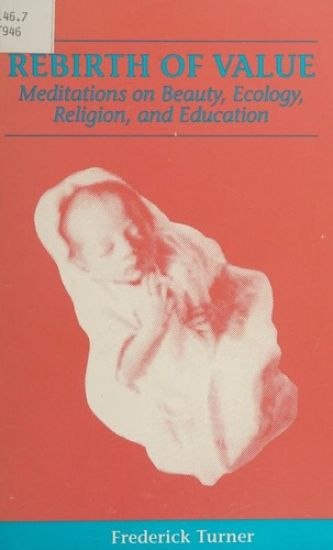
Rebirth of Value takes as its starting-point the emerging scientific view of the universe as a free, unpredictable, self-ordering evolutionary process in which our own cultural history plays a leading part. It outlines some of the startling implications of this view for contemporary art, literature, theater, ecological ethics, human studies, religion, and education. Turner goes beyond the current fashions of postmodern eclecticism, deconstructive critique, and self-consciousness about genre and ideology. Instead, he seeks out the creative and positive forces in contemporary culture that underlie the surface features, and identifies potent new themes and ideas that drive the trends. Among these are the recovery of a pan-cultural human nature; beauty as a real evolutionary tendency; the efficacy and reality of values in general; the reunion of the arts, sciences, and technology; a new science including the theory of non-linear and self-organizing systems, top-down as well as bottom-up causality, and a broader conception of causality in general. Other themes and ideas discussed are a new environmental ethic in which humans can play a constructive and leading part in the evolution of nature; a conception of history as driven by values; cybernetic technology as a spiritual development; a new religious consciousness including a rich syncretism and a renewal of ritual; eternity as a more intense form of time; and the essential unity, coherence, and fertility of knowledge.