Kirjojen hintavertailu. Mukana 12 250 643 kirjaa ja 12 kauppaa.

Kirjailija

Fredric Jameson

Kirjat ja teokset yhdessä paikassa: 55 kirjaa, julkaisuja vuosilta 1974-2027, suosituimpien joukossa Raymond Chandler. Vertaile teosten hintoja ja tarkista saatavuus suomalaisista kirjakaupoista.

55 kirjaa

Kirjojen julkaisuhaarukka 1974-2027.

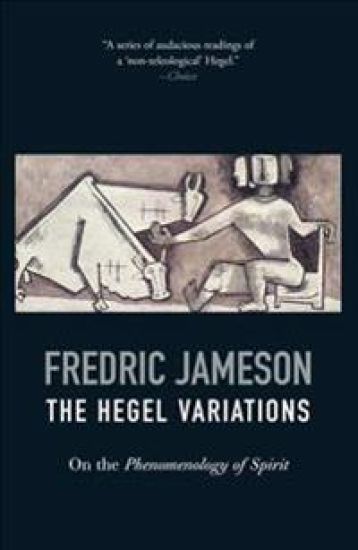
The Hegel Variations

The Hegel Variations

Fredric Jameson

Verso Books
2017
nidottu
In this major new study, the philosopher and cultural theorist Fredric Jameson offers a new reading of Hegel's foundational text Phenomenology of Spirit.In contrast to those who see the Phenomenology as a closed system ending with Absolute Spirit, Jameson's reading presents an open work in which Hegel has not yet reconstituted himself in terms of a systematic philosophy (Hegelianism) and in which the moments of the dialectic and its levels have not yet been formalized. Hegel's text executes a dazzling variety of changes on conceptual relationships, in terms with are never allowed to freeze over and become reified in purely philosophical named concepts. The ending, on the aftermath of the French Revolution, is interpreted by Jameson, contra Fukuyama's "end of history," as a provisional stalemate between the political and the social, which is here extrapolated to our own time.
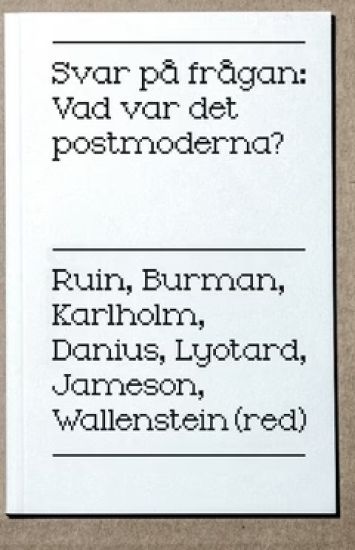
Svar på frågan : vad var det postmoderna?

Svar på frågan : vad var det postmoderna?

Fredric Jameson; Anders Burman; Sara Danius; Hans Ruin; Jean-François Lyotard

Axl Books
2016
nidottu
För drygt trettio år sedan publicerades Jean-François Lyotards La condition postmoderne, där frågan ställdes om innebörden i arvet från upplysningen. Ska det postmoderna förstås som ett brott med dess rationalitet och universalism, eller som en fortsättning och radikalisering av dess självkritik? Lyotards idé om ett postmodernt brott kom att kritiseras av bland andra Jürgen Habermas för vilken upplysningen var ett projekt som förvisso hade sin baksida, men som i grunden borde försvaras. Fredric Jameson utvecklade därefter begreppet postmodernism i en annan riktning – som ett uttryck för senkapitalismens kulturella logik. Debatten kom att röra sig från filosofi och politisk teori till bildkonst, litteratur, dans och arkitektur, från diskussioner om subjektet och språket till kultursociologiska analyser om skillnaden mellan högt och lågt inom kulturen. Vår egen samtid är på många sätt präglad av detta högst kontroversiella arv, men dess innebörd är likväl långt ifrån klar. Vad var det postmoderna? Vilka var debattens historiska förutsättningar? Kan vi idag formulera dessa problem så att de fortfarande är relevanta?
An American Utopia

An American Utopia

Fredric Jameson

Verso Books
2016
nidottu
Fredric Jameson's pathbreaking essay "An American Utopia" radically questions standard leftist notions of what constitutes an emancipated society. Advocated here are-among other things-universal conscription, the full acknowledgment of envy and resentment as a fundamental challenge to any communist society, and the acceptance that the division between work and leisure cannot be overcome. To create a new world, we must first change the way we envision the world. Jameson's text is ideally placed to trigger a debate on the alternatives to global capitalism. In addition to Jameson's essay, the volume includes responses from philosophers and political and cultural analysts, as well as an epilogue from Jameson himself.Many will be appalled at what they will encounter in these pages-there will be blood! But perhaps one has to spill such (ideological) blood to give the Left a chance.
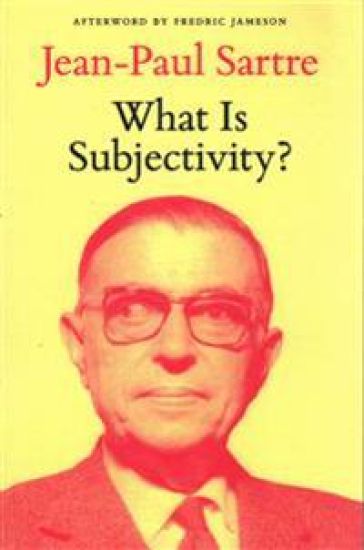
What Is Subjectivity?

What Is Subjectivity?

Jean-Paul Sartre; Fredric Jameson

Verso Books
2016
nidottu
In 1961, the prolific French intellectual Jean-Paul Sartre was invited to give a talk at the Gramsci Institute in Rome. In attendance were some of Italy's leading Marxist thinkers, such as Enzo Paci, Cesare Luporini, and Galvano Della Volpe, whose contributions to the long and remarkable discussion that followed are collected in this volume, along with the lecture itself. Sartre posed the question "What is subjectivity?" - a question of renewed importance today to contemporary debates concerning "the subject" in critical theory. This work includes a preface by Michel Kail and Raoul Kirchmayr and an afterword by Fredric Jameson, who makes a rousing case for the continued importance of Sartre's philosophy.
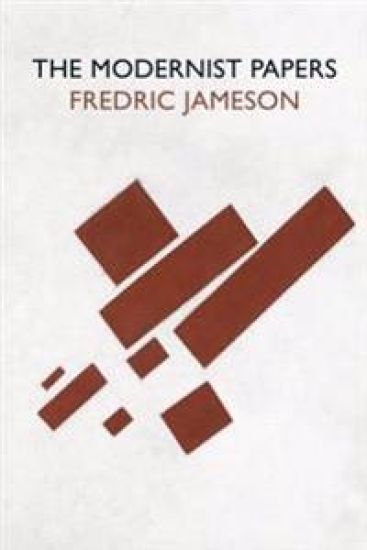
The Modernist Papers

The Modernist Papers

Fredric Jameson

Verso Books
2016
nidottu
The Modernist Papers is a tour de force of analysis and criticism, in which Jameson brings his dynamic and acute thought to bear on the modernist literature of the nineteenth and twentieth centuries. Jameson discusses modernist poetics, including the work of Baudelaire, Rimbaud, Mallarmé, Wallace Stevens, Joyce, Proust and Thomas Mann. He explores the peculiarities of the American literary field, taking in William Carlos Williams and the American epic, and examines the language theories of Gertrude Stein. Refusing to see modernism as simply a Western phenomenon, he also pays close attention to its Japanese expression, while the complexities of a late modernist representation of twentieth-century politics are articulated in a concluding section on Peter Weiss's novel The Aesthetics of Resistance. Challenging our previous understandings of the literature of this period, this monumental work will come to be regarded as the classic study of modernism.
Signatures of the Visible

Signatures of the Visible

Fredric Jameson

Routledge
2016
sidottu
In such celebrated works as Postmodernism: The Cultural Logic of Late Capitalism, Fredric Jameson has established himself as one of America’s most observant cultural commentators. In Signatures of the Visible, Jameson turns his attention to cinema - the artform that has replaced the novel as the defining cultural form of our time. Historicizing a form that has flourished in a post-modern and anti-historical culture, he explores the allegorical and ideological dimensions of such films as The Shining, Dog Day Afternoon and the works of Alfred Hitchcock, among many others. Fifteen years on from its original publication, this remains a piercing and original analysis of film from a writer and thinker whose influence continues to be felt long after that of the fashionable post-modernists he has always critiqued.
An Innocent Abroad

An Innocent Abroad

J. Hillis Miller; Fredric Jameson

Northwestern University Press
2015
nidottu
Since 1988, J. Hillis Miller has traveled to China to lecture on literary theory, especially the role of globalization in literary theory. Over time, he has assisted in the development of distinctively Chinese forms of literary theory, Comparative Literature, and World Literature. The fifteen lectures gathered in An Innocent Abroad span both time and geographic location, reflecting his work at universities across China for more than twenty-five years.More important, they reflect the evolution of Miller’sthinking and of the lectures’ contexts in China as these have markedly changed over the years, especially on either side of Tiananmen Square and in light of China’s economic growth and technological change. A foreword by the leading theorist Fredric Jameson provides additional context.
The Ancients and the Postmoderns

The Ancients and the Postmoderns

Fredric Jameson

Verso Books
2015
sidottu
Fredric Jameson sweeps from the Renaissance to "The Wire" High modernism is now as far from us as antiquity was for the Renaissance. Such is the premise of Fredric Jameson s major new work in which modernist works, this time in painting (Rubens) and music (Wagner and Mahler), are pitted against late-modernist ones (in film) as well as a variety of postmodern experiments (from SF to "The Wire," from Eurotrash in opera to Altman and East German literature): all of which attempt, in their different ways, to invent new forms to grasp a specific social totality. Throughout the historical periods, argues Jameson, the question of narrative persists through its multiple formal changes and metamorphoses."
The Antinomies of Realism

The Antinomies of Realism

Fredric Jameson

Verso Books
2015
nidottu
The Antinomies of Realism is a history of the nineteenth-century realist novel and its legacy told without a glimmer of nostalgia for artistic achievements that the movement of history makes it impossible to recreate. Fredric Jameson examines the most influential theories of artistic and literary realism, approaching the subject himself in terms of the social and historical preconditions for realism's emergence. The realist novel combined an attention to the body and its states of feeling with a focus on the quest for individual realization within the confines of history.
Representing 'Capital'

Representing 'Capital'

Fredric Jameson

Verso Books
2014
nidottu
Representing Capital, Fredric Jameson's first book-length engagement with Marx's magnum opus, is a unique work of scholarship that records the progression of Marx's thought as if it were a musical score. The textual landscape that emerges is the setting for paradoxes and contradictions that struggle toward resolution, giving rise to new antinomies and a new forward movement. These immense segments overlap each other to combine and develop on new levels in the same way that capital itself does, stumbling against obstacles that it overcomes by progressive expansions, which are in themselves so many leaps into the unknown.
The Antinomies of Realism

The Antinomies of Realism

Fredric Jameson

Verso Books
2013
sidottu
The Antinomies of Realism is a history ofthe nineteenth-century realist novel and its legacy told without a glimmer of nostalgia for artistic achievements that the movement of history makes it impossible to recreate. The works of Zola, Tolstoy, Perez Galdos, and George Eliot are in the most profound sense inimitable, yet continue to dominate the novel form to this day. Novels to emerge since struggle to reconcile the social conditions of their own creation with the history of this mode of writing: the so-called modernist novel is one attempted solution to this conflict, as is the ever-more impoverished variety of commercial narratives - what today's book reviewers dub "serious novels," which are an attempt at the impossible endeavor to roll back the past. Fredric Jameson examines the most influential theories of artistic and literary realism, approaching the subject himself in terms of the social and historical preconditions for realism's emergence. The realist novel combined an attention to the body and its states of feeling with a focus on the quest for individual realization within the confines of history. In contemporary writing, other forms of representation - for which the term "postmodern" is too glib - have become visible: for example, in the historical fiction of Hilary Mantel or the stylistic plurality of David Mitchell's novels. Contemporary fiction is shown to be conducting startling experiments in the representation of new realities of a global social totality, modern technological warfare, and historical developments that, although they saturate every corner of our lives, only become apparent on rare occasions and by way of the strangest formal and artistic devices. In a coda, Jameson explains how "realistic" narratives survived the end of classical realism. In effect, he provides an argument for the serious study of popular fiction and mass culture that transcends lazy journalism and the easy platitudes of recent cultural studies.
A Singular Modernity

A Singular Modernity

Fredric Jameson

Verso Books
2013
nidottu
The concepts of modernity and modernism are amongst the most controversial and vigorously debated in contemporary philosophy and cultural theory. In this intervention, Fredric Jameson-perhaps the most influential and persuasive theorist of postmodernity-excavates and explores these notions in a fresh and illuminating manner.The extraordinary revival of discussions of modernity, as well as of new theories of artistic modernism, demands attention in its own right. It seems clear that the (provisional) disappearance of alternatives to capitalism plays its part in the universal attempt to revive 'modernity' as a social ideal. Yet the paradoxes of the concept illustrate its legitimate history and suggest some rules for avoiding its misuse as well.In this major interpretation of the problematic, Jameson concludes that both concepts are tainted, but nonetheless yield clues as to the nature of the phenomena they purported to theorize. His judicious and vigilant probing of both terms-which can probably not be banished at this late date-helps us clarify our present political and artistic situations.
Att läsa Hegel

Att läsa Hegel

Judith Butler; Slavoj Zizek; Fredric Jameson; Susan Buck-Morss; Jacques Derrida; Jurgen Habermas

Tankekraft Förlag
2012
kartonkisidos
Georg Wilhelm Friedrich Hegel utgör på många sätt portalfiguren för de senaste två århundradenas filosofi och politiska teori. Såväl marxismen som existentialismen, fenomenologin och den kritiska teorin, ja även den moderna analytiska filosofin, uppstod till stor del som reaktioner på hans tänkande och den hegelianism som utvecklades efter hans död. Föreliggande antologi samlar tio tongivande läsningar av Hegel, skrivna av några av den så kallade kontinentalfilosofiska traditionens mest betydelsefulla företrädare. På olika sätt fokuserar samtliga texter på Hegels politiska tänkande. Särskilt uppmärksammas den berömda utläggningen i Andens fenomenologi om begäret, kampen om erkännandet och den dialektiska relationen mellan herren och slaven, men även Hegels idé om det borgerliga samhället och hans syn på staten diskuteras i flera av bidragen. Sammantaget visar texterna att det finns goda skäl att betrakta Hegel som den förste moderne filosofen. Bokens redaktörer, idéhistorikern Anders Burman och filosofen Anders Bartonek, är verksamma vid Södertörns högskola.
Brecht and Method

Brecht and Method

Fredric Jameson

Verso Books
2011
nidottu
The legacy of Bertolt Brecht is much contested, whether by those who wish to forget or to vilify his politics, but his stature as the outstanding political playwright and poet of the twentieth century is unforgettably established in this major critical work. Fredric Jameson elegantly dissects the intricate connections between Brecht's drama and politics, demonstrating the way these combined to shape a unique and powerful influence on a profoundly troubled epoch.Jameson sees Brecht's method as a multi-layered process of reflection and self-reflection, reference and self-reference, which tears open a gap for individuals to situate themselves historically, to think about themselves in the third person, and to use that self-projection in history as a basis for judgment. Emphasizing the themes of separation, distance, multiplicity, choice and contradiction in Brecht's entire corpus, Jameson's study engages in a dialogue with a cryptic work, unpublished in Brecht's lifetime, entitled Me-ti; Book of Twists and Turns. Jameson sees this text as key to understanding Brecht's critical reflections on dialectics and his orientally informed fascination with flow and flux, change and the non-eternal. For Jameson, Brecht is not prescriptive but performative. His plays do not provide answers but attempt to show people how to perform the act of thinking, how to begin to search for answers themselves. Brecht represents the ceaselessness of transformation while at the same time alienating it, interrupting it, making it comprehensible by making it strange. And thereby, in breaking it up by analysis, the possibility emerges of its reconstitution under a new law.
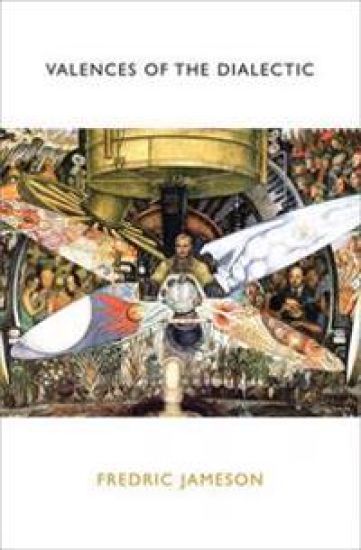
Valences of the Dialectic

Valences of the Dialectic

Fredric Jameson

Verso Books
2010
nidottu
After half a century exploring dialectical thought, renowned cultural critic Fredric Jameson presents a comprehensive study of a misunderstood yet vital strain in Western philosophy. The dialectic, the concept of the evolution of an idea through conflicts arising from its inherent contradictions, transformed two centuries of Western philosophy. To Hegel, who dominated nineteenth-century thought, it was a metaphysical system. In the works of Marx, the dialectic became a tool for materialist historical analysis.Jameson brings a theoretical scrutiny to bear on the questions that have arisen in the history of this philosophical tradition, contextualizing the debate in terms of commodification and globalization, and with reference to thinkers such as Rousseau, Lukács, Heidegger, Sartre, Derrida, and Althusser. Through rigorous, erudite examination, Valences of the Dialectic charts a movement toward the innovation of a "spatial" dialectic. Jameson presents a new synthesis of thought that revitalizes dialectical thinking for the twenty-first century.
The Cultural Turn

The Cultural Turn

Fredric Jameson

Verso Books
2009
nidottu
Fredric Jameson, a leading voice on the subject of postmodernism, assembles his most powerful writings on the culture of late capitalism in this essential volume. Classic insights on pastiche, nostalgia, and architecture stand alongside essays on the status of history, theory, Marxism, and the subject in an age propelled by finance capital and endless spectacle. Surveying the debates that blazed up around his earlier essays, Jameson responds to critics and maps out the theoretical positions of postmodernism's prominent friends and foes.
Ideologies of Theory

Ideologies of Theory

Fredric Jameson

Verso Books
2009
nidottu
Ideologies of Theory, updated and available for the first time in a single volume, brings together theoretical essays that span Fredric Jameson's long career as a critic. They chart a body of work suspended by the twin poles of literary scholarship and political history, occupying a space vibrant with the tension between critical exegesis and the Marxist intellectual tradition. Jameson's work pushes out the boundaries of the text, making evident the interaction between literature and the disciplines of psychoanalysis, philosophy and cultural theory, all of which are shown to be inseparable from their ideological milieu.The essays in this volume track a shift from ideological analysis to the phenomenology of everyday life, and constitute a rigorous and passionate argument for the necessity of theory as the simultaneous critique of empiricism and idealist philosophy.
Fables of Aggression

Fables of Aggression

Fredric Jameson

Verso Books
2008
nidottu
The novels of Wyndham Lewis have generally been associated with the work of the great modernists-Joyce, Pound, Eliot, Yeats-who were his sometime friends and collaborators. Lewis's originality, however, can only be fully grasped when it is understood that, unlike those writers, he was essentially a political novelist.In this now classic study, Fredric Jameson proposes a framework in which Lewis's explosive language practice-utterly unlike any other English or American modernism-can be grasped as a political and symbolic act. He does not, however, ask us to admire the energy of Lewis's style without confronting the inescapable and often scandalous ideological content of Lewis's works: the aggressivity and sexism, the predilection for racial and national categories, the brief flirtation with fascism, and the inveterate and cranky oppositionalism that informs his powerful polemics against virtually all the political and countercultural tendencies of his time.Fables of Aggression draws on the methods of narrative analysis and semiotics, psychoanalysis, and ideological analysis to construct a dynamic model of the contradictions from which Lewis's incomparable narrative corpus is generated, and of which it offers so many varying symbolic resolutions.
Jameson on Jameson

Jameson on Jameson

Fredric Jameson

Duke University Press
2007
sidottu
Fredric Jameson is one of the most influential literary and cultural critics writing today. He is a theoretical innovator whose ideas about the intersections of politics and culture have reshaped the critical landscape across the humanities and social sciences. Bringing together ten interviews conducted between 1982 and 2005, Jameson on Jameson is a compellingly candid introduction to his thought for those new to it, and a rich source of illumination and clarification for those seeking deeper understanding. Jameson discusses his intellectual and political preoccupations, most prominently his commitment to Marxism as a way of critiquing capitalism and the culture it has engendered. He explains many of his key concepts, including postmodernism, the dialectic, metacommentary, the political unconscious, the utopian, cognitive mapping, and spatialization.Jameson on Jameson displays Jameson’s extraordinary grasp of contemporary culture-architecture, art, cinema, literature, philosophy, politics, psychoanalysis, and urban geography-as well as the challenge that the geographic reach of his thinking poses to the Eurocentricity of the West. Conducted by accomplished scholars from United States, Egypt, Korea, China, Sweden, and England, the interviews elicit Jameson’s reflections on the broad international significance of his ideas and their applicability and implications in different cultural and political contexts, including the present phase of globalization.The volume includes an introduction by Jameson and a comprehensive bibliography of his publications in all languages.InterviewersMona Abousenna Abbas Al-TonsiSrinivas AravamudanJonathan CullerSara DaniusLeonard GreenSabry HafezStuart Hall Stefan JonssonRanjana KhannaRichard KleinHoracio MachinPaik Nak-chungMichael Speaks Anders StephansonXudong Zhang
Jameson on Jameson

Jameson on Jameson

Fredric Jameson

Duke University Press
2007
pokkari
Fredric Jameson is one of the most influential literary and cultural critics writing today. He is a theoretical innovator whose ideas about the intersections of politics and culture have reshaped the critical landscape across the humanities and social sciences. Bringing together ten interviews conducted between 1982 and 2005, Jameson on Jameson is a compellingly candid introduction to his thought for those new to it, and a rich source of illumination and clarification for those seeking deeper understanding. Jameson discusses his intellectual and political preoccupations, most prominently his commitment to Marxism as a way of critiquing capitalism and the culture it has engendered. He explains many of his key concepts, including postmodernism, the dialectic, metacommentary, the political unconscious, the utopian, cognitive mapping, and spatialization.Jameson on Jameson displays Jameson’s extraordinary grasp of contemporary culture-architecture, art, cinema, literature, philosophy, politics, psychoanalysis, and urban geography-as well as the challenge that the geographic reach of his thinking poses to the Eurocentricity of the West. Conducted by accomplished scholars from United States, Egypt, Korea, China, Sweden, and England, the interviews elicit Jameson’s reflections on the broad international significance of his ideas and their applicability and implications in different cultural and political contexts, including the present phase of globalization.The volume includes an introduction by Jameson and a comprehensive bibliography of his publications in all languages.InterviewersMona Abousenna Abbas Al-TonsiSrinivas AravamudanJonathan CullerSara DaniusLeonard GreenSabry HafezStuart Hall Stefan JonssonRanjana KhannaRichard KleinHoracio MachinPaik Nak-chungMichael Speaks Anders StephansonXudong Zhang