Kirjojen hintavertailu. Mukana 12 390 323 kirjaa ja 12 kauppaa.

Kirjailija

Fredrick J. Long

Kirjat ja teokset yhdessä paikassa: 29 kirjaa, julkaisuja vuosilta 2004-2026, suosituimpien joukossa Method in Teaching Inductive Bible Study-A Practitioner's Handbook: Essays in Honor of Robert A. Traina. Vertaile teosten hintoja ja tarkista saatavuus suomalaisista kirjakaupoista.

Mukana myös kirjoitusasut: Fredrick J Long

29 kirjaa

Kirjojen julkaisuhaarukka 2004-2026.

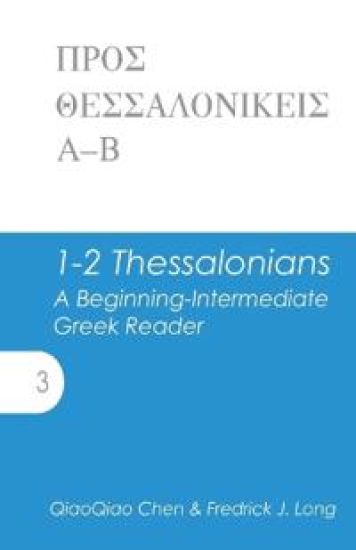
1-2 Thessalonians

1-2 Thessalonians

Fredrick J Long; Qiaoqiao Chen

Glossahouse Media, Inc.
2025
pokkari
1-2 Thessalonians: A Beginning-Intermediate Greek Reader is a Tier 3 GlossaHouse resource in the Accessible Greek Resources and Online Studies (AGROS) series. Tier 3 resources are designed to build confidence in understanding Greek and to encourage the reading of the Greek New Testament by providing: vocabulary glosses, morphological explanations, and translations helps.Any student using this book will be able to exercise his or her beginning Greek learning to read directly from the Greek NewTestament and understand how grammatical and syntactical classifications affect meaning and translation in context. Also included is a fresh, accurate translation of 1-2 Thessalonians.
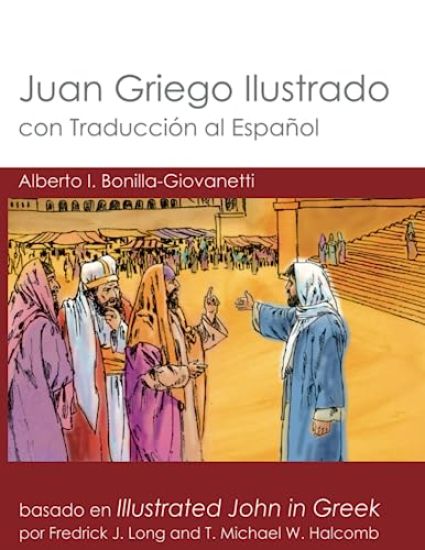
Juan Griego Ilustrado con Traducción al Español

Juan Griego Ilustrado con Traducción al Español

Fredrick J Long; T Michael W Halcomb

Glossahouse
2023
pokkari
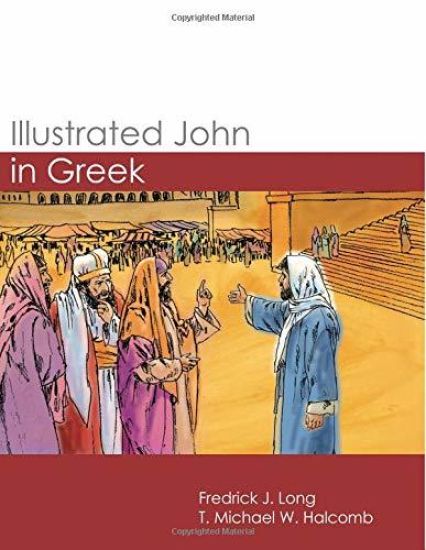
La serie GlossaHouse Illustrated Biblical Texts (GIBT) o Textos B blicos Ilustrados de GlossaHouse (TBIG) provee recursos innovadores que ayudar a lectores de idiomas b blicos y otros idiomas a tener una experiencia m s viva y estimulante con las Escrituras. Este volumen actual-el primero con una traducci n en espa ol localizada al final de cada p gina-combina las narrativas, los mon logos y los di logos griegos con ilustraciones coloridas. Combinar el texto griego de Juan con las ilustraciones art sticas tiene gran valor pedag gico y heur stico. Esto ayuda que el texto sea contextualizado (y recordado) de una manera que las palabras solas en una p gina simplemente no pueden hacer. Esta nueva traducci n al espa ol por Alberto I. Bonilla-Giovanetti tambi n es bastante literal. La traducci n original de Bonilla-Giovanetti del texto griego al espa ol sigue la filosof a de traducci n de Long y Halcomb, la cual se ve reflejada en su traducci n original al ingl s del Evangelio de Juan, y ahora es adaptada a los aspectos distintivos del idioma espa ol. En general, esta traducci n busca preservar el significado del orden de las palabras griegas y representar correctamente los aspectos importantes del texto griego que son m s enfatizados y prominentes. Esta traducci n actual tiene como audiencia al estudiante principiante hispanohablante que quiz s necesite ayuda con el significado de palabras griegas y entender el significado de construcciones especiales como el prop sito, los condicionales y los participios. ENGLISH: The GlossaHouse Illustrated Biblical Texts series (GIBT) provides innovative resources that will allow readers of biblical and other languages to have a more embodied and engaging experience with Scripture. This present volume-the first with a Spanish translation located at the bottom of each page-embeds Greek narrative, monologue, and dialogue within colorful illustrations. Pairing the Greek text of John with artistic renderings is of great pedagogical and heuristic value. This allows the text to be contextualized (and remembered) in a way that words standing on the page alone simply cannot do. This new Spanish translation by Alberto I. Bonilla-Giovanetti is also fairly literal. Bonilla-Giovanetti's original Spanish translation of the Greek text follows Long and Halcomb's translation philosophy as seen in their original English translation of John's Gospel and adapts it to the different distinctive features of the Spanish language. Throughout, this translation seeks to preserve Greek word order significance and accurately represent the important features of the Greek text that are more emphasized and prominent. This current translation is intended for the beginning native Spanish speaking student who may need help with Greek word meanings and understanding the significance of special constructions like purpose, conditionals, and participles.
Method in Teaching Inductive Bible Study-A Practitioner's Handbook: Essays in Honor of Robert A. Traina
The Inductive Bible Study movement has greatly impacted the global church; its influence continues to spread. One of the movement's most seminal advocates and educators-Robert A. Traina, who authored Methodical Bible Study and Inductive Bible Study (with David R. Bauer)-posthumously left substantial, unpublished material on "Method in Bible Teaching." Along with this 54 page essay, this volume assembles twenty essays by educational and church leaders who aptly treat issues of teaching IBS across the curriculum, in the church, and for the academy. Topics covered include pedagogy, hermeneutics, course design for undergraduate and graduate courses, online instruction, using Bible Software, grading comments and rubrics, lessons and assignments, church programs, and discipleship. This book contains the most comprehensive treatment of teaching the Bible inductively ever assembled.
Essays Exploring New Testament Texts

Essays Exploring New Testament Texts

Fredrick J Long

Glossahouse Media, Inc.
2025
pokkari
The critical study of biblical materials is foundational for biblical scholarship. Jesus himself was shaped by Hebrew Scripture and critically engaged it. Indeed, Jesus is an example for others to follow. By "critical" is meant the application of established methodologies to interpret biblical texts. In Essays Exploring New Testament Texts: Biblical Research Methods Applied, readers will see the application of various methodologies to the interpretation of New Testament texts: textual criticism, genre criticism, redaction criticism, intertextuality, narrative criticism, rhetorical criticism, discourse pragmatics, and inductive biblical study. A broad swath of New Testament books is here interpreted: Matthew, Luke, John, Acts, 1 Timothy, Hebrews, 2 Peter, Jude, and Revelation.
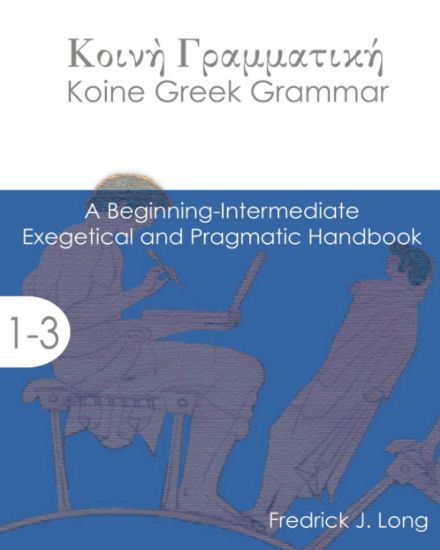
Koine Greek Grammar: A Beginning-Intermediate Exegetical and Pragmatic Handbook
Koine Greek Grammar and its accompanying Workbook and Answer Key & Guide have been in the making for decades. It was first a small manual Kairos Greek Grammar; then it grew into a fully integrated and hyperlinked CD that has been published by Logos Bible Software (2005). Now, this current handbook--KOINE GREEK GRAMMAR: A BEGINNING-INTERMEDIATE EXEGETICAL AND PRAGMATIC HANDBOOK--has been thoroughly expanded to include my more explicit description of marked, emphatic, prominent, and pragmatic features of Greek, ideas that were nascent in KAIROS, but now grounded in a communication theory informed by Relevance Theory (Dan Sperber and Deirdre Wilson), Prominence Theory with reference to translation (Kathleen Callow), and Discourse Grammar and Pragmatics (Stephen Levinsohn, Stanley Porter, and Steven Runge). Exegetically significant aspects of Greek syntax and the use of the Greek language (i.e., pragmatics) occur strategically throughout KOINE GREEK GRAMMAR and include the following: - conjunctions and their constraints- point/counterpoint sets- polysyndeton, asyndeton, correlative emphasis, and lists- fronted modifiers for emphasis (genitive, demonstrative, quantitative)- vocatives as thematic address- appositional statements- the historic present and the verb tense options in narrative- metacomments as orienting statements- interjections as attention getting devices- quantitative, qualitative, interrogative, negative, and comparative types of emphasis- special uses of the noun cases- participle uses, including periphrastic and genitive absolutes- special uses of the Moods- left-(dis)locations- discourse pragmatic uses of the article- conditional and exception clauses.Some of these discussions will have extended Intermediate-level treatments that are placed within greyed boxes. Other significant enhancements are the inclusion of CHECK POINTS that give students a chance to practice what is being learned in each chapter along with (SUGGESTED) ANSWERS that immediately follow. Scattered throughout KOINE GREEK GRAMMAR are images of ancient realia, i.e., remnants of Mediterranean material culture including biblical and non-biblical papyri fragments, vase paintings, coins, bas-reliefs, imperial artifacts, inscriptions, funerary stele, statues, gems, temples, maps, and reconstructed scenes of life in the polis. The language and syntax of the Greek NT is contextually located in these worlds. Still present (but improved) are the CASE IN POINTS at the end of each chapter that briefly describe how particular points of Greek grammar just presented helps us when interpreting the Greek NT. In other words, the CASE IN POINT illustrates how Greek grammar is valuable as a tool for the study of the NT. In addition to having a full APPENDIX, VOCABULARY OF WORDS OCCURRING 20 TIMES OR MORE, and INDICES, KOINE GREEK GRAMMAR has a separate extensive WORKBOOK AND ANSWER KEY & GUIDE. that has been carefully crafted with many exercises drawn directly from biblical expressions and actual verses.
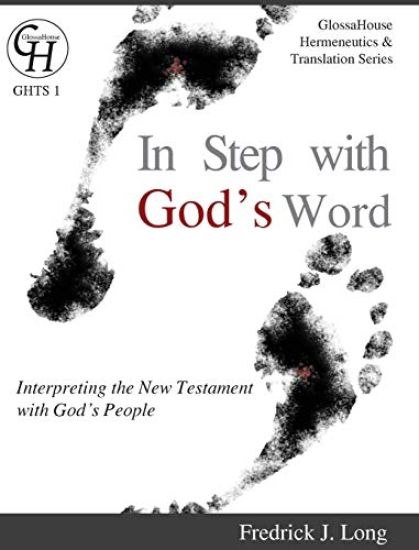
In Step with God's Word

In Step with God's Word

Fredrick J Long

Glossahouse
2019
sidottu
Studying Scripture is not just for pastors or teachers; it's for all of God's people. This is an honor, a privilege, and a humble service for the whole world. This book presents three levels of study for lay persons, pastors, and postgraduate students. In essence this book offers a summary of foundational issues followed by "best interpretive practices" across twelve essential areas of study such as contextual location, grammatical study, lexical research, historical context, scriptural correlations (intertextuality), and presentation brainstorm. Hermeneutically, this work utilizes three most fruitful streams of biblical interpretation: traditional historical-critical exegesis, transmodern socio-rhetorical investigation, and classical inductive biblical study. Throughout, readers will find hundreds of charts, illustrations, examples, and in-text exercises that will inform, guide, and provoke careful study of God's Word.
Dio Chrysostom's Kingship Orations (Or. 1-4): An Advanced Greek Reader
Dio Chrysostom or "golden mouth" (ca. 40-115 CE) was many things-rhetorician, orator, philosopher, historian, moralist as well as enemy and friend of Roman Emperors. He was a prime representative of the "Second Sophistic" movement. His command of the Greek language was Atticizing; his eighty extant discourses are a treasure trove of Greco-Roman cultural mores, lifestyle, religion, and ideology. Preeminent among these discourses are the first four of the collection-The Kingship Orations-written for the emperor Trajan. Within this Tier 5 Advanced Greek Reader of the AGROS series, the Greek text of Kingship Oration 1 is provided with glosses for Greek words occurring less than thirteen times in the Greek New Testament provided in footnotes. This is an ideal resource for self-study or classroom use. Features of this book include: -An Introduction to Dio Chrysostom's Kingship Orations with a select bibliography;-A succinct discussion of the most salient features of Dio's Greek;-A summary of the Constituent Marking Method for navigating the Greek text;-The Greek text of the first Kingship Oration with ample spacing & footnoted glosses for Greek words occurring less than thirteen times in the Greek New Testament;-An Appendix of Greek words occurring thirteen times or more in the Greek New Testament.
Method in Teaching Inductive Bible Study-A Practitioner's Handbook
The Inductive Bible Study (IBS) movement had a master educator in Robert A. Traina, author of Methodical Bible Study and Inductive Bible Study (with David R. Bauer). Traina posthumously left a seminal essay on "Method in Bible Teaching," here published with essays by leading IBS proponents for teaching IBS at home, church, school, and academy.
Dio Chrysostom's Kingship Oration 1: An Advanced Greek Reader with a New Translation
Dio Chrysostom or "golden mouth" (ca. 40-115 CE) was many things-rhetorician, orator, philosopher, historian, moralist as well as enemy and friend of Roman Emperors. He was a prime representative of the "Second Sophistic" movement. His command of the Greek language was Atticizing; his eighty extant discourses are a treasure trove of Greco-Roman cultural mores, lifestyle, religion, and ideology. Preeminent among these discourses are the first four of the collection-The Kingship Orations-written for the emperor Trajan. Within this Tier 5 Advanced Greek Reader of the AGROS series, the Greek text of Kingship Oration 1 is provided on the left page with glosses for Greek words occurring less than thirteen times in the Greek New Testament provided in footnotes. On the following page is space for composing one's own translation and at the bottom a new English translation is provided for comparison. This is an ideal resource for self-study or classroom use. Features of this book include: -An Introduction to Dio Chrysostom's Kingship Orations with a select bibliography; -A succinct discussion of the most salient features of Dio's Greek; -A summary of the Constituent Marking Method for navigating the Greek text; -The Greek text of the first Kingship Oration with ample spacing and footnoting glosses for Greek words occurring less than thirteen times in the Greek New Testament; -On the opposite page, space for taking notes and making a translation and, at the bottom of the page, a fresh new translation of Kingship Oration 1; -An Appendix of Greek words occurring thirteen times or more in the Greek New Testament. Advanced Greek readers for Kingship Orations 2, 3, and 4 are forthcoming from GlossaHouse.
Entrepreneurial Church Planting: Engaging Business and Mission for Marketplace Transformation
Church planters generally are optimistic and enthusiastic about church planting for this generation. Many are launching or about to experiment with innovative approaches to plant churches that engage the marketplace. They are applying missional perspectives to reach this large mission field. This book documents and explores these innovative approaches to church planting. The various authors describe how entrepreneurs are now finding where people are already gathering (or would gather) in the marketplace such that these businesses create a venue for a church. We are calling this Entrepreneurial Church Planting (ECP). In order to encourage and explore further innovative ECP approaches, this book provides both theoretical foundations and practical applications arranged in three parts. Part I contains an introduction to the volume. Part II provides the biblical foundations to undergird ECP. Part III provides practical applications from both historical and contemporary examples and concludes with suggested starting points for experimentation and implementation. The goal of this volume is to encourage church planters to explore creative church planting approaches by engaging their faith in the marketplace.