Kirjojen hintavertailu. Mukana 12 595 353 kirjaa ja 12 kauppaa.

Kirjailija

Freeman Dyson

Kirjat ja teokset yhdessä paikassa: 15 kirjaa, julkaisuja vuosilta 1981-2026, suosituimpien joukossa Disturbing The Universe. Vertaile teosten hintoja ja tarkista saatavuus suomalaisista kirjakaupoista.

15 kirjaa

Kirjojen julkaisuhaarukka 1981-2026.

The Scientist as Rebel: Revised Edition

The Scientist as Rebel: Revised Edition

Freeman Dyson

New York Review of Books
2026
nidottu
An illuminating collection of essays by an award-winning scientist whom the London Times calls "one of the world's most original minds." From Galileo to today's amateur astronomers, scientists have been rebels, writes Freeman Dyson. Like artists and poets, they are free spirits who resist the restrictions their cultures impose on them. In their pursuit of Nature's truths, they are guided as much by imagination as by reason, and their greatest theories have the uniqueness and beauty of great works of art. Dyson argues that the best way to understand science is by understanding those who practice it. He tells stories of scientists at work, ranging from Isaac Newton's absorption in physics, alchemy, theology, and politics, to Ernest Rutherford's discovery of the structure of the atom, to Albert Einstein's stubborn hostility to the idea of black holes. His descriptions of brilliant physicists like Edward Teller and Richard Feynman are enlivened by his own reminiscences of them. He looks with a skeptical eye at fashionable scientific fads and fantasies, and speculates on the future of climate prediction, genetic engineering, the colonization of space, and the possibility that paranormal phenomena may exist yet not be scientifically verifiable. Dyson also looks beyond particular scientific questions to reflect on broader philosophical issues, such as the limits of reductionism, the morality of strategic bombing and nuclear weapons, the preservation of the environment, and the relationship between science and religion. These essays, by a distinguished physicist who is also a lovely writer, offer informed insights into the history of science and fresh perspectives on contentious current debates about science, ethics, and faith.
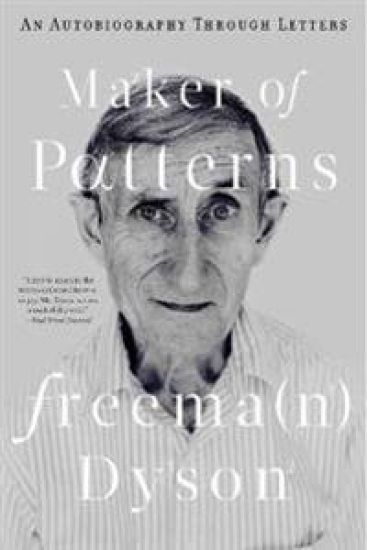
Maker of Patterns

Maker of Patterns

Freeman Dyson

Liveright Publishing Corporation
2019
nidottu
Written between 1940 and the late 1970s, the postwar recollections of renowned physicist Freeman Dyson have been celebrated as an historic portrait of modern science and its greatest players, including Robert Oppenheimer, Richard Feynman, Stephen Hawking, and Hans Bethe. Chronicling the stories of those who were engaged in solving some of the most challenging quandaries of twentieth-century physics, Dyson lends acute insight and profound observations to a life's work spent chasing what Einstein called those "deep mysteries that Nature intends to keep for herself." Whether reflecting on the drama of World War II, the moral dilemmas of nuclear development, the challenges of the space program, or the demands of raising six children, Dyson's annotated letters reveal the voice of one "more creative than almost anyone else of his generation" (Kip Thorne). An illuminating work in these trying times, Maker of Patterns is an eyewitness account of the scientific discoveries that define our modern age.
Maker of Patterns

Maker of Patterns

Freeman Dyson

Liveright Publishing Corporation
2018
sidottu
Having penned hundreds of letters to his family over four decades, Freeman Dyson has framed them with the reflections made by a man now in his nineties. While maintaining that "the letters record the daily life of an ordinary scientist doing ordinary work," Dyson nonetheless has worked with many of the twentieth century's most renowned physicists, mathematicians, and intellectuals, so that Maker of Patterns presents not only his personal story but chronicles through firsthand accounts an exciting era of twentieth-century science.Though begun in the dark year of 1941 when Hitler's armies had already conquered much of Europe, Dyson's letters to his parents, written at Trinity College, Cambridge, often burst with the curiosity of a precocious seventeen-year-old. Pursuing mathematics and physics with a cast of legendary professors, Dyson thrived in Cambridge's intellectual ferment, working on, for example, the theory of partitions or reading about Kurt G del's hypotheses, while still finding time for billiards and mountain climbing. After graduating and serving with the Royal Air Force's Bomber Command operational research section, whose job it was "to demolish German cities and kill as many German civilians as possible," Dyson visited a war-torn Germany, hoping through his experience to create a "tolerably peaceful world."Juxtaposing descriptions of scientific breakthroughs with concerns for mankind's future, Dyson's postwar letters reflect the quandaries faced by an entire scientific generation that was dealing with the aftereffects of nuclear detonations and concentration camp killings. Arriving in America in 1947 to study with Cornell's Hans Bethe, Dyson continued to send weekly missives to England that were never technical but written with grace and candor, creating a portrait of a generation that was eager, as Einstein once stated, to solve "deep mysteries that Nature intend[ed] to keep for herself."We meet, among others, scientists like Richard Feynman, who took Dyson across country on Route 66, Robert Oppenheimer, Eugene Wigner, Niels Bohr, James Watson, and a young Stephen Hawking; and we encounter intellectuals and leaders, among them Reinhold Niebuhr, George Kennan, Arthur C. Clarke, as well as Martin Luther King, Jr.The "patterns of comparable beauty in the dance of electrons jumping around atoms" invariably replicate themselves in this autobiography told through letters, one that combines accounts of wanton arms development with the not-inconsiderable demands of raising six children. As we once again attempt to guide society toward a more hopeful future, these letters, with their reenactment of what, at first, seems like a distant past, reveal invaluable truths about human nature.
Gamma

Gamma

Julian Havil; Freeman Dyson

Princeton University Press
2017
pokkari
Among the many constants that appear in mathematics, ?, e, and i are the most familiar. Following closely behind is ?,, or gamma, a constant that arises in many mathematical areas yet maintains a profound sense of mystery. In a tantalizing blend of history and mathematics, Julian Havil takes the reader on a journey through logarithms and the harmonic series, the two defining elements of gamma, toward the first account of gamma's place in mathematics. Introduced by the Swiss mathematician Leonhard Euler (1707-1783), who figures prominently in this book, gamma is defined as the limit of the sum of 1 + 1/2 + 1/3 + ...Up to 1/n, minus the natural logarithm of n--the numerical value being 0.5772156...But unlike its more celebrated colleagues ? and e, the exact nature of gamma remains a mystery--we don't even know if gamma can be expressed as a fraction. Among the numerous topics that arise during this historical odyssey into fundamental mathematical ideas are the Prime Number Theorem and the most important open problem in mathematics today--the Riemann Hypothesis (though no proof of either is offered!). Sure to be popular with not only students and instructors but all math aficionados, Gamma takes us through countries, centuries, lives, and works, unfolding along the way the stories of some remarkable mathematics from some remarkable mathematicians.
Dreams Of Earth And Sky

Dreams Of Earth And Sky

Freeman Dyson

The New York Review of Books, Inc
2015
sidottu
In this sequel to The Scientist as Rebel (2006), Freeman Dyson--whom The Times of London calls "one of the world's most original minds"--celebrates openness to unconventional ideas and "the spirit of joyful dreaming" in which he believes that science should be pursued. Throughout these essays, which range from the creation of the Royal Society in the seventeenth century to the scientific inquiries of the Romantic generation to recent books by Daniel Kahneman and Malcolm Gladwell, he seeks to "break down the barriers that separate science from other sources of human wisdom." Dyson discusses twentieth-century giants of physics such as Richard Feynman, J. Robert Oppenheimer, Paul Dirac, and Steven Weinberg, many of whom he knew personally, as well as Winston Churchill's pursuit of nuclear weapons for Britain and Wernher von Braun's pursuit of rockets for space travel. And he takes a provocative, often politically incorrect approach to some of today's most controversial scientific issues: global warming, the current calculations of which he thinks are probably wrong; the future of biotechnology, which he expects to dominate our lives in the next half-century as the tools to design new living creatures become available to everyone; and the flood of information in the digital age. Dyson offers fresh perspectives on the history, the philosophy, and the practice of scientific inquiry--and even on the blunders, the wild guesses and wrong theories that are also part of our struggle to understand the wonders of the natural world.
Dyson Quantenfeldtheorie

Dyson Quantenfeldtheorie

Freeman Dyson

Springer-Verlag Berlin and Heidelberg GmbH Co. K
2013
nidottu
Die berühmte Vorlesung von Freeman Dyson - nun erstmals auf Deutsch. In den 1940er Jahren zeigte Freeman Dyson die Äquivalenz zwischen den beiden Formulierungen der QED - des Pfadintegralansatzes von Richard Feynman und der Variationsmethoden von Julian Schwinger - und bewies somit die Konsistenz der QED. Dieses Buch beinhaltet die wertvollen - nie zuvor auf Deutsch publizierten - Vorlesungen über Quantenfeldtheorie, die Dyson an der Cornell Universität 1951 gehalten hat. Der Theoretiker Edwin Thompson Jaynes bemerkte dazu: "Für eine Generation von Physikern waren diese Vorlesungen ein Gewinn: klarer und besser motiviert als Feynmans Vorlesungen, und schneller und kompakter als Schwingers." Zukünftige Leser werden diese Vorlesungen ebenfalls mit großem Genuss lesen und von dem klaren Stil profitieren, der für Dyson stets so charakteristisch gewesen ist.Aus dem Inhaltsverzeichnis: 1 - Die Diracgleichung, 2 - Streuprobleme und die Born-Approximation, 3 - Die klassische und quantenmechanische Feldtheorie, 4 - Beispiele quantisierter Feldtheorien (Maxwellfeld, Diracelektronen), 5 - Streuprobleme freier Teilchen (Paar Annihilation, Möller-Streuung, Klein-Nishina-Formel), 6 - Allgemeine Theorie der Streuung (Feynman-Graphen, Infrarotkatastrophe), 7 - Streuung an einem statischen Potenzial und experimentelle Ergebnisse.
The Ultimate Quotable Einstein

The Ultimate Quotable Einstein

Albert Einstein; Freeman Dyson

Princeton University Press
2013
pokkari
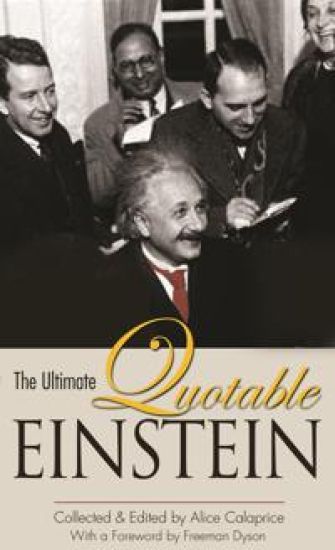
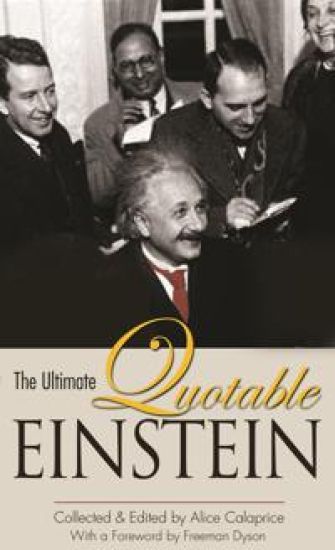
This is the definitive edition of the hugely popular collection of Einstein quotations that has sold tens of thousands of copies worldwide and been translated into twenty-five languages. The Ultimate Quotable Einstein features roughly 1,600 quotes in all. This paperback edition includes sections unique to the ultimate collection--"On and to Children," "On Race and Prejudice," and "Einstein's Verses: A Small Selection"--as well as a chronology of Einstein's life and accomplishments, Freeman Dyson's authoritative foreword, and commentary and descriptive source notes by Alice Calaprice.
The Best Writing on Mathematics 2011

The Best Writing on Mathematics 2011

Freeman Dyson

Princeton University Press
2011
pokkari
This anthology brings together the year's finest mathematics writing from around the world. Featuring promising new voices alongside some of the foremost names in the field, "The Best Writing on Mathematics 2011" makes available to a wide audience many articles not easily found anywhere else - and you don't need to be a mathematician to enjoy them. These writings offer surprising insights into the nature, meaning, and practice of mathematics today. They delve into the history, philosophy, teaching, and everyday occurrences of math, and take readers behind the scenes of today's hottest mathematical debates. Here Ian Hacking discusses the salient features that distinguish mathematics from other disciplines of the mind; Doris Schattschneider identifies some of the mathematical inspirations of M. C. Escher's art; Jordan Ellenberg describes compressed sensing, a mathematical field that is reshaping the way people use large sets of data; Erica Klarreich reports on the use of algorithms in the job market for doctors; and much, much more. In addition to presenting the year's most memorable writings on mathematics, this must-have anthology includes a foreword by esteemed physicist and mathematician Freeman Dyson. This book belongs on the shelf of anyone interested in where math has taken us - and where it is headed.
The Ultimate Quotable Einstein

The Ultimate Quotable Einstein

Albert Einstein; Freeman Dyson

Princeton University Press
2010
sidottu
Here is the definitive new edition of the hugely popular collection of Einstein quotations that has sold tens of thousands of copies worldwide and been translated into twenty-five languages. The Ultimate Quotable Einstein features 400 additional quotes, bringing the total to roughly 1,600 in all. This ultimate edition includes new sections--"On and to Children," "On Race and Prejudice," and "Einstein's Verses: A Small Selection"--as well as a chronology of Einstein's life and accomplishments, Freeman Dyson's authoritative foreword, and new commentary by Alice Calaprice. In The Ultimate Quotable Einstein, readers will also find quotes by others about Einstein along with quotes attributed to him. Every quotation in this informative and entertaining collection is fully documented, and Calaprice has carefully selected new photographs and cartoons to introduce each section. * Features 400 additional quotations * Contains roughly 1,600 quotations in all * Includes new sections on children, race and prejudice, and Einstein's poetry * Provides new commentary * Beautifully illustrated * The most comprehensive collection of Einstein quotes ever published
Sacred Mathematics

Sacred Mathematics

Fukagawa Hidetoshi; Tony Rothman; Freeman Dyson

Princeton University Press
2008
sidottu
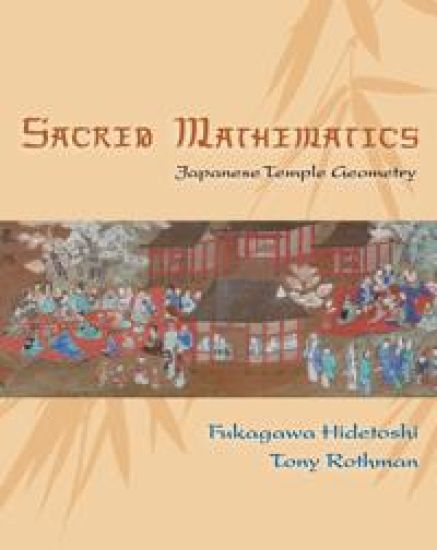
Between the seventeenth and nineteenth centuries Japan was totally isolated from the West by imperial decree. During that time, a unique brand of homegrown mathematics flourished, one that was completely uninfluenced by developments in Western mathematics. People from all walks of life--samurai, farmers, and merchants--inscribed a wide variety of geometry problems on wooden tablets called sangaku and hung them in Buddhist temples and Shinto shrines throughout Japan. Sacred Mathematics is the first book published in the West to fully examine this tantalizing--and incredibly beautiful--mathematical tradition. Fukagawa Hidetoshi and Tony Rothman present for the first time in English excerpts from the travel diary of a nineteenth-century Japanese mathematician, Yamaguchi Kanzan, who journeyed on foot throughout Japan to collect temple geometry problems. The authors set this fascinating travel narrative--and almost everything else that is known about temple geometry--within the broader cultural and historical context of the period. They explain the sacred and devotional aspects of sangaku, and reveal how Japanese folk mathematicians discovered many well-known theorems independently of mathematicians in the West--and in some cases much earlier. The book is generously illustrated with photographs of the tablets and stunning artwork of the period. Then there are the geometry problems themselves, nearly two hundred of them, fully illustrated and ranging from the utterly simple to the virtually impossible. Solutions for most are provided. A unique book in every respect, Sacred Mathematics demonstrates how mathematical thinking can vary by culture yet transcend cultural and geographic boundaries.
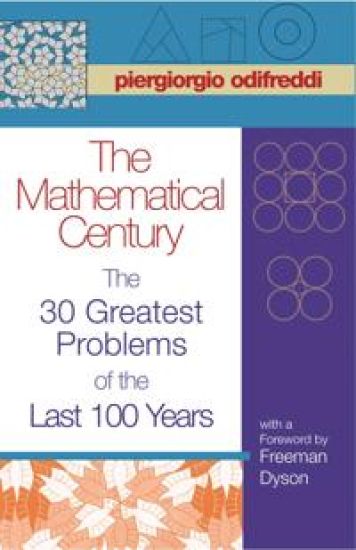
The Mathematical Century

The Mathematical Century

Piergiorgio Odifreddi; Freeman Dyson

Princeton University Press
2006
pokkari
The twentieth century was a time of unprecedented development in mathematics, as well as in all sciences: more theorems were proved and results found in a hundred years than in all of previous history. In The Mathematical Century, Piergiorgio Odifreddi distills this unwieldy mass of knowledge into a fascinating and authoritative overview of the subject. He concentrates on thirty highlights of pure and applied mathematics. Each tells the story of an exciting problem, from its historical origins to its modern solution, in lively prose free of technical details. Odifreddi opens by discussing the four main philosophical foundations of mathematics of the nineteenth century and ends by describing the four most important open mathematical problems of the twenty-first century. In presenting the thirty problems at the heart of the book he devotes equal attention to pure and applied mathematics, with applications ranging from physics and computer science to biology and economics. Special attention is dedicated to the famous "23 problems" outlined by David Hilbert in his address to the International Congress of Mathematicians in 1900 as a research program for the new century, and to the work of the winners of the Fields Medal, the equivalent of a Nobel prize in mathematics. This eminently readable book will be treasured not only by students and their teachers but also by all those who seek to make sense of the elusive macrocosm of twentieth-century mathematics.
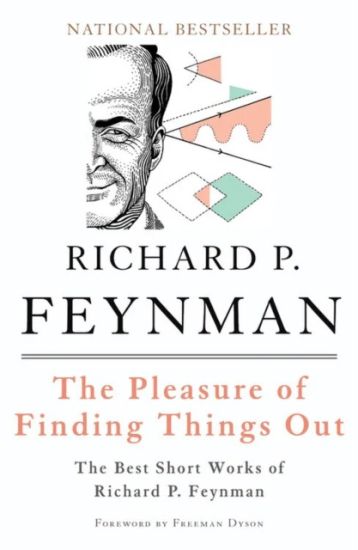
The Pleasure of Finding Things Out

The Pleasure of Finding Things Out

Freeman Dyson; Richard Feynman

Basic Books
2005
pokkari
The Pleasure of Finding Things Out is a magnificent treasury of the best short works of Richard P. Feynman,from interviews and speeches to lectures and printed articles. A sweeping, wide-ranging collection, it presents an intimate and fascinating view of a life in science-a life like no other. From his ruminations on science in our culture to his Nobel Prize acceptance speech, this book will fascinate anyone interested in the world of ideas.
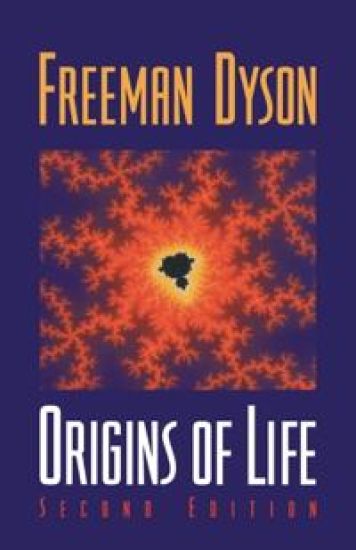
Origins of Life

Origins of Life

Freeman Dyson

Cambridge University Press
1999
pokkari
How did life on earth originate? Did replication or metabolism come first in the history of life? In this book, Freeman Dyson examines these questions and discusses the two main theories that try to explain how naturally occurring chemicals could organize themselves into living creatures. The majority view is that life began with replicating molecules, the precursors of modern genes. The minority belief is that random populations of molecules evolved metabolic activities before exact replication existed. Dyson analyzes both of these theories with reference to recent important discoveries by geologists and chemists. His main aim is to stimulate new experiments that could help to decide which theory is correct. This second edition covers the enormous advances that have been made in biology and geology in the past decade and the impact they have had on our ideas about how life began. It is a clearly-written, fascinating book that will appeal to anyone interested in the origins of life.
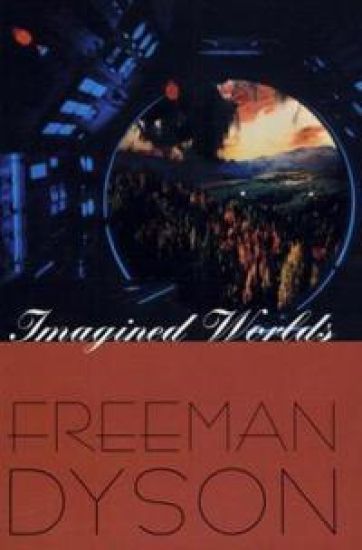
Imagined Worlds

Imagined Worlds

Freeman Dyson

Harvard University Press
1998
nidottu
Imagine a world where whole epochs will pass, cultures rise and fall, between a telephone call and the reply. Think of the human race multiplying 500-million fold, or evolving new, distinct species. Consider the technology of space colonization, computer-assisted reproduction, the “Martian potato.” One hundred years after H. G. Wells visited the future in The Time Machine, Freeman Dyson marshals his uncommon gifts as a scientist and storyteller to take us once more to that ever-closer, ever-receding time to come.Since Disturbing the Universe, the book that first brought him international renown, Freeman Dyson has been helping us see ourselves and our world from a scientist’s point of view. In Imagined Worlds he brings this perspective to a speculative future to show us where science and technology, real and imagined, may be taking us. The stories he tells—about “Napoleonic” versus “Tolstoyan” styles of doing science; the coming era of radioneurology and radiotelepathy; the works of writers from Aldous Huxley to Michael Crichton to William Blake; Samuel Gompers and the American labor movement—come from science, science fiction, and history. Sharing in the joy and gloom of these sources, Dyson seeks out the lessons we must learn from all three if we are to understand our future and guide it in hopeful directions.Whether looking at the Gaia theory or the future of nuclear weapons, science fiction or the dangers of “science worship,” seagoing kayaks or the Pluto Express, Dyson is concerned with ethics, with how we might mitigate the evil consequences of technology and enhance the good. At the heart of it all is the belief once expressed by the biologist J. B. S. Haldane, that progress in science will bring enormous confusion and misery to humankind unless it is accompanied by progress in ethics.
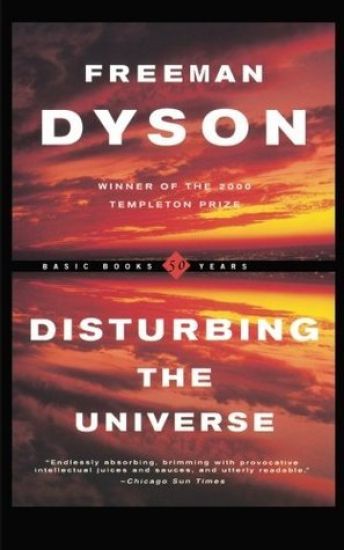
Disturbing The Universe

Disturbing The Universe

Freeman Dyson

Basic Books
1981
pokkari
Spanning the years from World War II, when he was a civilian statistician in the operations research section of the Royal Air Force Bomber Command, through his studies with Hans Bethe at Cornell University, his early friendship with Richard Feynman, and his postgraduate work with J. Robert Oppenheimer, Freeman Dyson has composed an autobiography unlike any other. Dyson evocatively conveys the thrill of a deep engagement with the world-be it as scientist, citizen, student, or parent. Detailing a unique career not limited to his ground-breaking work in physics, Dyson discusses his interest in minimizing loss of life in war, in disarmament, and even in thought experiments on the expansion of our frontiers into the galaxies.