Kirjojen hintavertailu. Mukana 12 595 353 kirjaa ja 12 kauppaa.

Kirjailija

Friedrich Waismann

Kirjat ja teokset yhdessä paikassa: 11 kirjaa, julkaisuja vuosilta 1968-2021, suosituimpien joukossa Ludwig Wittgenstein and The Vienna Circle. Vertaile teosten hintoja ja tarkista saatavuus suomalaisista kirjakaupoista.

11 kirjaa

Kirjojen julkaisuhaarukka 1968-2021.

Ludwig Wittgenstein and The Vienna Circle

Ludwig Wittgenstein and The Vienna Circle

G. H. von Wright; Friedrich Waismann

JOHN WILEY AND SONS LTD
1984
nidottu
This collection contains hitherto unknown letters exchanged between Wittgenstein and the most important of his Cambridge friends and includes editorial notes based on archival material not previously explored. Incorporates many previously undiscovered unique and significant letters. A powerful record and intimate insight into Wittgenstein's life and thought. Extensive editorial annotations.
Introduction to Mathematical Thinking: the Formation of Concepts in Modern Mathematics;
This work has been selected by scholars as being culturally important and is part of the knowledge base of civilization as we know it.This work is in the public domain in the United States of America, and possibly other nations. Within the United States, you may freely copy and distribute this work, as no entity (individual or corporate) has a copyright on the body of the work.Scholars believe, and we concur, that this work is important enough to be preserved, reproduced, and made generally available to the public. To ensure a quality reading experience, this work has been proofread and republished using a format that seamlessly blends the original graphical elements with text in an easy-to-read typeface.We appreciate your support of the preservation process, and thank you for being an important part of keeping this knowledge alive and relevant.
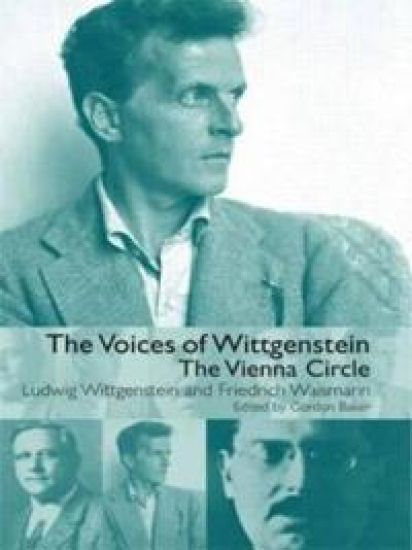
The Voices of Wittgenstein

The Voices of Wittgenstein

Friedrich Waismann

Routledge
2013
nidottu
The Voices of Wittgenstein brings for the first time, in both the original German and in English translation, over one hundred short essays in philosophical logic and the philosophy of mind. This text is of key historical importance to understanding Wittgenstein's philosophical thought and development in the 1930's. Transcribed from the papers of Friedrich Waismann and dating from 1932 to 1935, the majority are highly important dictations by Wittgenstein to Waismann. It also includes texts of redrafted material by Waismann, closely based on these dictations.
Ethics and the Will

Ethics and the Will

Friedrich Waismann; Josef Schächter; Moritz Schlick

Springer
2012
nidottu
INTRODUCTION The present volume unites contributions by the leading figure of the Vienna Circle and by two of his closest assoCiates, contributions that deal with an area of thought represented, indeed, in this Collection but certainly not the central one in the common picture ofthe Circle's activities. It is no accident that an interest in ethics and the philosophy of action was particularly marked in what Neurath was apt to call the right wing of the Circle. For them, as for Wittgenstein (the respected mentorofSchlickandWaismanninparticular),theadvancetobehoped for in philosophy consisted not solely in freeing natural science from a confused sense of dependence on speculative metaphysics but also in seeingthatotherareasoflanguageandaction hadto bethoughtaboutin theirownterms, whichwereneitherthoseofnaturalsciencenorthoseof philosophy as traditionally conceived. The scepticismofSchlick about theprogrammeofUnifiedSciencewaswellknown: EinheizwissenschaJt he called it, as it might be 'boozified science'. And in sober truth the programme sometimes masked a left-wing set of values taken (surely illogically) for granted, though the membersofthe Circle entertained a wide range ofpolitical views. Schlick's own contribution to the present volume is a section from thenotesforoneofhisfinal lectureseries,forsightofwhich wewarmly thanktheonlysurvivingcontributortoourvolume,DrJosephSchachter: Schlick'sgrandsonDra. M. H. vandeVeldehaskindlyconsentedtotheir publication. This section poses the problem we have outlined: there are questionsandaneedforclarificationinethics,butthesenomoredemand a metaphysical solution than does a similar situation in epistemology. Here, as in his earlier Problems of Ethics,l Schlick sets his face against thewholeprocess,mostobviousin Kant,ofmakingtheconceptofvalue absolute. One might say that for Schlick there is no unhypothetical imperative.
The Voices of Wittgenstein

The Voices of Wittgenstein

Friedrich Waismann

Routledge
2003
sidottu
The Voices of Wittgenstein brings for the first time, in both the original German and in English translation, over one hundred short essays in philosophical logic and the philosophy of mind. This text is of key historical importance to understanding Wittgenstein's philosophical thought and development in the 1930's. Transcribed from the papers of Friedrich Waismann and dating from 1932 to 1935, the majority are highly important dictations by Wittgenstein to Waismann. It also includes texts of redrafted material by Waismann, closely based on these dictations.
Ethics and the Will

Ethics and the Will

Friedrich Waismann; Josef Schächter; Moritz Schlick

Springer
1994
sidottu
INTRODUCTION The present volume unites contributions by the leading figure of the Vienna Circle and by two of his closest assoCiates, contributions that deal with an area of thought represented, indeed, in this Collection but certainly not the central one in the common picture ofthe Circle's activities. It is no accident that an interest in ethics and the philosophy of action was particularly marked in what Neurath was apt to call the right wing of the Circle. For them, as for Wittgenstein (the respected mentorofSchlickandWaismanninparticular),theadvancetobehoped for in philosophy consisted not solely in freeing natural science from a confused sense of dependence on speculative metaphysics but also in seeingthatotherareasoflanguageandaction hadto bethoughtaboutin theirownterms, whichwereneitherthoseofnaturalsciencenorthoseof philosophy as traditionally conceived. The scepticismofSchlick about theprogrammeofUnifiedSciencewaswellknown: EinheizwissenschaJt he called it, as it might be 'boozified science'. And in sober truth the programme sometimes masked a left-wing set of values taken (surely illogically) for granted, though the membersofthe Circle entertained a wide range ofpolitical views. Schlick's own contribution to the present volume is a section from thenotesforoneofhisfinal lectureseries,forsightofwhich wewarmly thanktheonlysurvivingcontributortoourvolume,DrJosephSchachter: Schlick'sgrandsonDra. M. H. vandeVeldehaskindlyconsentedtotheir publication. This section poses the problem we have outlined: there are questionsandaneedforclarificationinethics,butthesenomoredemand a metaphysical solution than does a similar situation in epistemology. Here, as in his earlier Problems of Ethics,l Schlick sets his face against thewholeprocess,mostobviousin Kant,ofmakingtheconceptofvalue absolute. One might say that for Schlick there is no unhypothetical imperative.
Philosophical Papers

Philosophical Papers

Friedrich Waismann

Kluwer Academic Publishers
1977
sidottu
Friedrich Waismann was born in Vienna in 1896 and lived there until the time of the Anschluss in 1938. From then until his death in 1959 he lived in England; this, apart from a brief period at Cambridge early on, was almost wholly at Oxford, \,Vhere he held the posts, first, or reader in the philosophy of mathematics and then of reader in the philosophy of science. He was of Jewish descent -his father being Russian, his mother German. He studied mathematics and physics at the University of Vienna and attended the lec- tures of Hahn. Beginning his career as a teacher of mathematics he soon be- came an unofficial assistant to Moritz Schlick. It was Schlick's concern to see that the new philosophical ideas developed by Wittgenstein from the time of his return to philosophy in the later 1920s were made public that de- termined the subsequent shape of Waismann's activities. Until the out- break of the war in 1939 his main task was the preparation of a book in which Wittgenstein's thought was to be systematically expounded. Be- tween 1927 and 1935 this project was carried on in close personal conjunc- tion with Wittgenstein. A first version of the planned book, Logik. Sprache. Philosophie seems to have been completed by 1931. A very differ- ent version came to England with Waismann in 1938. It finally appeared, in an English translation, as Principles of Linguistic Philosophy.
Philosophical Papers

Philosophical Papers

Friedrich Waismann

Kluwer Academic Publishers
1977
nidottu
Friedrich Waismann was born in Vienna in 1896 and lived there until the time of the Anschluss in 1938. From then until his death in 1959 he lived in England; this, apart from a brief period at Cambridge early on, was almost wholly at Oxford, \,Vhere he held the posts, first, or reader in the philosophy of mathematics and then of reader in the philosophy of science. He was of Jewish descent -his father being Russian, his mother German. He studied mathematics and physics at the University of Vienna and attended the lec- tures of Hahn. Beginning his career as a teacher of mathematics he soon be- came an unofficial assistant to Moritz Schlick. It was Schlick's concern to see that the new philosophical ideas developed by Wittgenstein from the time of his return to philosophy in the later 1920s were made public that de- termined the subsequent shape of Waismann's activities. Until the out- break of the war in 1939 his main task was the preparation of a book in which Wittgenstein's thought was to be systematically expounded. Be- tween 1927 and 1935 this project was carried on in close personal conjunc- tion with Wittgenstein. A first version of the planned book, Logik. Sprache. Philosophie seems to have been completed by 1931. A very differ- ent version came to England with Waismann in 1938. It finally appeared, in an English translation, as Principles of Linguistic Philosophy.