Kirjojen hintavertailu. Mukana 12 298 572 kirjaa ja 12 kauppaa.
Kirjailija
Friedrich Wilhelm Nietzsche
Kirjat ja teokset yhdessä paikassa: 756 kirjaa, julkaisuja vuosilta 1886-2026, suosituimpien joukossa The Antichrist. Vertaile teosten hintoja ja tarkista saatavuus suomalaisista kirjakaupoista.
F. W. Nietzsche's controversial work, "The Antichrist," remains a powerful and unsettling exploration of morality, ethics, and religion. A scathing critique of Christianity, this philosophical text delves into the roots of nihilism and challenges conventional notions of good and evil. Nietzsche rigorously examines Christian theology and its impact on Western thought, offering a provocative counter-narrative to traditional apologetics. As a cornerstone of philosophical discourse, "The Antichrist" invites readers to confront fundamental questions about values, belief systems, and the nature of truth. It is a significant work for anyone interested in the history of ideas, the philosophy of religion, and the enduring debate surrounding Christian ethics. This meticulously prepared print edition ensures the accessibility of Nietzsche's influential and intensely debated arguments.This work has been selected by scholars as being culturally important, and is part of the knowledge base of civilization as we know it.This work is in the public domain in the United States of America, and possibly other nations. Within the United States, you may freely copy and distribute this work, as no entity (individual or corporate) has a copyright on the body of the work.Scholars believe, and we concur, that this work is important enough to be preserved, reproduced, and made generally available to the public. We appreciate your support of the preservation process, and thank you for being an important part of keeping this knowledge alive and relevant.
Reproduction of the original. The publishing house Megali specialises in reproducing historical works in large print to make reading easier for people with impaired vision.
Reproduction of the original. The publishing house Megali specialises in reproducing historical works in large print to make reading easier for people with impaired vision.
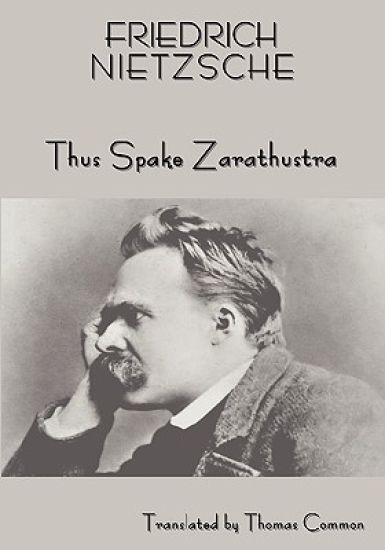
Friedrich Wilhelm Nietzsche (1844-1900) was a nineteenth-century German philosopher. He wrote critical texts on religion, morality, contemporary culture, philosophy and science, using a distinctive German language style and displaying a fondness for aphorism. Nietzsche's influence remains substantial within and beyond philosophy, notably in existentialism and postmodernism. Thus Spake Zarathustra is a work composed in four parts between 1883 and 1885. Much of the work deals with ideas such as the "eternal recurrence of the same", the parable on the "death of God", and the "prophecy" of the Overman, which were first introduced in The Gay Science. Described by Nietzsche himself as "the deepest ever written", the book is a dense and esoteric treatise on philosophy and morality, featuring as protagonist a fictionalized Zarathustra. A central irony of the text is that the style of the Bible is used by Nietzsche to present ideas of his which fundamentally oppose Judaeo-Christian morality and tradition.
"The Great Man... is colder, harder, less hesitating, and without fear of 'opinion'; he lacks the virtues that accompany respect and 'respectability, ' and altogether everything that is the 'virtue of the herd.' If he cannot lead, he goes alone... He knows he is incommunicable: he finds it tasteless to be familiar... When not speaking to himself, he wears a mask. There is a solitude within him that is inaccessible to praise or blame."
Thus Spoke Zarathustra: A Book for All and None (German: Also sprach Zarathustra: Ein Buch f r Alle und Keinen, also translated as Thus Spake Zarathustra) is a philosophical novel by German philosopher Friedrich Nietzsche, composed in four parts. Much of the work deals with ideas such as the "eternal recurrence of the same", the parable on the "death of God", and the "prophecy" of the bermensch, which were first introduced in The Gay Science.
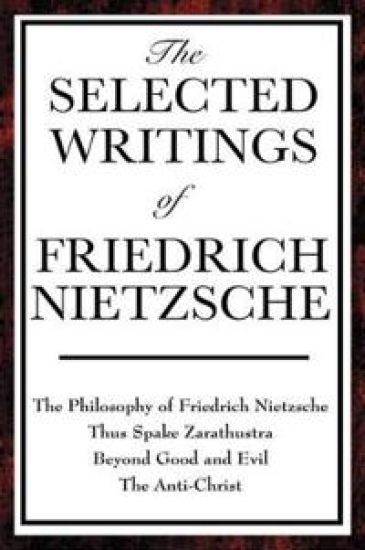
Der Friedrich Wilhelm Nietzsche (1844 -1900) isch en d tsche Filosof u klassische Filolog gsi. Vo 1869 bis 1879 isch er Prof sser ar Uni Basu gse. r het i sim L be Morau, Religion, Filosofi, W sseschafte u au Kunst kritisiert. Was er schpeziell agriffe het isch die chrischtlechi Morau u di chrischtlechi u platonischtischi Metaf sik gsi. Bekannt isch sin Satz Gott isch toot. r het sech gfrogt, was Woret berhoupt isch. W g all d m meine einigi, sini Filosofi sig deschtruktiv. As sis Hoptwerch gelt s Buech: Also sprach Zarathustra, wo an Religiosstifter Zarathustra erinneret. In diesem Buch: Also Sprach Zarathustra Jenseits von Gut und Bose Ecce Homo Menschliches, Allzumenschliches Die Geburt der Tragoedie Gotzen-Dammerung
We Philologists deals with the subject of education which was important to Nietzsche, especially during his residence in Basel, paid considerable attention, and his insight into it was very much deeper than that of, say, Herbert Spencer or even Johann Friedrich Herbart, the latter of whom has in late years exercised considerable influence in scholastic circles. Nietzsche clearly saw that the "philologists" (using the word chiefly in reference to the teachers of the classics in German colleges and universities) were absolutely unfitted for their high task, since they were one and all incapable of entering into the spirit of antiquity. Friedrich Wilhelm Nietzsche (15 October 1844 - 25 August 1900) was a German philosopher, cultural critic, composer, poet, philologist, and Latin and Greek scholar whose work has exerted a profound influence on Western philosophy and modern intellectual history. He began his career as a classical philologist before turning to philosophy. He became the youngest ever to hold the Chair of Classical Philology at the University of Basel in 1869 at the age of 24. He resigned in 1879 due to health problems that plagued him most of his life, and he completed much of his core writing in the following decade. In 1889, at age 44, he suffered a collapse and afterwards, a complete loss of his mental faculties. He lived his remaining years in the care of his mother until her death in 1897, and then with his sister Elisabeth F rster-Nietzsche. Nietzsche died in 1900. Nietzsche's body of work touched a wide range of topics, including art, philology, history, religion, tragedy, culture, and science. His early inspiration was drawn from figures such as Schopenhauer, Wagner, and Goethe. His writing spans philosophical polemics, poetry, cultural criticism, and fiction while displaying a fondness for aphorism and irony. Prominent elements of his philosophy include his radical critique of truth in favor of perspectivism; his genealogical critique of religion and Christian morality, and his related theory of master-slave morality; 8] 17] his aesthetic affirmation of existence in response to the "death of God" and the profound crisis of nihilism; 8] his notion of the Apollonian and Dionysian; and his characterization of the human subject as the expression of competing wills, collectively understood as the will to power. He also developed influential concepts such as the bermensch and the doctrine of eternal return.In his later work, he became increasingly preoccupied with the creative powers of the individual to overcome social, cultural, and moral contexts in pursuit of new values and aesthetic health. 11] After his death, Elisabeth F rster-Nietzsche became the curator and editor of her brother's manuscripts. She reworked Nietzsche's unpublished writings to fit her own German nationalist ideology while often contradicting or obfuscating Nietzsche's stated opinions, which were explicitly opposed to antisemitism and nationalism. Through her published editions, Nietzsche's work became associated with fascism and Nazism; 21] 20th century scholars contested this interpretation of his work and corrected editions of his writings were soon made available. Nietzsche's thought enjoyed renewed popularity in the 1960s, and his ideas have since had a profound impact on 20th and early-21st century thinkers across philosophy-especially in schools of continental philosophy such as existentialism, postmodernism, and post-structuralism-as well as art, literature, psychology, politics, and popular culture