Kirjojen hintavertailu. Mukana 12 595 353 kirjaa ja 12 kauppaa.

Kirjailija

Fritz Hans Schweingruber

Kirjat ja teokset yhdessä paikassa: 13 kirjaa, julkaisuja vuosilta 1991-2021, suosituimpien joukossa Stem Anatomy of Dalbergia and Diospyros Species from Madagascar. Vertaile teosten hintoja ja tarkista saatavuus suomalaisista kirjakaupoista.

13 kirjaa

Kirjojen julkaisuhaarukka 1991-2021.

Atlas of Stem Anatomy of Arctic and Alpine Plants Around the Globe

Atlas of Stem Anatomy of Arctic and Alpine Plants Around the Globe

Fritz Hans Schweingruber; Miroslav Dvorský; Annett Börner; Jirí Doležal

Springer Nature Switzerland AG
2021
nidottu
This is the first book to provide comprehensive information on the anatomy and ecology of arctic and alpine plants from cold sites around the globe, including representative species from Greenland, Iceland, Svalbard, Himalaya, Japan, Argentina, Ecuador and Western USA. It presents the study sites, including characteristic landscape and vegetation photographs. It also discusses species distribution, habitat preferences and features plant pictures, particularly focusing on the specific stem anatomical features, which differ in many cases from temperate zone herbs. Furthermore, each plant is characterized according to a newly constructed codification system. Based on the first author’s 20-years of field research, a close collaboration with numerous botanical gardens, and the vast ecological experience of the other authors, the book presents approximately 350 species. The general layout is comparable to Doležal et al’s 2018 book Anatomy, Age and Ecology of High Mountain Plants in Ladakh, the Western Himalaya.

Atlas of Stem Anatomy of Arctic and Alpine Plants Around the Globe

Atlas of Stem Anatomy of Arctic and Alpine Plants Around the Globe

Fritz Hans Schweingruber; Miroslav Dvorský; Annett Börner; Jirí Doležal

Springer Nature Switzerland AG
2020
sidottu
This is the first book to provide comprehensive information on the anatomy and ecology of arctic and alpine plants from cold sites around the globe, including representative species from Greenland, Iceland, Svalbard, Himalaya, Japan, Argentina, Ecuador and Western USA. It presents the study sites, including characteristic landscape and vegetation photographs. It also discusses species distribution, habitat preferences and features plant pictures, particularly focusing on the specific stem anatomical features, which differ in many cases from temperate zone herbs. Furthermore, each plant is characterized according to a newly constructed codification system. Based on the first author’s 20-years of field research, a close collaboration with numerous botanical gardens, and the vast ecological experience of the other authors, the book presents approximately 350 species. The general layout is comparable to Doležal et al’s 2018 book Anatomy, Age and Ecology of High Mountain Plants in Ladakh, the Western Himalaya.

Anatomy, Age and Ecology of High Mountain Plants in Ladakh, the Western Himalaya

Anatomy, Age and Ecology of High Mountain Plants in Ladakh, the Western Himalaya

Jirí Doležal; Miroslav Dvorský; Annett Börner; Jan Wild; Fritz Hans Schweingruber

Springer International Publishing AG
2018
sidottu
This aesthetically unique book combines ecological, morphological and anatomical, as well as phylogenetic studies on plant material in a largely unexplored dry mountain region above the timberline. It offers the first comparative analysis of hundreds of plants - annuals, perennial herbs and dwarf shrubs - in an area of 87,000 km2 at altitudes from 2600 to 6150 m above sea level in the Western Himalaya. Characteristic landscape pictures of all major vegetation types and maps show at which locations and altitudes the individual species of vascular plants are distributed, while macroscopic plant pictures and plant age are related to high-quality micro-sections and micro-photographs. The anatomical features of 345 dicotyledons were characterized using the published coding systems and those of 155 monocotyledones were characterized on the basis of a newly developed key. The number of annual rings and anatomical features of the xylem and phloem of dicots are compared and related to different ecological conditions within this extremely dry and cold environment. The ecological and anatomical characterization is used to create a phylogenetic tree based on nucleotide sequences, and indicates which features are genetically stable and which ones are modified by environmental factors. The book appeals to scientists in the fields of plant taxonomy, morphology, anatomy and ecology.
Stem Anatomy of Dalbergia and Diospyros Species from Madagascar

Stem Anatomy of Dalbergia and Diospyros Species from Madagascar

Bako Harisoa Ravaomanalina; Alan Crivellaro; Fritz Hans Schweingruber

Springer International Publishing AG
2017
sidottu
This atlas offers anatomical descriptions of 19 Dalbergia and 31 Diospyros species, most of them endemic to Madagascar. Each species is illustrated with color micrographs of double-stained sections through the xylem, bark, and pith of stems, branches, and twigs. Further, a photograph of each plant and information on its height, DBH, habit, and geographical and elevational distribution in Madagascar are included. Dalbergia and Diospyros species provide highly-priced woods, which are intensively traded across the world and therefore highly endangered by illegal trade and harvesting. This book represents a response to the action plan for Diospyros and Dalbergia species regarding the establishment of a reference collection and reliable identification system for species listed by CITES, the Convention on International Trade in Endangered Species of Wild Fauna and Flora. Bringing together a wealth of material recently collected in different biogeographical regions of Madagascar and identified by the Missouri Botanical Garden, the book will appeal to plant scientists, taxonomists and practitioners involved in wood identification, and will help to safeguard the legacy of precious wood trading through proper identification.
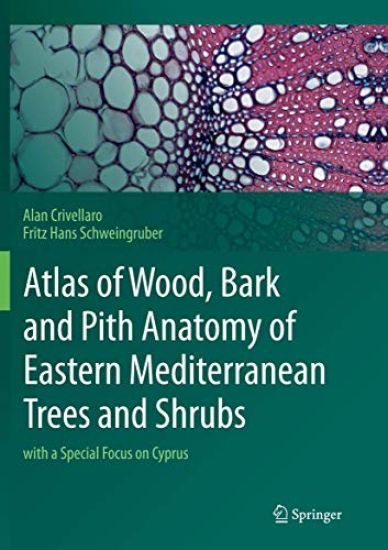
Atlas of Wood, Bark and Pith Anatomy of Eastern Mediterranean Trees and Shrubs

Atlas of Wood, Bark and Pith Anatomy of Eastern Mediterranean Trees and Shrubs

Alan Crivellaro; Fritz Hans Schweingruber

Springer-Verlag Berlin and Heidelberg GmbH Co. K
2016
nidottu
This atlas presents anatomical descriptions of the xylem, bark and pith of 264 species belonging to 71 families. It highlights the anatomical diversity of trees, shrubs, dwarf shrubs, woody lianas and several of the prominent perennial herbs from the Eastern Mediterranean region, with a focus on the island of Cyprus. The island’s topography and biogeographic history combine to provide a wide range of habitats and diverse flora including widespread, endemic, and ornamental species.The monograph for each species includes a description of the anatomical structures of the stem and twig xylem and the twig’s bark and pith, as well as color micrographs of double-stained sections of each of these plant parts. These entries are accompanied by a photograph and a brief description of the plant including stem wood density, height, habit, flower, leaf and fruit characteristics, and a map showing its geographic and altitudinal distribution in the region. Xylem descriptions follow the IAWA lists of microscopic features for hardwood and softwood identification. For bark and pith descriptions, a new coding system developed by the authors is applied. Lastly, the work offers a key for wood identification that was developed to differentiate between groups of species by using a small number of features that are unambiguous and clearly visible. The atlas will be a valuable guide for botanists, ecologists, foresters, archeologists, horticulturists and paleobotanists.
Atlas of Stem Anatomy in Herbs, Shrubs and Trees

Atlas of Stem Anatomy in Herbs, Shrubs and Trees

Fritz Hans Schweingruber; Annett Börner; Ernst-Detlef Schulze

Springer-Verlag Berlin and Heidelberg GmbH Co. K
2016
nidottu
This work, published in two volumes, contains descriptions of the wood and bark anatomies of 3000 dicotyledonous plants of 120 families, highlighting the anatomical and phylogenetic diversity of dicotyledonous plants of the Northern Hemisphere. The first volume principally treats families of the Early Angiosperms, Eudicots, Core Eudicots and Rosids, while the second concentrates on the Asterids. Presented in Volume 1 are microsections of the xylem and phloem of herbs, shrubs and trees of 1200 species and 85 families of various life forms of the temperate zone along altitudinal gradients from the lowland at the Mediterranean coast to the alpine zone in Western Europe. The global perspective of the findings is underlined by the analysis of 500 species from the Caucasus, the Rocky Mountains and Andes, the subtropical zone on the Canary Islands, the arid zones in the Sahara, in Eurasia, Arabia and Southwest North America, and the boreal and arctic zones in Eurasia and Canada. The presence of annual rings in all life forms demonstrates that herbs and dwarf shrubs are an excellent tool for the reconstruction of annual biomass production and the interannual dynamic of plant associations. The common principle of the anatomical expression of secondary growth is a key factor in understanding evolution and adaptation processes in all life forms, from the 2 cm tall whitlow grass (Draba arctica) in the arctic to the 40 m tall beech (Fagus sylvatica) in Central European managed forests. The study opens vast fields of research for dendrochronology, wood anatomy, taxonomy and ecology.
Atlas of Stem Anatomy in Herbs, Shrubs and Trees

Atlas of Stem Anatomy in Herbs, Shrubs and Trees

Fritz Hans Schweingruber; Annett Börner; Ernst-Detlef Schulze

Springer-Verlag Berlin and Heidelberg GmbH Co. K
2016
nidottu
This work, published in two volumes, contains descriptions of the wood and bark anatomies of 3000 dicotyledonous plants of 120 families, highlighting the anatomical and phylogenetic diversity of dicotyledonous plants of the Northern Hemisphere. The first volume principally treats families of the Early Angiosperms, Eudicots, Core Eudicots and Rosids, while the second concentrates on the Asterids. Presented in Volume 2 are microsections of the xylem and phloem of herbs, shrubs and trees of 1000 species and ca. 35 families of various life forms of the temperate zone along altitudinal gradients from the lowland at the Mediterranean coast to the alpine zone in Western Europe. Special attention is given to the very diverse family of Asteraceae. The global perspective of the findings is underlined by the analysis of 400 species from the Caucasus, the Rocky Mountains and Andes, the subtropical zone on the Canary Islands, the arid zones in the Sahara, in Eurasia, Arabia and Southwest North America, New Zealand and the boreal and arctic zones in Eurasia and Canada. The presence of annual rings in all life forms demonstrates that herbs and dwarf shrubs are an excellent tool for the reconstruction of annual biomass production and the interannual dynamic of plant associations. The common principle of the anatomical expression of secondary growth is a key factor in understanding evolution and adaptation processes in all life forms, from the 3 cm tall crepide pigmea (Crepis pygmaea) in the alpine zone to the 40 m tall ash (Fraxinus excelsior) in Central European riparian forests. The study opens vast fields of research for dendrochronology, wood anatomy, taxonomy and ecology.
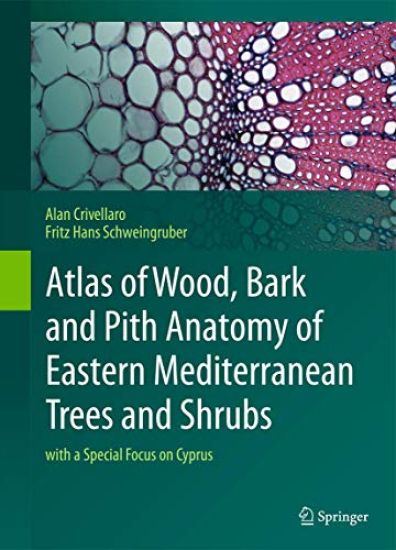
Atlas of Wood, Bark and Pith Anatomy of Eastern Mediterranean Trees and Shrubs

Atlas of Wood, Bark and Pith Anatomy of Eastern Mediterranean Trees and Shrubs

Alan Crivellaro; Fritz Hans Schweingruber

Springer-Verlag Berlin and Heidelberg GmbH Co. K
2013
sidottu
This atlas presents anatomical descriptions of the xylem, bark and pith of 264 species belonging to 71 families. It highlights the anatomical diversity of trees, shrubs, dwarf shrubs, woody lianas and several of the prominent perennial herbs from the Eastern Mediterranean region, with a focus on the island of Cyprus. The island’s topography and biogeographic history combine to provide a wide range of habitats and diverse flora including widespread, endemic, and ornamental species.The monograph for each species includes a description of the anatomical structures of the stem and twig xylem and the twig’s bark and pith, as well as color micrographs of double-stained sections of each of these plant parts. These entries are accompanied by a photograph and a brief description of the plant including stem wood density, height, habit, flower, leaf and fruit characteristics, and a map showing its geographic and altitudinal distribution in the region. Xylem descriptions follow the IAWA lists of microscopic features for hardwood and softwood identification. For bark and pith descriptions, a new coding system developed by the authors is applied. Lastly, the work offers a key for wood identification that was developed to differentiate between groups of species by using a small number of features that are unambiguous and clearly visible. The atlas will be a valuable guide for botanists, ecologists, foresters, archeologists, horticulturists and paleobotanists.
Atlas of Stem Anatomy in Herbs, Shrubs and Trees

Atlas of Stem Anatomy in Herbs, Shrubs and Trees

Fritz Hans Schweingruber; Annett Börner; Ernst-Detlef Schulze

Springer-Verlag Berlin and Heidelberg GmbH Co. K
2012
sidottu
This work, published in two volumes, contains descriptions of the wood and bark anatomies of 3000 dicotyledonous plants of 120 families, highlighting the anatomical and phylogenetic diversity of dicotyledonous plants of the Northern Hemisphere. The first volume principally treats families of the Early Angiosperms, Eudicots, Core Eudicots and Rosids, while the second concentrates on the Asterids. Presented in Volume 2 are microsections of the xylem and phloem of herbs, shrubs and trees of 1000 species and ca. 35 families of various life forms of the temperate zone along altitudinal gradients from the lowland at the Mediterranean coast to the alpine zone in Western Europe. Special attention is given to the very diverse family of Asteraceae. The global perspective of the findings is underlined by the analysis of 400 species from the Caucasus, the Rocky Mountains and Andes, the subtropical zone on the Canary Islands, the arid zones in the Sahara, in Eurasia, Arabia and Southwest North America, New Zealand and the boreal and arctic zones in Eurasia and Canada. The presence of annual rings in all life forms demonstrates that herbs and dwarf shrubs are an excellent tool for the reconstruction of annual biomass production and the interannual dynamic of plant associations. The common principle of the anatomical expression of secondary growth is a key factor in understanding evolution and adaptation processes in all life forms, from the 3 cm tall crepide pigmea (Crepis pygmaea) in the alpine zone to the 40 m tall ash (Fraxinus excelsior) in Central European riparian forests. The study opens vast fields of research for dendrochronology, wood anatomy, taxonomy and ecology.
Atlas of Stem Anatomy in Herbs, Shrubs and Trees

Atlas of Stem Anatomy in Herbs, Shrubs and Trees

Fritz Hans Schweingruber; Annett Börner; Ernst-Detlef Schulze

Springer-Verlag Berlin and Heidelberg GmbH Co. K
2011
sidottu
This work, published in two volumes, contains descriptions of the wood and bark anatomies of 3000 dicotyledonous plants of 120 families, highlighting the anatomical and phylogenetic diversity of dicotyledonous plants of the Northern Hemisphere. The first volume principally treats families of the Early Angiosperms, Eudicots, Core Eudicots and Rosids, while the second concentrates on the Asterids. Presented in Volume 1 are microsections of the xylem and phloem of herbs, shrubs and trees of 1200 species and 85 families of various life forms of the temperate zone along altitudinal gradients from the lowland at the Mediterranean coast to the alpine zone in Western Europe. The global perspective of the findings is underlined by the analysis of 500 species from the Caucasus, the Rocky Mountains and Andes, the subtropical zone on the Canary Islands, the arid zones in the Sahara, in Eurasia, Arabia and Southwest North America, and the boreal and arctic zones in Eurasia and Canada. The presence of annual rings in all life forms demonstrates that herbs and dwarf shrubs are an excellent tool for the reconstruction of annual biomass production and the interannual dynamic of plant associations. The common principle of the anatomical expression of secondary growth is a key factor in understanding evolution and adaptation processes in all life forms, from the 2 cm tall whitlow grass (Draba arctica) in the arctic to the 40 m tall beech (Fagus sylvatica) in Central European managed forests. The study opens vast fields of research for dendrochronology, wood anatomy, taxonomy and ecology.
Wood Structure and Environment

Wood Structure and Environment

Fritz Hans Schweingruber

Springer-Verlag Berlin and Heidelberg GmbH Co. K
2010
nidottu
Dendrochronology and wood anatomy developed for decades as two independent scientific fields. It was only in the last decade that it was made clear that the dimension of time is the fourth dimension for both sciences and that it was demonstrated that wood anatomy and dendrochronology are perfect partners. The main aim of this book is to show the hidden ecological richness in stems and roots from trees, shrubs and herbs. It should encourage researchers to consider the anatomic microcosm of wood plants and use it as a retrospective source of information, solving problems related to ecophysiology, competition, site conditions, population biology, earth science, wood quality and even human history.
Wood Structure and Environment

Wood Structure and Environment

Fritz Hans Schweingruber

Springer-Verlag Berlin and Heidelberg GmbH Co. K
2007
sidottu
Dendrochronology and wood anatomy developed for decades as two independent scientific fields. It was only in the last decade that it was made clear that the dimension of time is the fourth dimension for both sciences and that it was demonstrated that wood anatomy and dendrochronology are perfect partners. The main aim of this book is to show the hidden ecological richness in stems and roots from trees, shrubs and herbs. It should encourage researchers to consider the anatomic microcosm of wood plants and use it as a retrospective source of information, solving problems related to ecophysiology, competition, site conditions, population biology, earth science, wood quality and even human history.
Tree Rings

Tree Rings

Fritz Hans Schweingruber

Springer
1991
nidottu
At a meeting of dendrochronologists an American colleague described the effects of volcanic eruptions on annual ring formation in bristlecone pines. I knew very little about either volcanoes or American pines! At the same meeting European scientists spoke on the dendrochronological dating of lakeshore settlements and the effects of larch bud moth attack on trees in the Alps. It is possible that American participants were not in a position to fully appreciate these papers either. In other words, dendrochronology is an extremely interdisciplinary science; its facets range from modern statistics on wood anatomy to the history of art. It is difficult even for dendrochronol­ ogists to keep in touch with the whole spectrum, and even more difficult for the layman to obtain an overall view of the many methods and fields of application. In recent times specialisation has begun to hinder communication be­ tween the various sectors. Archaeologists, for instance, set up their own dendrochronological laboratories and construct independent chronologies to serve their particular interests. The scientific institutions which previously carried out such work are now turning more and more to strongly statistically or biologically-oriented questions. The full wealth of information contained in tree rings, however, will be revealed only when dendrochronologists make a concerted effort to relate the findings of the different fields. In spite of inevitable specialisation, it is necessary that the expert concern himself with the work of his colleagues.