Kirjojen hintavertailu. Mukana 12 390 323 kirjaa ja 12 kauppaa.
Kirjailija
G E Zaikov
Kirjat ja teokset yhdessä paikassa: 25 kirjaa, julkaisuja vuosilta 1987-2011, suosituimpien joukossa Biometals & Ligands for Anticancer Drug Design. Vertaile teosten hintoja ja tarkista saatavuus suomalaisista kirjakaupoista.
Mukana myös kirjoitusasut: G. E. Zaikov, G.E. Zaikov
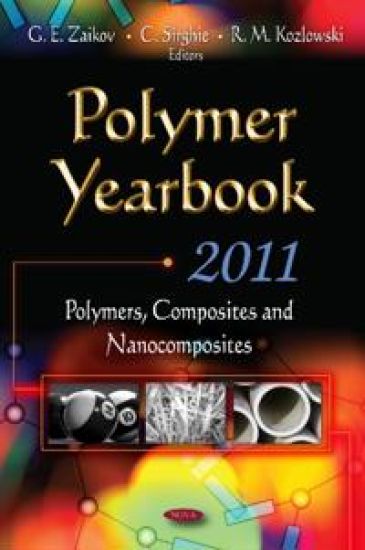
This book examines the chemistry and physical properties of polymers and composites within the framework of chemical kinetics, chemical physics and quantum calculations. Such an approach allows for quantitative estimation and physical treatment of oligomers, polymers and composites on the basis of polymers and filled polymers. In addition, information about calculations of bond energy in cluster aqueous nanostructures, mathematical modelling dependence of thermodynamic characteristics upon spatial-energy parameter of free atoms, exchange spatial-energy interactions and cyclohexane oxidation activated by glyoxal are a few of the topics discussed in this book.
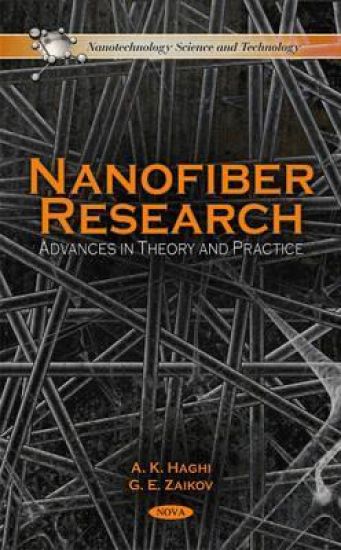
Nanotechnology is revolutionising the world of materials. The research and development of nanofibres has gained much prominence in recent years due to the heightened awareness of its potential applications in the medical, engineering and defence fields. Among the most successful methods for producing nanofibres is the electrospinning process. Electrospinning introduces a new level of versatility and broader range of materials into the micro/nanofibre range. An old technology, electrospinning has been rediscovered, refined, and expanded into non-textile applications. Electrospinning has the unique ability to produce ultrathin fibres from a rich variety of materials that include polymers, inorganic or organic compounds and blends. This book presents some fascinating phenomena associated with the remarkable features of nanofibres in electrospinning processes and new progress in applications of electrospun nanofibres.
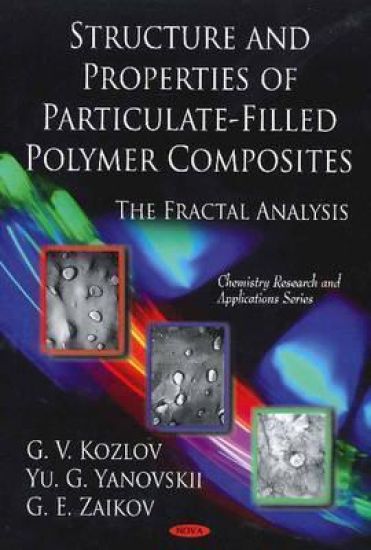
The interest in polymer composites research is due to their enlarged application. Filling with hard particles gives to polymers a number of desirable properties: increases hardness, decreases heat expansion coefficient, improves resistance to creep and fracture toughness. Difficulties in structure-properties relationships researching for polymer composites are due to their structure complexity. Till now, composites studies were conducted within the frameworks of continuum mechanics and thermodynamic conceptions. However, these conceptions applications does not allow satisfactory descriptions nor predictions of such materials properties. As a matter of fact, an experimental data set dictates one or another physical model of structure choice for composites macroscopic properties description.
Cellulose and its derivatives -- cellulose acetate -- are renewed polymers, that, together with the whole complex of valuable and indispensable properties, defines continuous growth of their production. Acetate fibres differ from cellulose fibres in light and thermooxidative stability, as the presence of ester groups decreases stability of molecular structure, owing to which destructive processes begin at much lower temperatures and weak energy effects. Since macromolecules of cellulose acetate are constructed on the basis of cellulose then mechanism of photodestruction of these polymers may be considered as general. The most important energetic factor, which photodestruction of cellulose and its derivatives depend on, is intensity of irradiation and wave length. Destruction of cellulose and its derivatives under atmospheric conditions, proceeding as a result of photochemical reaction, on the whole takes place under the action of ultraviolet rays with ?=200-360 nm. Since cellulose contains three types of chromophore groups -- hydroxyl, acetate and semiacetate and also aldehyde -- then it is considered that light absorption in the region of 250-300 nm is caused just by them. At the same time some authors, bringing the possibility of light absorption by acetal chromophore in question, have put forward the supposition that photochemically active centres in cellulose materials, containing carboxyl and hydroxyl groups, may be molecular complexes between these groups, connected by the system of hydrogen bounds with definite energy of interaction. Disproportion of intermolecular bonds, providing fixation of excited state in cellulose matrix takes place in such complexes at their excitation. Thus, there are many different hypotheses, often contradicting each other, about the effect of chromophore groups on light absorption by cellulose. There are many data about the nature of free-radical particles, being formed at irradiation of cellulose by ultraviolet light. Since, being formed products of phototransformation are highly mobile and easily undergo further transformations, method of electron-paramagnetic resonance (ESP) is one of the most effective for these particles identification. Critical analysis of a great number of works on EPR spectra interpretation is quite fully given in surveys. More than 20 different radicals are being formed at ultraviolet irradiation as a result of break of practically all bonds C-C; C-H; C-O. Main types of macroradicals, with indication of atom and groups of atoms after removal of which these macroradicals are formed, are presented in scheme 1. of this book.
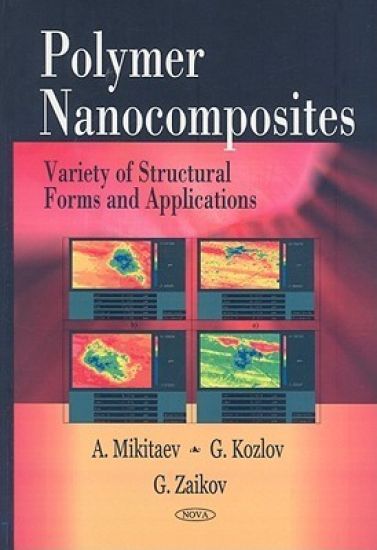
Nanotechnologies development in various directions of science and engineering represents one of the most high-priority problems of modern science. One of such directions is the development and research of polymer nanocomposites with filler from nanoparticles and nanotubes possessing the increased strength and flame-resistance. In the last decade in the world literature a large amount of works have appeared which are dedicated both to technological and fundamental problems of polymer nanocomposites creation. The main part of these works adduced studies of polymer nanocomposites structure and properties, in which as filler organoclays with particles size of nanometre scale (for example, Na+-montmorillonite) were applied as a filler. Key studies in this field mainly use various kinds of modifications of large micromechanical models, created at one time for the description of polymer composites properties in general. These modifications are cumbersome enough, and mainly use complex computer technologies and although with their help convincing enough results were obtained, one should pay attention on their narrowness. In present quite many classes of polymer nanocomposites are obtained, having different reinforcement mechanisms, but the general ones in the sense, that these mechanisms are realised at the expense of introduction in polymer matrix particles of nanometre sizes. As it is known, the main peculiarity of such particles is a sharply increased polymer-filler contact area in comparison with usual fillers of micron scale size, that gives maximum reinforcement effect at small nanofiller contents. Hence it follows, that the main research object in the given case should be interfacial phenomena on polymer matrix-filler boundary, to which Academician Lipatov pointed as long as 40 years ago. Another important postulate is the fractal nature of nanoparticles structure, defining the mentioned above interfacial interactions level. The two postulates mentioned would be the main at the structure and properties of polymer nanocomposites analysis in the present monograph. At the same time the authors do not exlude the application of other model representations, for example, of the mentioned above micromechanical models.The purpose of the present monograph is the research of structure-properties relationships, defining a polymer nanocomposites reinforcement mechanism, for seven different classes of these materials. For these tasks solution the modern physical conceptions: synergetics of solid body, cluster model of polymers amorphous state structure, percolation theory are used.
Since the early investigations by Berthelot (1862) and N.A. Menshutkin (1887) the solvent effects on the chemical reaction rate is an object of regard for chemists. Primarily, solvents were considered as reaction media, and attempts were made to explain solvent effects by pure physical interactions. In recent decades, specific (chemical) interactions between solutes and the medium became of greater attention. Further on, the necessity of combined consideration of all solvation interactions in the solution was highly apprehended. Hence, a solvent may not only solvate the initial reagents and the initial state, but also take active part in its formation. Such consideration may be performed using linear free energy relationships (LFER). Numerical accuracy of the description will depend on adequacy of a formal solvation model which forms the basis of corresponded linear free energy (LFE) equation. At present, Koppel-Palm and Kamlet-Taft models are the most widespread. Corresponded reviews of various models are discussed. However, it should be remembered that these approaches are not the final dogma and are permanently changed and modified.
In the present monograph, theoretical structural analysis of the main processes of gas transport in polymeric materials (diffusion, solubility, permeability and selectivity) was offered. The mentioned analysis uses fractal (multifractal) analysis and cluster model of polymers amorphous state structure, based on the local order notions, as a tool for polymeric materials structure description. Besides, for the mentioned gas transport processes description, such modern physical treatments as a multifractal model of fluctuation free volume and the conception of anomalous (strange) diffusion were used. Such approach allows the quantitative description of gas transport processes and their prediction as a function of testing temperature, degree of crystallinity, cross-linking and grafting, and so on. Special attention is given to gas transport processes in multicomponent polymeric systems. A number of practical aspects of theoretical structural analysis application was considered in cases of thermal degradation, interfacial layers formation in polymer composites, stability to cracking in active environments and chemical reactions.
Fractal analysis gives just general mathematical description of polymers, i.e. it does not identify structural units (elements), from which any real polymer is formed. Physical description of thermodynamically non-equilibrium polymer structure in the framework of the local order ideas gives the cluster model of the polymer amorphous state structure that quantitatively identify its elements. Since these models consider the polymer structure somewhat from two sides, they are excellent completing one another. It is common knowledge that structures displaying fractal behaviour on small length scale and being homogeneous on large length scale are named homogeneous fractals. These fractals are percolation clusters at the percolation threshold. As shown below, the cluster structure represents the percolation system and, due to the above-said, the homogeneous fractal. To put it differently, the presence of the local order in the condensed phase of polymers determines fractality of their structures.
The monograph is devoted to modern methods of calculation and the designing of devices of vortical type providing realisation of effective processes of division and mass transfer. In the book the designs of vortical devices are considered, the available experimental material on research of de-dusters is systematised. Interaction of structure of current of a liquid and gas with design parameter of the device is revealed, the generalised characteristics of hydrodynamics of streams are offered. The extensive experimental material on regimes of movement of a liquid film in the device as empirical dependencies is generalised. Methods of calculation of efficiency mass transfer in devices of the vortical type, taking into account aerohydrodynamical laws of stream of gas and a liquid are offered. Results of the work can be used development and designing of vortical devices for processes for dust separation.
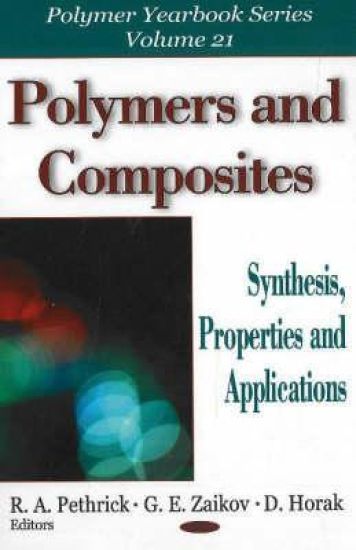
Book & CD. This book aims to present the progress in the science of polymers and monomer, synthesis, study of properties and application of polymers, polymer mixtures, composites and filled polymers. The book collects original articles and reviews important for both pure and applied chemistry. The application of polymers in medicine, composites and nanocomposites, reduction of polymer material combustibility, kinetics and the mechanism of various reactions are of special attention. Both synthetic and natural polymers are discussed. Some part of the collection, related to chemistry and physics of polymers, is devoted to oligomers and low-molecular compounds. This book brings together new and exciting research in this field.
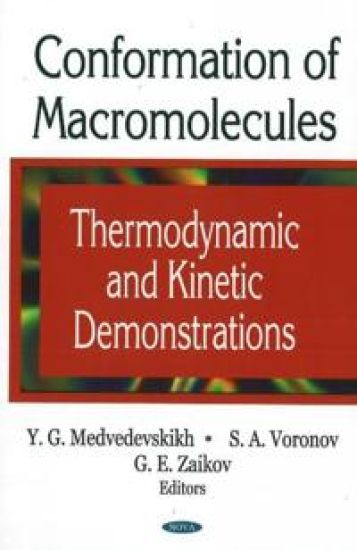
Conformation is statistical property of the macromolecules consisting of a number of N structural units, links, position of which in a space one relatively to other is not inflexibly fixed by chemical bonds and assumes the possible random configurations. The number of possible configurations at N >> 1 is so great that permits to use the statistical methods at their analysis. That is why the conformation is a result of statistical averaging on all possible configurations of the macromolecule. It was for a long time notified and confirmed by computer modelling that the conformation of polymeric chain should be described by self-avoiding random walks statistics (SARW) but not Gaussian random walks statistics, assuming the phantom behaviour of polymeric chains. Nevertheless, Gaussian statistics is dominating at the analysis of thermodynamic, dynamic and kinetic stainings of the macromolecules conformation. This book will be useful for scientists who are engaged in the physical chemistry of polymers and their solutions.
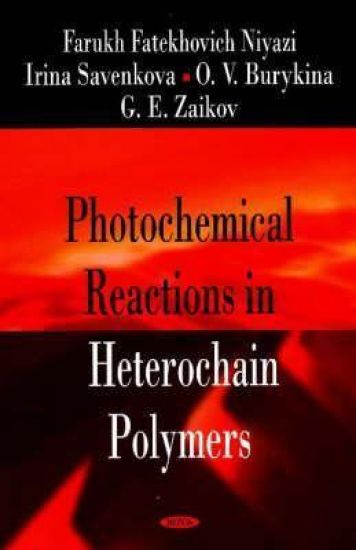
Photochemical reactions are the main class of chemical processes. These processes provide for life on Earth, since due to photochemical processes, plants absorb carbon oxide from the atmosphere changing them into the "meal" for all creatures on Earth. Together with "good" photochemical processes there are some "bad" as well. This book is about photodestruction and light stabilisation and is devoted to these processes. For example, the heterochain polymers. They are the main class of large-tonnage polymers, which are used for manning a great variety of polymer and composite materials (including nanocomposites).
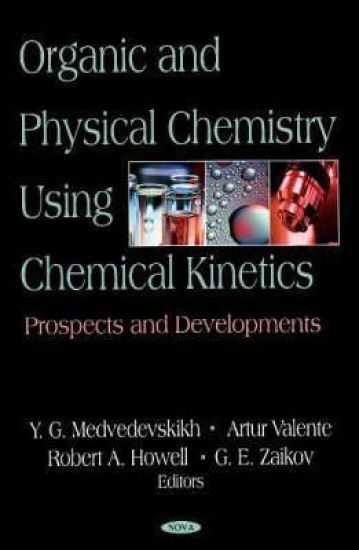
This collection examines the influence of liquid and solid states during radical, ionic, and molecular reactions, specifically how cage effect, diffusion hindrance, donor-acceptor interaction, electrostatic interaction, dispersion forces and other factors affect the rates, mechanism, and direction of chemical reactions. Topics of the 11 papers include spherical hydrogel particles for endovascular embolisation, the synthesis and thermal degradation of phenolic resins, mono-molecular chain termination in dimethacrylate postpolymerisation, and calculating the effect of chain deformation on macromolecule scission. Most of the researchers work in Russia.