

Kirjailija
G. Evans
Kirjat ja teokset yhdessä paikassa: 8 kirjaa, julkaisuja vuosilta 1999-2025, suosituimpien joukossa Within the Gates. Vertaile teosten hintoja ja tarkista saatavuus suomalaisista kirjakaupoista.
Mukana myös kirjoitusasut: G Evans
8 kirjaa
Kirjojen julkaisuhaarukka 1999-2025.


Reprint of the original, first published in 1871.

Reprint of the original, first published in 1871.

Tsvet - eto lish osobennost vosprijatija glazom raznykh voln sveta. Ili net? My okruzheny nastojaschim bujstvom krasok, my znaem ogromnoe kolichestvo tsvetov i razlichaem desjatki ottenkov. I slozhno predstavit, chto kogda-to vse bylo po-drugomu. Khudozhniki vsju zhizn mogli iskat sposob poluchit idealnyj sinij, a tem vremenem v nekotorykh stranakh ne suschestvovalo dazhe ponjatija "sinij tsvet", on schitalsja lish ottenkom zelenogo. My privykli k assotsiatsii rozovogo kak tsveta dlja devochek, a vsego neskolko desjatiletij nazad izvestnyj bokser pokupal sebe rozovyj kabriolet, i nikto ne nakhodil eto smeshnym ili strannym. Nashe otnoshenie k tsvetu est sovokupnost assotsiatsij i traditsij, kotorye formirovalis na protjazhenii mnogikh tysjacheletij. Khotja nekotorye iz nikh zakrepilis otnositelno nedavno. Iz etoj knigi vy uznaete: pochemu dlja taksi vybrali zheltyj; pochemu v odnikh kulturakh belyj simvoliziruet chistotu, a v drugikh - smert; pochemu v odnikh stranakh tsvet revnosti - zelenyj, a v drugikh - krasnyj? Okunites v jarkuju istoriju mira!
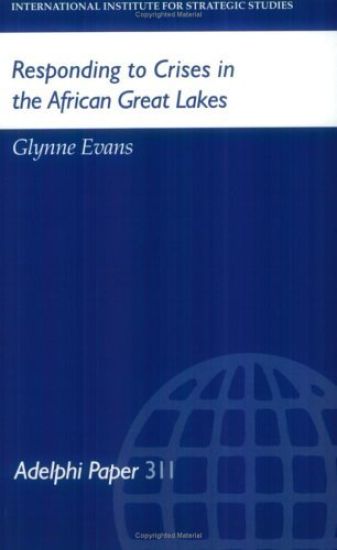
Examines the international responses to the ethnic conflicts in Burundi and Rwanda from 1993-1997 and their overspill into Zaire. Concludes that the external reaction was impotent and incoherent, and urges a number of changes in response by the international community.
Analytic Methods for Partial Differential Equations
G. Evans; J. Blackledge; P. Yardley
Springer-Verlag Berlin and Heidelberg GmbH Co. K
1999
nidottu
The subject of partial differential equations holds an exciting and special position in mathematics. Partial differential equations were not consciously created as a subject but emerged in the 18th century as ordinary differential equations failed to describe the physical principles being studied. The subject was originally developed by the major names of mathematics, in particular, Leonard Euler and Joseph-Louis Lagrange who studied waves on strings; Daniel Bernoulli and Euler who considered potential theory, with later developments by Adrien-Marie Legendre and Pierre-Simon Laplace; and Joseph Fourier's famous work on series expansions for the heat equation. Many of the greatest advances in modern science have been based on discovering the underlying partial differential equation for the process in question. J ames Clerk Maxwell, for example, put electricity and magnetism into a unified theory by estab lishing Maxwell's equations for electromagnetic theory, which gave solutions for problems in radio wave propagation, the diffraction of light and X-ray developments. Schrodinger's equation for quantum mechankal processes at the atomic level leads to experimentally verifiable results which have changed the face of atomic physics and chemistry in the 20th century. In fluid mechanics, the Navier-Stokes' equations form a basis for huge number-crunching activities associated with such widely disparate topics as weather forcasting and the design of supersonic aircraft. Inevitably the study of partial differential equations is a large undertaking, and falls into several areas of mathematics.
Numerical Methods for Partial Differential Equations
G. Evans; J. Blackledge; P. Yardley
Springer-Verlag Berlin and Heidelberg GmbH Co. K
1999
nidottu
The subject of partial differential equations holds an exciting and special position in mathematics. Partial differential equations were not consciously created as a subject but emerged in the 18th century as ordinary differential equations failed to describe the physical principles being studied. The subject was originally developed by the major names of mathematics, in particular, Leonard Euler and Joseph-Louis Lagrange who studied waves on strings; Daniel Bernoulli and Euler who considered potential theory, with later developments by Adrien-Marie Legendre and Pierre-Simon Laplace; and Joseph Fourier's famous work on series expansions for the heat equation. Many of the greatest advances in modern science have been based on discovering the underlying partial differential equation for the process in question. James Clerk Maxwell, for example, put electricity and magnetism into a unified theory by establishing Maxwell's equations for electromagnetic theory, which gave solutions for prob lems in radio wave propagation, the diffraction of light and X-ray developments. Schrodinger's equation for quantum mechanical processes at the atomic level leads to experimentally verifiable results which have changed the face of atomic physics and chemistry in the 20th century. In fluid mechanics, the Navier Stokes' equations form a basis for huge number-crunching activities associated with such widely disparate topics as weather forecasting and the design of supersonic aircraft. Inevitably the study of partial differential equations is a large undertaking, and falls into several areas of mathematics.