

Kirjailija
G. K. Chesterton
Kirjat ja teokset yhdessä paikassa: 2 004 kirjaa, julkaisuja vuosilta 1900-2026, suosituimpien joukossa A Miscellany of Poems by G. K. Chesterton. Vertaile teosten hintoja ja tarkista saatavuus suomalaisista kirjakaupoista.
Mukana myös kirjoitusasut: G K Chesterton, G.K. Chesterton, G.K Chesterton, G. K Chesterton
2 004 kirjaa
Kirjojen julkaisuhaarukka 1900-2026.

A Chesterton Calendar; Compiled from the writings of 'G.K.C.' both in verse and in prose. With a section apart for the moveable feasts.
G K Chesterton
ALPHA EDITION
2021
pokkari
A miscellany of men, By: G. K. Chesterton ( Speculative fiction ): Miscellany of Men is Chesterton at his most versatile and vibrant, defending
G. K. Chesterton
Createspace Independent Publishing Platform
2016
nidottu
Covering topics ranging from literature to philosophy, history to social criticism, this is a snapshot of thought on 20th-century Europe (and the world) by one of Europe's sharpest wits and ablest pens. With chapter titles ranging from "The Miser and His Friends" to "The Red Reactionary," from "The Separatist and Sacred Things" to "The New Theologian" and "The Romantic in the Rain," this volume includes 39 brief sketches of individuals, each one of whom illustrates an aspect of contemporary society. Social, historical, and religious thought all figure prominently in this book, making it of great use in any study of the literary, religious, and social aspects of early 20th-century England and Europe generally. It will be of interest to students and scholars of the essay in English literature. It is a fine introduction to Chesterton's social criticism, which remains unique for its willingness to criticize some of the uncomfortable truths about capitalism without straying toward an inhuman bureaucratic socialism........... Gilbert Keith Chesterton(29 May 1874 - 14 June 1936), better known as G. K. Chesterton, was an English writer, poet, philosopher, dramatist, journalist, orator, lay theologian, biographer, and literary and art critic. Chesterton is often referred to as the "prince of paradox." 3] Time magazine has observed of his writing style: "Whenever possible Chesterton made his points with popular sayings, proverbs, allegories-first carefully turning them inside out." Chesterton is well known for his fictional priest-detective Father Brown, and for his reasoned apologetics. Even some of those who disagree with him have recognised the wide appeal of such works as Orthodoxy and The Everlasting Man.Chesterton, as a political thinker, cast aspersions on both Progressivism and Conservatism, saying, "The whole modern world has divided itself into Conservatives and Progressives. The business of Progressives is to go on making mistakes. The business of the Conservatives is to prevent the mistakes from being corrected."Chesterton routinely referred to himself as an "orthodox" Christian, and came to identify this position more and more with Catholicism, eventually converting to Catholicism from High Church Anglicanism. George Bernard Shaw, Chesterton's "friendly enemy" according to Time, said of him, "He was a man of colossal genius."Biographers have identified him as a successor to such Victorian authors as Matthew Arnold, Thomas Carlyle, Cardinal John Henry Newman, and John Ruskin

A Year with G. K. Chesterton
Kevin Charles (EDT) Belmonte; G. K. Chesterton
Thomas Nelson Publishers
2012
pokkari
"A Year with G.K. Chesterton will be a treasure, both for those who are coming to his wit and wisdom as a fresh discovery, and for those who have known and loved his work for years...Chesterton's talent for paradox, and his ability to embody profound truth in simple images, makes him as compelling now as he was a hundred years ago...He was a prophet in his own time and a prophet for ours, speaking out against insidious evils and kindling us all again to a common love of the common good." -The Reverend Dr. Malcolm Guite, chaplain of Girton College, Cambridge University "This world of ours has some purpose; and if there is a purpose, there is a Person. I had always felt life first as a story: and if there is a story, there is a Storyteller." -G. K. Chesterton A Year with G. K. Chesterton daily brings this truth to life. And we are heir to the winsome, arresting, utterly original outpouring of Chesterton's reasons for hope. During his lifetime, a host of perspectives clamored for his attention, but he saw nothing as vital and alive as Christianity.Readers of this book will find their faith strengthened and enriched, even as they see the many reasons why George Bernard Shaw called Chesterton "a colossal genius." A true anthology, the best of Chesterton's many works are presented in concise, memorable selections. From New Year's Day to New Year's Eve, each page contains a passage of Scripture and myriad moments for reflection, appreciation, and laughter. "Chesterton once a day? Well, that's a start. It is good to see that someone is finally recognizing the need for a daily minimum requirement of mirth and meditation from GKC." -Dale Ahlquist, President, American Chesterton Society "Kevin Belmonte writes in the preface to this excellent book that his editing of it has been a gift. As an author who has written regularly on Chesterton I can understand his sense of gratitude at having been able to spend so much time with a genius as genial as the great GKC. Thanks to Belmonte's labor of love we can all spend a few moments of every day of the year in Chesterton's inimitable company. All admirers of Chesterton and the Christian truth he explicates so sublimely will be grateful to Kevin Belmonte for this gem of a gift."-Joseph Pearce, author of Wisdom and Innocence: A Life of G. K. Chesterton "Who could not be grateful for a year spent with GKC? The great subverter of everything taken for granted, he stretches and deepens us with his insights, shakes us with his startling paradoxes and delights us with his wit. Thank God there is no getting to the end of Chesterton." -Os Guinness, author of A Free People's Suicide

A Miscellany of Men (1912) by G.K. Chesterton (World's Classics)
G. K. Chesterton
Createspace Independent Publishing Platform
2016
nidottu
A Short History of England by G. K. Chesterton (1917)
G. K. Chesterton
Createspace Independent Publishing Platform
2015
nidottu
Bread and Wine
C.S. Lewis; G.K. Chesterton; Philip Yancey; Frederick Buechner; Madeleine L'Engle; Henri J. M. Nouwen; Dorothy Day; Kathleen Norris; Meister Eckhart; Kahlil Gibran; Søren Kierkegaard
PLOUGH PUBLISHING HOUSE
2014
nidottu
Though Easter (like Christmas) is often trivialized by the culture at large, it is still the high point of the religious calendar for millions of people around the world. And for most of them, there can be no Easter without Lent, the season that leads up to it. A time for self-denial, soul-searching, and spiritual preparation, Lent is traditionally observed by daily reading and reflection. This collection will satisfy the growing hunger for meaningful and accessible devotions. Culled from the wealth of twenty centuries, the selections in Bread and Wine are ecumenical in scope, and represent the best classic and contemporary Christian writers. Includes more than seventy Lenten and Easter readings by Alexander Stuart Baillie, Alfred Kazin, Alister E. McGrath, Amy Carmichael, Barbara Brown Taylor, Barbara Cawthorne Crafton, Blaise Pascal, Brennan Manning, C. S. Lewis, Christina Rossetti, Christoph Friedrich Blumhardt, Clarence Jordan, Dag Hammarskjöld, Dale Aukerman, Dietrich Bonhoeffer, Dorothee Soelle, Dorothy Day, Dorothy Sayers, Dylan Thomas, E. Stanley Jones, Eberhard Arnold, Edith Stein, Edna Hong, Emil Brunner, Ernesto Cardenal, Fleming Rutledge, Frederica Mathewes-Green, Frederick Buechner, Fyodor Dostoevsky, G. K. Chesterton, Geoffrey Hill, George MacDonald, Henri Nouwen, Henry Drummond, Howard Hageman, J. Heinrich Arnold, Jean-Pierre de Caussade, Johann Christoph Arnold, John Dear, John Donne, John Howard Yoder, John Masefield, John Stott, John Updike, Joyce Hollyday, Jürgen Moltmann, Kahlil Gibran, Karl Barth, Kathleen Norris, Leo Tolstoy, Madeleine L’Engle, Malcolm Muggeridge, Martin Luther, Meister Eckhart, Morton T. Kelsey, Mother Teresa, N. T. Wright, Oscar Wilde, Oswald Chambers, Paul Tillich, Peter Kreeft, Philip Berrigan, Philip Yancey, Romano Guardini, Sadhu Sundar Singh , Saint Augustine, Simone Weil, Søren Kierkegaard, Thomas à Kempis , Thomas Howard, Thomas Merton, Toyohiko Kagawa, Walter J. Ciszek, Walter Wangerin, Watchman Nee, Wendell Berry and William Willimon.

A Short History of England by G. K. Chesterton, History, Europe, Great Britain
G K Chesterton
Aegypan
2008
pokkari

A short history of England (1917). By: G. K. Chesterton: Great Britain -- History
G. K. Chesterton
Createspace Independent Publishing Platform
2016
nidottu


Trial of John Jasper, Lay Precentor of Cloisterham Cathedral in the County of Kent, for the Murder of Edwin Drood, Engineer
England) Dickens Fellowship (London; G K Chesterton; J W T (James William Thomas) Ley
Anson Street Press
2025
pokkari

In Defense Of Sanity: The Best Essays of G.K. Chesterton
G K Chesterton
Happy Hour Books
2023
sidottu
"In Defense of Sanity: The Best Essays of G.K. Chesterton" is a captivating collection of G.K. Chesterton's most insightful and witty essays. Covering a wide range of topics, from literature to faith and politics, Chesterton's timeless wisdom shines through. These essays offer a refreshing perspective on the complexities of the modern world, championing traditional values and common sense. With humor and clarity, Chesterton's work continues to inspire and challenge readers to embrace enduring truths in a fast-paced world.


Heretics: (G.K. Chesterton Classics Collection)
G. K. Chesterton
Createspace Independent Publishing Platform
2015
nidottu
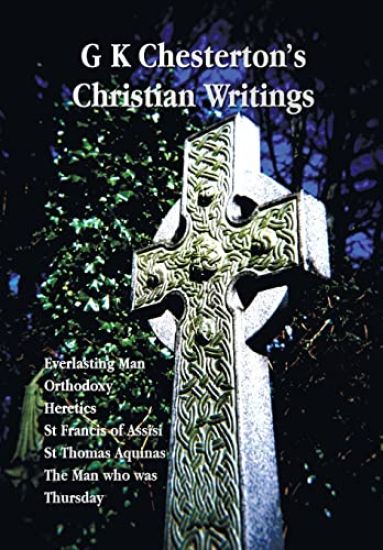
This Omnibus edition of g K Chesterton's writings includes the following complete and unabridged classic books: The Everlasting Man. What makes the human uniquely human? This is the question that G.K. Chesterton starts with in this exploration of human history. Chesterton responds to H.G. Wells, affirming the uniqueness of being human and the message of the Christian faith. Chesterton refutes the idea of Social Darwinism, which claims that we have been gradually evolving from the barbaric to the civilised state we currently find ourselves in. He sees Christianity as a blend of reason and story, which satisfies both the mind and the heart. Orthodoxy. Chesterton explores ""right thinking"" and explains how it led him to come to faith. This is a very personal account of his conversion, but Chesterton makes it clear that for him it was as a result of his scholarly examination of Christianity's arguments. Heretics. Chesterton is at his very witty best in this collection of twenty articles. He focussed his brilliant mind on ""heretics"", prominent figures who Chesterton considers theologically wrong, including Kipling, Shaw, Wells, and Whistler. St Francis of Assisi. Francis of Assisi is without doubt on of the greatest saints, and hugely influential in human history. This biography by G. K. Chesterton is considered to be the greatest tribute to this great man's life and one that fully appreciates what St Francis offered to humanity. St Thomas Aquinas. This Biography of St Thomas Aquinas ranks as one of the best books ever written on the life and thought of this great saint. Aquinas was shy and dubbed ""the Dumb Ox"" by his classmates. Little did they know that he was an unparalleled genius and would revolutionise Christian thought. The Man who was Thursday. This book is included because like much of G. K. Chesterton's fiction, it is full of Christian allegory. This is a true masterpiece, a psychological thriller that weaves its way around seven anarchists who are called by the names of the days of the week. The aim of the book is to expose moral relativism and nihilism for the evil that they are.
This Omnibus edition of g K Chesterton's writings includes the following complete and unabridged classic books: The Everlasting Man. What makes the human uniquely human? This is the question that G.K. Chesterton starts with in this exploration of human history. Chesterton responds to H.G. Wells, affirming the uniqueness of being human and the message of the Christian faith. Chesterton refutes the idea of Social Darwinism, which claims that we have been gradually evolving from the barbaric to the civilised state we currently find ourselves in. He sees Christianity as a blend of reason and story, which satisfies both the mind and the heart. Orthodoxy. Chesterton explores "right thinking" and explains how it led him to come to faith. This is a very personal account of his conversion, but Chesterton makes it clear that for him it was as a result of his scholarly examination of Christianity's arguments. Heretics. Chesterton is at his very witty best in this collection of twenty articles. He focussed his brilliant mind on "heretics", prominent figures who Chesterton considers theologically wrong, including Kipling, Shaw, Wells, and Whistler. St Francis of Assisi. Francis of Assisi is without doubt on of the greatest saints, and hugely influential in human history. This biography by G. K. Chesterton is considered to be the greatest tribute to this great man's life and one that fully appreciates what St Francis offered to humanity. St Thomas Aquinas. This Biography of St Thomas Aquinas ranks as one of the best books ever written on the life and thought of this great saint. Aquinas was shy and dubbed "the Dumb Ox" by his classmates. Little did they know that he was an unparalleled genius and would revolutionise Christian thought. The Man who was Thursday. This book is included because like much of G. K. Chesterton's fiction, it is full of Christian allegory. This is a true masterpiece, a psychological thriller that weaves its way around seven anarchists who are called by the names of the days of the week. The aim of the book is to expose moral relativism and nihilism for the evil that they are.

G.K.Chesterton (1874-1936), was one of the great Catholic writers of the twentieth century. He brought a distinctive Catholic perspective to scores of books and articles - even to the genre of detective novels in the famous Father Brown mysteries. As this collection shows, Chestertons writing contains a spiritual dimension. In his ability to combine matters of great seriousness with great humour the contours of his distinctive and "paradoxical" spirituality emerge.