Kirjojen hintavertailu. Mukana 12 595 353 kirjaa ja 12 kauppaa.

Kirjailija

G.V Efimov

Kirjat ja teokset yhdessä paikassa: 2 kirjaa, julkaisuja vuosilta 1993-2014, suosituimpien joukossa The Quark Confinement Model of Hadrons. Vertaile teosten hintoja ja tarkista saatavuus suomalaisista kirjakaupoista.

Mukana myös kirjoitusasut: G.V. Efimov

2 kirjaa

Kirjojen julkaisuhaarukka 1993-2014.

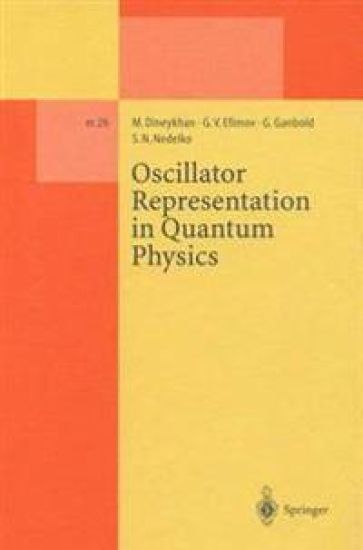
Oscillator Representation in Quantum Physics

Oscillator Representation in Quantum Physics

M. Dineykhan; G.V. Efimov; G. Ganbold; S.N. Nedelko

Springer-Verlag Berlin and Heidelberg GmbH Co. K
2014
nidottu
The investigation ofmost problems of quantum physics leads to the solution of the Schrodinger equation with an appropriate interaction Hamiltonian or potential. However, the exact solutions are known for rather a restricted set of potentials, so that the standard eternal problem that faces us is to find the best effective approximation to the exact solution of the Schrodinger equation under consideration. In the most general form, this problem can be formulated as follows. Let a total Hamiltonian H describing a relativistic (quantum field theory) or a nonrelativistic (quantum mechanics) system be given. Our problem is to solve the Schrodinger equation Hlft = Enlftn, n i. e. , to find the energy spectrum {En} and the proper wave functions {lft } n including the'ground state or vacuum lft = 10). The main idea of any ap­ o proximation technique is to find a decomposition in such a way that Ha describes our physical system in the "closest to H" manner, and the Schrodinger equation HolJt. (O) = E(O)lJt. (O) n n n can be solved exactly. The interaction Hamiltonian HI is supposed to give small corrections to the zero approximation which can be calculated. In this book, we shall consider the problem of a strong coupling regime in quantum field theory, calculations ofpath or functional integrals over the Gaussian measure and spectral problems in quantum mechanics. Let us con­ sider these problems briefly.
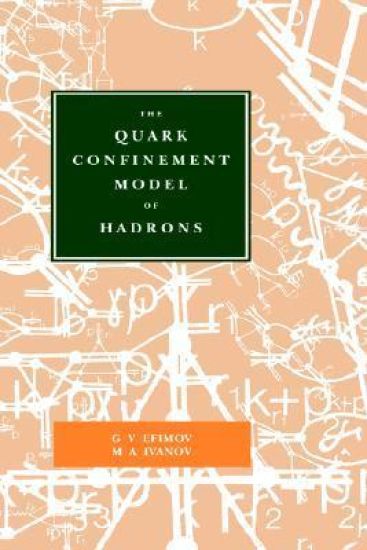
The Quark Confinement Model of Hadrons

The Quark Confinement Model of Hadrons

G.V Efimov; M.A Ivanov

Institute of Physics Publishing
1993
sidottu
Filling the gap in the literature on low-energy quark models, The Quark Confinement Model of Hadrons investigates confinement effects in the low-energy regions of particle physics using the methods of nonlocal quantum field theory. It also elucidates their role in describing microscopic quantities that characterize hadron-hadron interactions. The authors present a quark confinement model to describe the low-energy physics of light hadrons. Hadrons are treated as collective colorless excitations of quark-gluon interactions while the quark confinement is to be provided by averaging over gluon backgrounds. The model is shown to reproduce the low-energy relations of chiral theory in the case of null momenta and, in addition, allow the researcher to obtain more sophisticated hadron characteristics, such as slope parameters and form factors. Presenting a unified view on a number of low-energy phenomena, The Quark Confinement Model of Hadrons enables an understanding of problems related to the treatment of large distances within quantum chromodynamics.