
Kirjailija
G. Wayne Miller
Kirjat ja teokset yhdessä paikassa: 10 kirjaa, julkaisuja vuosilta 2001-2026, suosituimpien joukossa Drowned. Vertaile teosten hintoja ja tarkista saatavuus suomalaisista kirjakaupoista.
Mukana myös kirjoitusasut: G Wayne Miller
10 kirjaa
Kirjojen julkaisuhaarukka 2001-2026.


What happens when SuperGoodMedia, a ridiculous out-of-town newspaper chain buys the venerable Boston Daily Tribune, which has published every day since 1823? Heads roll and the few journalists left wonder when it will be their turn. That's protagonist Nick Nolan's worry, too - until he gets exclusive coverage of a single mother who claims that the Virgin Mary is speaking to the world through her young comatose daughter. Nolan not only keeps his job but becomes an international celebrity as The Tribune's circulation soars, advertisers bring record revenues, SuperGoodMedia negotiates lucrative movie and TV contracts, and circus-like crowds of thousands gather outside the single mother's home, awaiting miracles as the pope plans to visit... and a secret disaster looms. Enter Benjamin Franklin, Founding Father and early pillar of the American press. Appearing to Nolan in dreams, Franklin offers a brutal critique of much of today's media, when real-life hedge funds and chains gut and close local newspapers, creating an unprecedented threat to American democracy. Franklin also prompts Nolan's eventual crisis of conscience, which leads to his redemption and an initiative that might help save local journalism while furthering social-justice causes. By turns dramatic, fantastical, and darkly comedic, "Unfit to Print" is a scathing indictment of today's media by G. Wayne Miller, author and multiple award-winning journalist for four decades, most of them at the Pulitzer Prize-winning Providence Journal, oldest continuously published newspaper in the U.S. "Unfit to Print" is also a keen commentary on today's politics and culture, when so many get their "news" from social media, misinformation from domestic and foreign sources distorts truth, and reporters are disparaged as enemies of the people. But why a novel and not a memoir or expos ? Because as Ralph Waldo Emerson is purported to have said, "fiction reveals truth that reality obscures."

Toy Wars: The Epic Struggle Between G.I. Joe, Barbie and the Companies That Make Them
G. Wayne Miller
Independently Published
2019
nidottu
This is the real toy story, an unprecedented behind-the-scenes journey through a world of influence, fantasy, and multimillion-dollar Hollywood deals, a world where the whims of children make millionaires and topple titans.This is also the story of an unusual man. Alan Hassenfeld, the chief executive officer of Hasbro, never intended to run a Fortune 500 company. A free spirit who dreamed of being a writer and exploring Asia, he was content to remain in the shadow of his older brother Stephen, a marketing genius who transformed a family firm established by immigrant Jews into powerhouse and Wall Street darling.Then tragedy struck. Stephen, and intensely private man, died of AIDS, a disease he had not acknowledged he had, even to his family. Alan Hassenfeld was named CEO, just as Hasbro was facing a daunting onslaught of challenges. Toy Wars is about Alan's struggle to balance the demands of the bottom line with his ideals about the kind of toys children deserve, as well as the ethical obligations of management.Wayne Miller, an award-winning journalist and novelist, was granted unprecedented access to Hasbro, the maker of G.I. Joe, Star Wars toys, Mr. Potato Head, Batman, Monopoly, Scrabble, Trivial Pursuit, and countless other favorites. For five years, he sat in on design sessions, marketing meetings, and focus groups, and interviewed employees in every part of the company. He witnessed a major corporate restructuring; crucial deal with Dreamworks SKG; a hostile takeover bid by archrival Mattel; the collapse of a $45 million virtual reality game; and the company makeover of G.I. Joe, Hasbro's flagship product and one of the most popular toys of all time.Toy Wars is filled with many colorful characters, including: Hollywood moguls Steven Spielberg and George Lucas, whose kid-friendly movies can translate into licensing gold for toymakersMighty Morphin Power Rangers creator Haim Saban, who tapped into a popular Japanese TV series and made it a worldwide television and merchandising phenomenonMattel CEO Jill Barad, the second-highest-paid woman in corporate America, who promotes and defends Barbie with the zeal of a religious crusaderHasbro executive Al Verrecchia, the loyal second in command who did not let friendship or tradition stand in the way of a dramatic restructuringLarry Bernstein, arguably the best toy salesman ever, a riotous raconteur whose divisional presidency crumbled when he was unable to meet Hasbro's profit goalsRich in family drama and written with sly wit, Toy Wars is a deeply compelling business story, a fascinating tour through a billion-dollar industry that exerts tremendous influence on the lives of children everywhere.

Before the Big Three," even before the Model T, the race for dominance in the American car market was fierce, fast, and sometimes farcical. Car Crazy takes readers back to the passionate and reckless years of the early automobile era, from 1893, when the first US-built auto was introduced, through 1908, when General Motors was founded and Ford's Model T went on the market. The motorcar was new, paved roads few, and devotees of this exciting and unregulated technology battled with citizens who considered the car a dangerous scourge, wrought by the wealthy, that was shattering a more peaceful way of life.Among the pioneering competitors were Ransom E. Olds, founder of Olds Motor Works and creator of a new company called REO Olds' cutthroat new CEO Frederic L. Smith William C. Billy" Durant of Buick Motor Company (and soon General Motors) and inventor Henry Ford. They shared a passion for innovation, both mechanical and entrepreneurial, but their maniacal pursuit of market share would also involve legal manipulation, vicious smear campaigns, and zany publicity stunts,including a wild transcontinental car race that transfixed the public. Their war on wheels ultimately culminated in a courtroom battle that would shape the American car industry forever.Based on extensive original research, Car Crazy is a page-turning story of popular culture, business, and sport at the dawn of the twentieth century, filled with compelling, larger-than-life characters, each an American original.
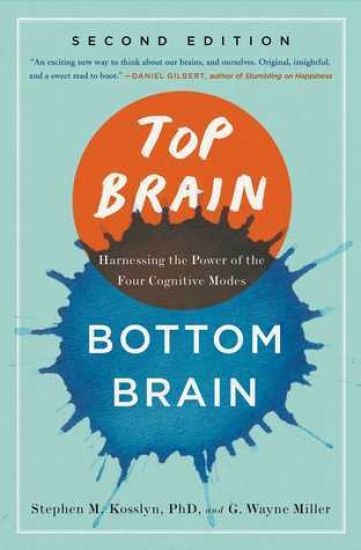
One of the world's leading neuroscientists teams up with an accomplished writer to debunk the popular left-brain/right-brain theory and offer an exciting new way of thinking about our minds.For the past fifty years, popular culture has led us to believe in the left-brain vs. right-brain theory of personality types. Right-brain people, we've been told, are artistic, intuitive, and thoughtful, while left-brain people tend to be more analytical, logical, and objective. It would be an illuminating theory if it did not have one major drawback: It is simply not supported by science. Dr. Stephen M. Kosslyn, who Steven Pinker calls "one of the world's great cognitive neuroscientists," explains with cowriter G. Wayne Miller an exciting new theory of the brain. Presenting extensive research in an inviting and accessible way, Kosslyn and Miller describe how the human brain uses patterns of thought that can be identified and understood through four modes of thinking: Mover, Perceiver, Stimulator, and Adaptor. Once you've identified your usual mode of thought, the practical applications are limitless, from how you work with others when you conduct business, to your personal relationships, to your voyage of self-discovery. The second edition of Top Brain, Bottom Brain includes expanded practical applications and highlights how readers can harness the theory to succeed in their own lives.

What is it that makes a man strap himself into an automobile and drive it hundreds of laps around a track at speeds surpassing 200 miles per hour? Critically acclaimed journalist G. Wayne Miller decided to find out by spending a year on the NASCAR circuit with Roush Racing's legendary owner Jack Roush and his four title-contending Winston Cup drivers: Mark Martin, Jeff Burton, Matt Kenseth, and Kurt Busch. Miller plumbs the allure of speed and the exploding popularity of stock-car racing through the dramatic 2001 season, which opened with the most famous Daytona 500 in history, when NASCAR legend Dale Earnhardt died as his car slammed into the wall on the final turn. Miller takes us inside the minds and behind the wheels of the of the hottest drivers of the past two seasons, as they cope with the thrills and the dangers along the way to the Cup. Miller also takes us inside Roush Racing, a 125 million business, showing a side of NASCAR that few fans ever get to see. For longtime fans and curious newcomers alike, Men and Speed takes you for a wild ride through the fastest sport in the land.