Kirjojen hintavertailu. Mukana 12 595 353 kirjaa ja 12 kauppaa.
Kirjailija
Gabriele Diewald
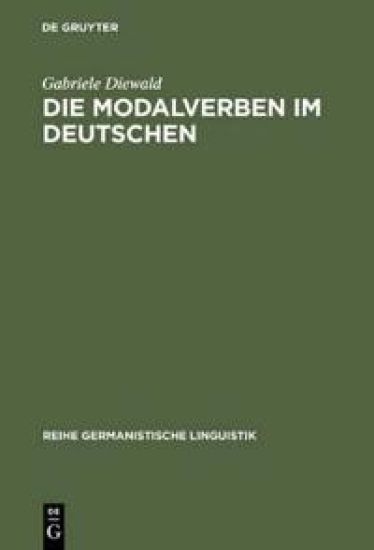
Kirjat ja teokset yhdessä paikassa: 7 kirjaa, julkaisuja vuosilta 1997-2023, suosituimpien joukossa Die Modalverben im Deutschen. Vertaile teosten hintoja ja tarkista saatavuus suomalaisista kirjakaupoista.
The volume discusses the breadth of applications for an extended notion of paradigm. Paradigms in this sense are not only tools of morphological description but constitute the inherent structure of grammar. Grammatical paradigms are structural sets forming holistic, semiotic structures with an informational value of their own. We argue that as such, paradigms are a part of speaker knowledge and provide necessary structuring for grammaticalization processes. The papers discuss theoretical as well as conceptual questions and explore different domains of grammatical phenomena, ranging from grammaticalization, morphology, and cognitive semantics to modality, aiming to illustrate what the concept of grammatical paradigms can and cannot (yet) explain.
This book is a comprehensive study of the evidential system in German. It presents a systematic description of the encoding of evidentiality in present-day German, as well as a diachronic reconstruction of the relevant sources and paths of grammaticalization from the Old High German period onwards. Based on empirical corpus research, the study investigates the degree of grammaticalization of each single evidential construction and the make-up of the present-day system as well as the diachronic stages that lead to the present state. The book focuses on three main issues. First, it is concerned with the general notion of evidentiality, its deictic character, and with the interrelations between the domains of evidentiality and epistemic modality. Second, the book presents the results of the synchronic corpus-based analysis of the German evidential periphrastic constructions werden 'become' + infinitive, scheinen 'seem', drohen 'threaten', versprechen 'promise' + zu 'to'- infinitive, which constitute a paradigm for coding evidentiality in Present Day German. Third, the diachronic development of the evidential constructions is represented as a complex grammaticalization process, interacting with the development of modal constructions and leading to a highly differentiated category of modal and evidential distinctions in the grammar of German.
Die verschiedenen Funktionen der Modalverben dürfen, können, mögen, müssen, sollen und wollen werden im Rahmen der Grammatikalisierungstheorie untersucht, wobei sowohl das synchrone System als auch seine diachrone Entwicklung berücksichtigt werden. Im Zentrum des Interesses steht die im Laufe der Sprachgeschichte des Deutschen erfolgte Grammatikalisierung der Modalverben als Faktizitätsmarker, also zum Ausdruck einer sprecherbasierten Einschätzung der Faktizität des dargestellten Sachverhalts, wie in Sie muß zuhause gewesen sein. Der synchrone Teil der Arbeit gibt eine systematische Beschreibung der verschiedenen Gebrauchsweisen der Modalverben nach ihrem jeweiligen Grammatikalisierungsgrad. Der diachrone Teil zeichnet zum einen die semantische Entwicklung der weniger grammatikalisierten Gebrauchsweisen der Modalverben seit dem Althochdeutschen nach, zum anderen entwirft er ein Phasenmodell zum Ablauf der Entstehung der grammatikalisierten Varianten. Dieses Modell wird an jedem der sechs Modalverblexeme überprüft, und es wird ein einheitlicher Grammatikalisierungsweg für die Modalverben nachgewiesen. Die Ergebnisse werden durch die Auswertung von Textkorpora aus verschiedenen diachronen Stufen des Deutschen untermauert.
This introduction centres mainly around a discussion of the theory, methods and work-fields of research into grammaticalization and its application to selected problems of German. The following theoretical aspects are dealt with: distinctive features of grammatical signs, the structure of grammatical categories, degrees of grammaticalization, grammaticalization scales, cognitive and communicative strategies, grammaticalization cycles, and the links between grammaticalization theory and research into language change. Four extensive case studies on the German language revolve around grammaticalization phenomena in connection with modal verbs, the passive with bekommen, prepositions, and modal particles.