Kirjojen hintavertailu. Mukana 12 595 353 kirjaa ja 12 kauppaa.
Kirjailija
Gaetano Palumbo
Kirjat ja teokset yhdessä paikassa: 10 kirjaa, julkaisuja vuosilta 1999-2024, suosituimpien joukossa High-Performance Integrated Charge Pumps. Vertaile teosten hintoja ja tarkista saatavuus suomalaisista kirjakaupoista.
This book enables readers to gain a deep understanding of the challenges related to the design of a charge pump (CP). Analysis, modeling, design strategies and topologies are treated in detail. Novel and high-performance CP topologies and related design are organized in a coherent manner, with particular care devoted to ultra-low power and energy harvesting applications. The authors provide basic theoretical foundations as needed, in order to set the stage for readers’ comprehension of analyses and results. Exhaustive methodologies are presented and analytical derivations are included, enabling readers to gain insight on the main dependencies among the relevant circuit parameters. Although the material is presented in a formal and theoretical manner, emphasis is on the design perspective, using many practical examples and measured results.
This book provides a unified treatment of Flip-Flop design and selection in nanometer CMOS VLSI systems. The design aspects related to the energy-delay tradeoff in Flip-Flops are discussed, including their energy-optimal selection according to the targeted application, and the detailed circuit design in nanometer CMOS VLSI systems. Design strategies are derived in a coherent framework that includes explicitly nanometer effects, including leakage, layout parasitics and process/voltage/temperature variations, as main advances over the existing body of work in the field. The related design tradeoffs are explored in a wide range of applications and the related energy-performance targets. A wide range of existing and recently proposed Flip-Flop topologies are discussed. Theoretical foundations are provided to set the stage for the derivation of design guidelines, and emphasis is given on practical aspects and consequences of the presented results. Analytical models and derivations are introduced when needed to gain an insight into the inter-dependence of design parameters under practical constraints. This book serves as a valuable reference for practicing engineers working in the VLSI design area, and as text book for senior undergraduate, graduate and postgraduate students (already familiar with digital circuits and timing).
This book provides a unified treatment of Flip-Flop design and selection in nanometer CMOS VLSI systems. The design aspects related to the energy-delay tradeoff in Flip-Flops are discussed, including their energy-optimal selection according to the targeted application, and the detailed circuit design in nanometer CMOS VLSI systems. Design strategies are derived in a coherent framework that includes explicitly nanometer effects, including leakage, layout parasitics and process/voltage/temperature variations, as main advances over the existing body of work in the field. The related design tradeoffs are explored in a wide range of applications and the related energy-performance targets. A wide range of existing and recently proposed Flip-Flop topologies are discussed. Theoretical foundations are provided to set the stage for the derivation of design guidelines, and emphasis is given on practical aspects and consequences of the presented results. Analytical models and derivations are introduced when needed to gain an insight into the inter-dependence of design parameters under practical constraints. This book serves as a valuable reference for practicing engineers working in the VLSI design area, and as text book for senior undergraduate, graduate and postgraduate students (already familiar with digital circuits and timing).
CMOS Current Amplifiers presents design strategies for high performance current amplifiers based on CMOS technology. After an introduction to various architectures of operational amplifiers, the operating principles of the current amplifier are outlined. This book provides the reader with simple and compact design equations for use in a pencil and paper design and the following simulation step. Chapter 1 introduces the general aspects of current amplifiers. After a preliminary classification of operational amplifiers, ideal blocks and models are discussed for different architectures and a first high-level comparison is made between traditional amplifiers and current amplifiers. Analysis and examples of basic circuits, as well as signal processing applications involving current amplifiers, are also given. Non-idealities and second- order effects causing limitations in performance are then discussed and evaluated. Chapter 2 focuses on low-drive current amplifiers. Several design examples for current conveyors and class A current amplifiers are discussed in detail and design equations are presented for the main performance parameters, which allows a good trade-off between requirements. High-performance solutions for high bandwidth and low voltage capability are also considered, and, finally, current comparators with progressively enhanced performance are reported and analyzed critically. Chapter 3 deals with current amplifiers for off-chip loads. Several class AB current-mode output stages are discussed and design strategies which improve performance are presented. A detailed analysis of non-ideal effect is carried out with particular emphasis on linearity. Design examples are given and circuit arrangements for further developments are included. CMOS Current Amplifiers serves as an excellent reference for researchers and professionals of analog IC design, and may also be used as an advanced text on current amplifiers.
Feedback Amplifiers: Theory and Design deals with feedback and feedback amplifiers. Although this topic has been extensively investigated over the years, theoretically exact and at the same time sufficiently simple and well organized material is not, to the authors' judgement, present today in literature. After describing the fundamental properties of feedback, the book illustrates techniques of analysis for greater insight into feedback amplifiers and design strategies to optimise their performance. The book has two main targets 1) a tutorial purpose since its aim is first to introduce and then to bring the reader to in-depth analysis and design of feedback circuits; 2) to present original material on the topic of feedback circuits. In particular, a new comprehensive approach for the frequency compensation of two-stage and three-stage amplifiers is adopted, and insightful new results are reported for harmonic distortion in the frequency domain.
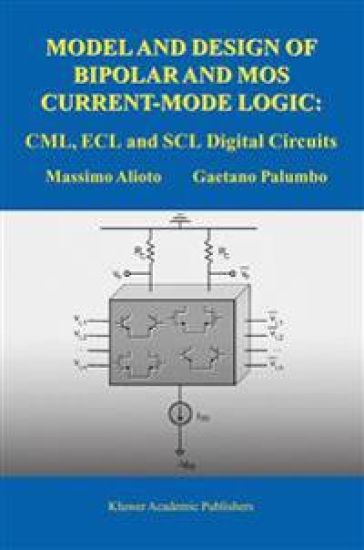
Current-Mode digital circuits have been extensively analyzed and used since the early days of digital ICs. In particular, bipolar Current-Mode digital circuits emerged as an approach to realize digital circuits with the highest speed. Together with its speed performance, CMOS Current-Mode logic has been rediscovered to allow logic gates implementations which, in contrast to classical VLSI CMOS digital circuits, have the feature of low noise level generation. Thus, CMOS Current-Mode gates can be efficiently used inside analog and mixed-signal ICs, which require a low noise silicon environment. For these reasons, until today, many works and results have been published which reinforce the importance of Current-Mode digital circuits. In the topic of Current-Mode digital circuits, the authors spent a lot of effort in the last six years, and their original results highly enhanced both the modeling and the related design methodologies. Since the fundamental Current-Mode logic building block is the classical differential amplifier, the winning idea, that represents the starting point of the authors’ research, was to change the classical point of view typically followed in the investigation and design of Current-Mode digital circuits. In particular, they properly exploited classical paradigms developed and used in the analog circuit domain (a topic in which one of the authors maturated a great experience).
Current-Mode digital circuits have been extensively analyzed and used since the early days of digital ICs. In particular, bipolar Current-Mode digital circuits emerged as an approach to realize digital circuits with the highest speed. Together with its speed performance, CMOS Current-Mode logic has been rediscovered to allow logic gates implementations which, in contrast to classical VLSI CMOS digital circuits, have the feature of low noise level generation. Thus, CMOS Current-Mode gates can be efficiently used inside analog and mixed-signal ICs, which require a low noise silicon environment. For these reasons, until today, many works and results have been published which reinforce the importance of Current-Mode digital circuits. In the topic of Current-Mode digital circuits, the authors spent a lot of effort in the last six years, and their original results highly enhanced both the modeling and the related design methodologies. Since the fundamental Current-Mode logic building block is the classical differential amplifier, the winning idea, that represents the starting point of the authors’ research, was to change the classical point of view typically followed in the investigation and design of Current-Mode digital circuits. In particular, they properly exploited classical paradigms developed and used in the analog circuit domain (a topic in which one of the authors maturated a great experience).
Feedback Amplifiers: Theory and Design deals with feedback and feedback amplifiers. Although this topic has been extensively investigated over the years, theoretically exact and at the same time sufficiently simple and well organized material is not, to the authors' judgement, present today in literature. After describing the fundamental properties of feedback, the book illustrates techniques of analysis for greater insight into feedback amplifiers and design strategies to optimise their performance. The book has two main targets 1) a tutorial purpose since its aim is first to introduce and then to bring the reader to in-depth analysis and design of feedback circuits; 2) to present original material on the topic of feedback circuits. In particular, a new comprehensive approach for the frequency compensation of two-stage and three-stage amplifiers is adopted, and insightful new results are reported for harmonic distortion in the frequency domain.
CMOS Current Amplifiers presents design strategies for high performance current amplifiers based on CMOS technology. After an introduction to various architectures of operational amplifiers, the operating principles of the current amplifier are outlined. This book provides the reader with simple and compact design equations for use in a pencil and paper design and the following simulation step. Chapter 1 introduces the general aspects of current amplifiers. After a preliminary classification of operational amplifiers, ideal blocks and models are discussed for different architectures and a first high-level comparison is made between traditional amplifiers and current amplifiers. Analysis and examples of basic circuits, as well as signal processing applications involving current amplifiers, are also given. Non-idealities and second- order effects causing limitations in performance are then discussed and evaluated. Chapter 2 focuses on low-drive current amplifiers. Several design examples for current conveyors and class A current amplifiers are discussed in detail and design equations are presented for the main performance parameters, which allows a good trade-off between requirements. High-performance solutions for high bandwidth and low voltage capability are also considered, and, finally, current comparators with progressively enhanced performance are reported and analyzed critically. Chapter 3 deals with current amplifiers for off-chip loads. Several class AB current-mode output stages are discussed and design strategies which improve performance are presented. A detailed analysis of non-ideal effect is carried out with particular emphasis on linearity. Design examples are given and circuit arrangements for further developments are included. CMOS Current Amplifiers serves as an excellent reference for researchers and professionals of analog IC design, and may also be used as an advanced text on current amplifiers.