Kirjojen hintavertailu. Mukana 12 497 188 kirjaa ja 12 kauppaa.

Kirjailija

Gail Jefferson

Kirjat ja teokset yhdessä paikassa: 7 kirjaa, julkaisuja vuosilta 2015-2024, suosituimpien joukossa Clark's Positioning in Radiography 13E. Vertaile teosten hintoja ja tarkista saatavuus suomalaisista kirjakaupoista.

7 kirjaa

Kirjojen julkaisuhaarukka 2015-2024.

Clark's Pocket Handbook for Radiographers

Clark's Pocket Handbook for Radiographers

A Stewart Whitley; Charles Sloane; Gail Jefferson; Ken Holmes; Craig Anderson

TAYLOR FRANCIS LTD
2024
sidottu
Drawn from the renowned reference Clark's Positioning in Radiography, this bestselling pocket handbook provides clear and practical advice to help radiographers in their day-to-day work. Designed and structured for rapid reference, it covers how to position the patient and image receptor as well as the direction and location of the beam, describes the essential image characteristics, and illustrates each radiographic projection with a positioning photograph and corresponding radiographic image.This third edition has been updated to include new positioning photographs reflecting the dominance of direct digital radiography detectors (DDRs), helpful information on the importance of optimisation, exposure factors and geometry in image production, evaluating exposure in digital imaging and aspects of bariatric imaging.
Clark's Pocket Handbook for Radiographers

Clark's Pocket Handbook for Radiographers

A Stewart Whitley; Charles Sloane; Gail Jefferson; Ken Holmes; Craig Anderson

TAYLOR FRANCIS LTD
2024
nidottu
Drawn from the renowned reference Clark's Positioning in Radiography, this bestselling pocket handbook provides clear and practical advice to help radiographers in their day-to-day work. Designed and structured for rapid reference, it covers how to position the patient and image receptor as well as the direction and location of the beam, describes the essential image characteristics, and illustrates each radiographic projection with a positioning photograph and corresponding radiographic image.This third edition has been updated to include new positioning photographs reflecting the dominance of direct digital radiography detectors (DDRs), helpful information on the importance of optimisation, exposure factors and geometry in image production, evaluating exposure in digital imaging and aspects of bariatric imaging.
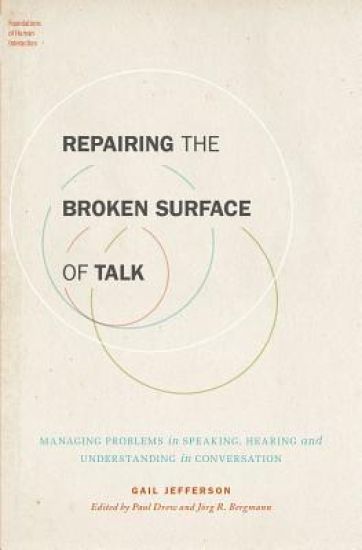
Repairing the Broken Surface of Talk

Repairing the Broken Surface of Talk

Gail Jefferson

Oxford University Press Inc
2017
nidottu
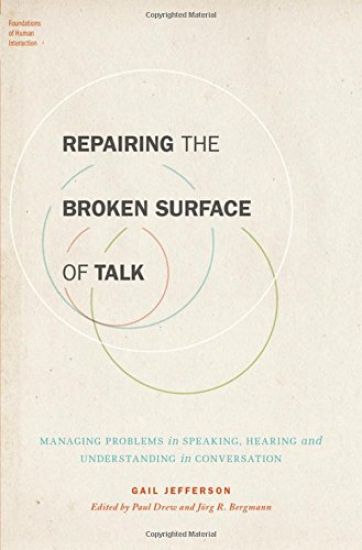
This book is a collection of studies of corrections and repair in conversation, by Gail Jefferson, co-founder of the field of Conversation Analysis and one of its foremost researchers. Throughout her career, Jefferson explored the almost hidden, subterranean world of the seemingly minor errors and mistakes that people make in interaction. Speech errors sometimes have an ideological significance (e.g. a defendant apparently about to refer to the police as "cops" but cutting off just in time to correct that to "officer"). Despite the virtual invisibility of these errors, such problematic moments in interaction bring into play ways of remedying and correcting errors that can have profound significance for the participants. Through these studies Jefferson reveals the delicacy, the subtlety with which moments of communication difficulties and possible miscommunications are remedied, in such a way as to minimize the damage that might otherwise be caused to the interaction. This collection represents the most distinctive, sustained, and incisive exploration of what speakers are "up to" in episodes when they correct errors in their own and one another's speech. Combining rigorous technical analysis, extraordinary methodological innovation, and acute observation, Jefferson explored what she herself referred to as the "wild side of Conversation Analysis." The coherence and depth of her research is revealed in these studies, which include four previously unpublished papers, as well as others that were published variously in less widely-distributed journals and publications. In the volume's introduction, editors Jörg Bergmann and Paul Drew provide an appraisal, for the first time, of the significance of Jefferson's stunningly inventive research into errors and their correction in conversation.
Repairing the Broken Surface of Talk

Repairing the Broken Surface of Talk

Gail Jefferson

Oxford University Press Inc
2017
sidottu
This book is a collection of studies of corrections and repair in conversation, by Gail Jefferson, co-founder of the field of Conversation Analysis and one of its foremost researchers. Throughout her career, Jefferson explored the almost hidden, subterranean world of the seemingly minor errors and mistakes that people make in interaction. Speech errors sometimes have an ideological significance (e.g. a defendant apparently about to refer to the police as "cops" but cutting off just in time to correct that to "officer"). Despite the virtual invisibility of these errors, such problematic moments in interaction bring into play ways of remedying and correcting errors that can have profound significance for the participants. Through these studies Jefferson reveals the delicacy, the subtlety with which moments of communication difficulties and possible miscommunications are remedied, in such a way as to minimize the damage that might otherwise be caused to the interaction. This collection represents the most distinctive, sustained, and incisive exploration of what speakers are "up to" in episodes when they correct errors in their own and one another's speech. Combining rigorous technical analysis, extraordinary methodological innovation, and acute observation, Jefferson explored what she herself referred to as the "wild side of Conversation Analysis." The coherence and depth of her research is revealed in these studies, which include four previously unpublished papers, as well as others that were published variously in less widely-distributed journals and publications. In the volume's introduction, editors Jörg Bergmann and Paul Drew provide an appraisal, for the first time, of the significance of Jefferson's stunningly inventive research into errors and their correction in conversation.
Clark's Positioning in Radiography 13E

Clark's Positioning in Radiography 13E

A. Stewart Whitley; Gail Jefferson; Ken Holmes; Charles Sloane; Craig Anderson; Graham Hoadley

Routledge
2015
sidottu
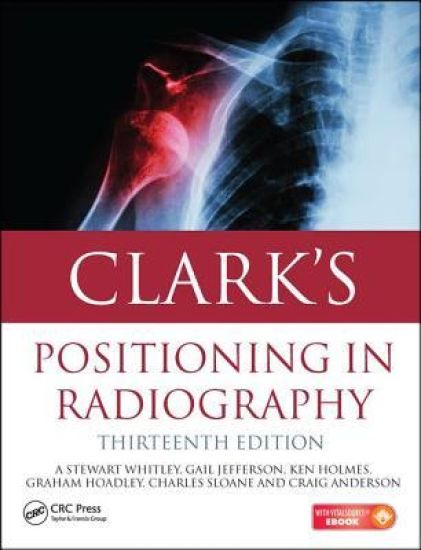
First published in 1939, Clark’s Positioning in Radiography is the preeminent text on positioning technique for diagnostic radiographers.Whilst retaining the clear and easy-to-follow structure of the previous edition, the thirteenth edition includes a number of changes and innovations in radiographic technique. The text has been extensively updated, including a new section on evaluating images, The 10-point plan, which is linked throughout to a listing of Essential image characteristics for each procedure. The section on digital imaging has been expanded not only to elaborate more extensively on the technology but to demonstrate its various clinical applications.New sections also include imaging informatics and its role in the modern world of medical imaging, holistic approaches to patient care and discussion of the important aspect of the patient journey.Students will also benefit from more detailed reference to positioning errors and how to avoid mistakes, as well as a greater emphasis on standard radiation protection measures and guidance on the most recent radiation dose reference levels for specific examinations.Clark’s Positioning in Radiography continues to be the definitive work on radiographic technique for all students on radiography courses, radiographers in practice and trainee radiologists.
Talking About Troubles in Conversation

Talking About Troubles in Conversation

Gail Jefferson

Oxford University Press Inc
2015
nidottu
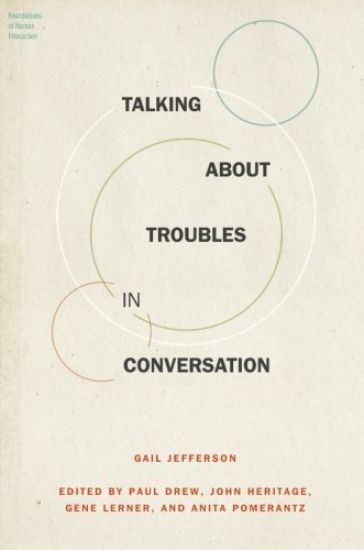
Few conversational topics can be as significant as our troubles in life, whether everyday and commonplace, or more exceptional and disturbing. In groundbreaking research conducted with John Lee at the University of Manchester UK, Gail Jefferson turned the microscope on how people talk about their troubles, not in any professional or therapeutic setting, but in their ordinary conversations with family and friends. Through recordings of interactions in which people talk about problems they're having with their children, concerns about their health, financial problems, marital and relationship difficulties (their own or other people's), examination failures, dramatic events such as burglaries or a house fire and other such troubles, Jefferson explores the interactional dynamics and complexities of introducing such topics, of how speakers sustain and elaborate their descriptions and accounts of their troubles, how participants align and affiliate with one another, and finally manage to move away from such topics. The studies Jefferson published out of that remarkable period of research have been collected together in this volume. They are as insightful and informative about how we talk about our troubles, as they are innovative in the development and application of Conversation Analysis. Gail Jefferson (1938-2008) was one of the co-founders of Conversation Analysis (CA); through her early collaboration with Harvey Sacks and in her subsequent research, she laid the foundations for what has become an immensely important interdisciplinary paradigm. She co-authored, with Harvey Sacks and Emanuel Schegloff, two of the most highly cited articles ever published in Language, on turn-taking and repair. These papers were foundational, as was the transcription system that she developed and that is used by conversation analysts world-wide. Her research papers were a distinctive and original voice in the emerging micro-analysis of interaction in everyday life.
Talking About Troubles in Conversation

Talking About Troubles in Conversation

Gail Jefferson

Oxford University Press Inc
2015
sidottu
Few conversational topics can be as significant as our troubles in life, whether everyday and commonplace, or more exceptional and disturbing. In groundbreaking research conducted with John Lee at the University of Manchester UK, Gail Jefferson turned the microscope on how people talk about their troubles, not in any professional or therapeutic setting, but in their ordinary conversations with family and friends. Through recordings of interactions in which people talk about problems they're having with their children, concerns about their health, financial problems, marital and relationship difficulties (their own or other people's), examination failures, dramatic events such as burglaries or a house fire and other such troubles, Jefferson explores the interactional dynamics and complexities of introducing such topics, of how speakers sustain and elaborate their descriptions and accounts of their troubles, how participants align and affiliate with one another, and finally manage to move away from such topics. The studies Jefferson published out of that remarkable period of research have been collected together in this volume. They are as insightful and informative about how we talk about our troubles, as they are innovative in the development and application of Conversation Analysis. Gail Jefferson (1938-2008) was one of the co-founders of Conversation Analysis (CA); through her early collaboration with Harvey Sacks and in her subsequent research, she laid the foundations for what has become an immensely important interdisciplinary paradigm. She co-authored, with Harvey Sacks and Emanuel Schegloff, two of the most highly cited articles ever published in Language, on turn-taking and repair. These papers were foundational, as was the transcription system that she developed and that is used by conversation analysts world-wide. Her research papers were a distinctive and original voice in the emerging micro-analysis of interaction in everyday life.