Kirjojen hintavertailu. Mukana 12 595 353 kirjaa ja 12 kauppaa.

Kirjailija

Ganesh Gopalakrishnan

Kirjat ja teokset yhdessä paikassa: 6 kirjaa, julkaisuja vuosilta 2006-2026, suosituimpien joukossa Computation Engineering. Vertaile teosten hintoja ja tarkista saatavuus suomalaisista kirjakaupoista.

6 kirjaa

Kirjojen julkaisuhaarukka 2006-2026.

Specification and Analysis of Discrete Systems:
This class-tested textbook provides a comprehensive and accessible introduction to discrete systems. The author uses illustrations, engaging examples, and historical remarks to make the material interesting and relevant for students. The book uses multiple notations to convey each idea, and also multiple automated tools. It also adopts a programmer's perspective, using a declarative subset of Python to emphasize the "what" and not the "how." A Jupyter notebook will accompany the book to feature code, YouTube videos, and other supplements to assist instructors and students.
Automata and Computability

Automata and Computability

Ganesh Gopalakrishnan

CRC Press
2020
nidottu
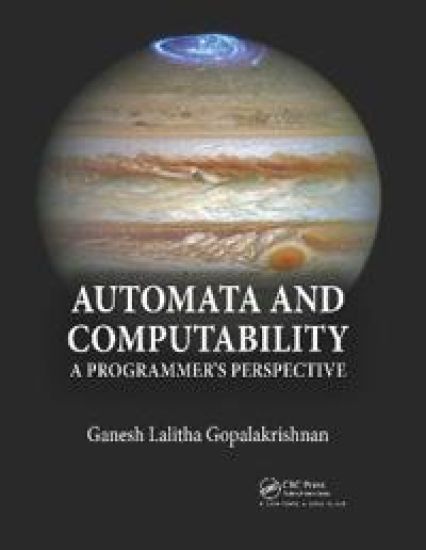
Automata and Computability is a class-tested textbook which provides a comprehensive and accessible introduction to the theory of automata and computation. The author uses illustrations, engaging examples, and historical remarks to make the material interesting and relevant for students. It incorporates modern/handy ideas, such as derivative-based parsing and a Lambda reducer showing the universality of Lambda calculus. The book also shows how to sculpt automata by making the regular language conversion pipeline available through a simple command interface. A Jupyter notebook will accompany the book to feature code, YouTube videos, and other supplements to assist instructors and studentsFeaturesUses illustrations, engaging examples, and historical remarks to make the material accessible Incorporates modern/handy ideas, such as derivative-based parsing and a Lambda reducer showing the universality of Lambda calculusShows how to "sculpt" automata by making the regular language conversion pipeline available through simple command interfaceUses a mini functional programming (FP) notation consisting of lambdas, maps, filters, and set comprehension (supported in Python) to convey math through PL constructs that are succinct and resemble mathProvides all concepts are encoded in a compact Functional Programming code that will tesselate with Latex markup and Jupyter widgets in a document that will accompany the books. Students can run code effortlessly.All the code can be accessed here.
Automata and Computability

Automata and Computability

Ganesh Gopalakrishnan

CRC Press
2019
sidottu
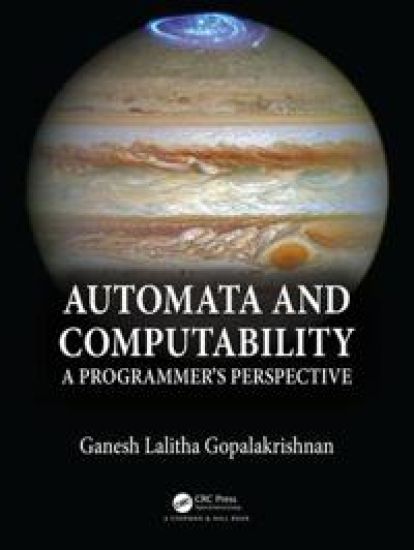
Automata and Computability is a class-tested textbook which provides a comprehensive and accessible introduction to the theory of automata and computation. The author uses illustrations, engaging examples, and historical remarks to make the material interesting and relevant for students. It incorporates modern/handy ideas, such as derivative-based parsing and a Lambda reducer showing the universality of Lambda calculus. The book also shows how to sculpt automata by making the regular language conversion pipeline available through a simple command interface. A Jupyter notebook will accompany the book to feature code, YouTube videos, and other supplements to assist instructors and studentsFeaturesUses illustrations, engaging examples, and historical remarks to make the material accessible Incorporates modern/handy ideas, such as derivative-based parsing and a Lambda reducer showing the universality of Lambda calculusShows how to "sculpt" automata by making the regular language conversion pipeline available through simple command interfaceUses a mini functional programming (FP) notation consisting of lambdas, maps, filters, and set comprehension (supported in Python) to convey math through PL constructs that are succinct and resemble mathProvides all concepts are encoded in a compact Functional Programming code that will tesselate with Latex markup and Jupyter widgets in a document that will accompany the books. Students can run code effortlessly href="https://github.com/ganeshutah/Jove.git/"here.
Computation Engineering

Computation Engineering

Ganesh Gopalakrishnan

Springer-Verlag New York Inc.
2010
nidottu
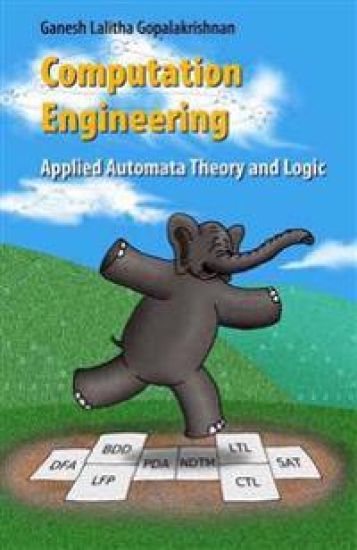
It takes more e?ort to verify that digital system designs are correct than it does to design them, and as systems get more complex the proportion of cost spent on veri?cation is increasing (one estimate is that veri?cation complexity rises as the square of design complexity). Although this veri?cation crisis was predicted decades ago, it is only recently that powerful methods based on mathematical logic and automata theory have come to the designers’ rescue. The ?rst such method was equivalence checking, which automates Boolean algebra calculations.Nextcamemodelchecking,whichcanautomatically verify that designs have – or don’t have – behaviours of interest speci?ed in temporal logic. Both these methods are available today in tools sold by all the major design automation vendors. It is an amazing fact that ideas like Boolean algebra and modal logic, originating frommathematicians andphilosophersbeforemodern computers were invented, have come to underlie computer aided tools for creating hardware designs. The recent success of ’formal’ approaches to hardware veri?cation has lead to the creation of a new methodology: assertion based design, in which formal properties are incorporated into designs and are then validated by a combination of dynamic simulation and static model checking. Two industrial strength property languages based on tem- ral logic are undergoing IEEE standardisation. It is not only hardwaredesignand veri?cation that is changing: new mathematical approaches to software veri?cation are starting to be - ployed. Microsoft provides windows driver developers with veri?cation tools based on symbolic methods.
Computation Engineering

Computation Engineering

Ganesh Gopalakrishnan

Springer-Verlag New York Inc.
2006
sidottu
It takes more e?ort to verify that digital system designs are correct than it does to design them, and as systems get more complex the proportion of cost spent on veri?cation is increasing (one estimate is that veri?cation complexity rises as the square of design complexity). Although this veri?cation crisis was predicted decades ago, it is only recently that powerful methods based on mathematical logic and automata theory have come to the designers’ rescue. The ?rst such method was equivalence checking, which automates Boolean algebra calculations.Nextcamemodelchecking,whichcanautomatically verify that designs have – or don’t have – behaviours of interest speci?ed in temporal logic. Both these methods are available today in tools sold by all the major design automation vendors. It is an amazing fact that ideas like Boolean algebra and modal logic, originating frommathematicians andphilosophersbeforemodern computers were invented, have come to underlie computer aided tools for creating hardware designs. The recent success of ’formal’ approaches to hardware veri?cation has lead to the creation of a new methodology: assertion based design, in which formal properties are incorporated into designs and are then validated by a combination of dynamic simulation and static model checking. Two industrial strength property languages based on tem- ral logic are undergoing IEEE standardisation. It is not only hardwaredesignand veri?cation that is changing: new mathematical approaches to software veri?cation are starting to be - ployed. Microsoft provides windows driver developers with veri?cation tools based on symbolic methods.