Kirjojen hintavertailu. Mukana 12 595 353 kirjaa ja 12 kauppaa.

Kirjailija

Gary Clyde Hufbauer

Kirjat ja teokset yhdessä paikassa: 27 kirjaa, julkaisuja vuosilta 1992-2021, suosituimpien joukossa US–China Trade Dispute – Rising Tide, Rising Stakes. Vertaile teosten hintoja ja tarkista saatavuus suomalaisista kirjakaupoista.

27 kirjaa

Kirjojen julkaisuhaarukka 1992-2021.

Global Warming and the World Trading System

Global Warming and the World Trading System

Gary Clyde Hufbauer; Steve Charnovitz; Jisun Kim

The Peterson Institute for International Economics
2009
nidottu
In 2006, a team led by the English economist Sir Nicholas Stern issued a striking report that analyzed the economic dimensions of global climate change and called for immediate collective action to reduce greenhouse gas (GHG) emissions. This seminal report poses the critical question of how much emissions should be reduced within specific timeframes. To answer the challenge of finding a best-practices approach, Global Warming and the World Trading System looks at the economic aspects of GHG emissions and seeks a policy method to reduce them without adversely affecting global trade. The book begins with a survey of relevant data-such as emissions reports per sector-and evaluates current US climate policy options, focusing on the intricacies of specific Congressional bills.In this vein, this study examines whether the competitiveness provisions now under consideration are compatible with the rules of the World Trade Organization (WTO) and explores the pragmatic opportunities the WTO should capitalize on in order to accomplish two goals simultaneously: ensure "policy space" for countries to limit national GHG emissions without sacrificing the competitive position of their own industries and preserve an open trading system relatively free of discrimination and opportunistic protectionist measures. Should governments use trade measures to encourage other countries to cooperate in the adoption of environmental policies? The authors anticipate the potential negative environmental and economic outcomes as well as the disputes over violation of GATT articles. This book addresses how to avoid serious setbacks in an effort to reduce emissions without compromising the status of both domestic and international carbon-intensive industries. Most importantly, the book considers what can be done by environmental organizations to head off conflict with the WTO.
US–China Trade Dispute – Rising Tide, Rising Stakes

US–China Trade Dispute – Rising Tide, Rising Stakes

Gary Clyde Hufbauer; Yee Wong; Ketki Sheth

The Peterson Institute for International Economics
2006
nidottu
Since its accession to the WTO, China has become the United States' third-largest trading partner and the sixth-largest market for US exports. Between 2000 and 2005, US imports from China rose from $100 billion to $243 billion, while US exports to China climbed from $16 billion to $42 billion. As China continues its rise as a great power, The United States Congress and the administration wrestle with one another over the proper tactics and strategies to shape US-China economic relations. What major disputes now, and looming on the horizon, will shape future US-China relations; and what can be done to solve, or at the very least to manage, them? This important new book examines these issues and offers suggestions for both sides.
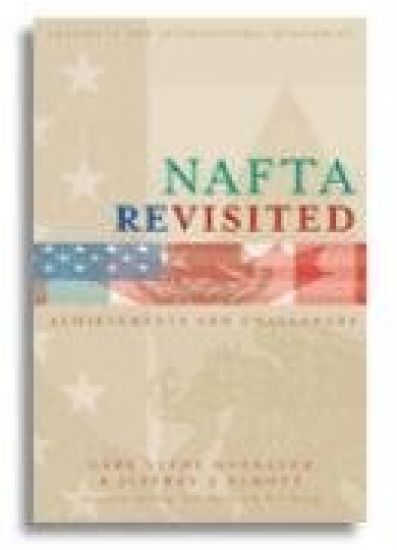
NAFTA Revisited – Achievements and Challenges

NAFTA Revisited – Achievements and Challenges

Gary Clyde Hufbauer; Jeffrey Schott; Paul L. E. Grieco; Yee Wong

The Peterson Institute for International Economics
2005
nidottu
NAFTA entered into force in 1994 after a bitter Congressional debate. But NAFTA in operation has proved no less controversial than NAFTA before ratification, for both supporters and opponents of trade liberalization have cited experience with the agreement to justify their positions. To provide a factual basis for this ongoing debate, the authors evaluate NAFTA's performance over the first seven years, comparing actual experience with both the objectives of the agreement's supporters and the charges of its critics. They then examine future challenges and opportunities in the trade and investment relationships among the three partner countries and the broader implications for new trade initiatives throughout the hemisphere.
Economic Sanctions Reconsidered – [Softcover with CD–ROM]

Economic Sanctions Reconsidered – [Softcover with CD–ROM]

Gary Clyde Hufbauer; Jeffrey Schott; Kimberly Ann Elliott; Barbara Oegg

The Peterson Institute for International Economics
2021
sidottu
Economic sanctions continue to play an important role in the response to terrorism, nuclear proliferation, military conflicts, and other foreign policy crises. But poor design and implementation of sanctions policies often mean they fall short of their desired effects. This landmark study, first published in 1985, delves into the rich experience of sanctions in the 20th century to harvest lessons on how to use sanctions more effectively. This volume - now conveniently available in a paperback format - is the third and expanded edition of this widely cited study. The authors' unique database on sanctions now covers almost 200 case studies. The analysis is substantially revised to take account of the new challenges facing policymakers since the end of the Cold War and the acceleration of globalization of trade and financial markets. This study is offered in two parts: Economic Sanctions Reconsidered, which summarizes the analysis and outlines the policy recommendations, and Economic Sanctions Reconsidered: Case Histories and Data, a supplemental CD-ROM containing the case studies and new database.
Bridging the Pacific – Toward Free Trade and Investment Between China and the United States

Bridging the Pacific – Toward Free Trade and Investment Between China and the United States

C. Fred Bergsten; Gary Clyde Hufbauer; Sean Miner

The Peterson Institute for International Economics
2014
nidottu
The terrain of the world trading system is shifting as countries in Asia, Europe, and North America negotiate new trade agreements. However, none of these talks include both China and the United States, the two biggest economies in the world. In this pathbreaking study, C. Fred Bergsten, Gary Clyde Hufbauer, and Sean Miner argue that China and the United States would benefit substantially from a bilateral free trade and investment accord or from participating together in a regional agreement like the TPP. In the process, they contend, each country would also achieve progress in addressing its internal economic challenges, such as the low saving rate in the United States. Achieving greater trade and investment integration could be accomplished with one comprehensive effort or through step-by-step negotiations over key issues. The authors call on the United States to seek liberalization of China's services sector as vital to securing an agreement, and they explain that such contentious matters as cyberespionage and currency manipulation be handled through parallel negotiations rather than in the agreement itself. This is an important study of the benefits and difficulties of a complex matter that could yield dividends to the two economies and help stabilize the security and well-being of the rest of the world.
Local Content Requirements – A Global Problem

Local Content Requirements – A Global Problem

Gary Clyde Hufbauer; Jeffrey Schott; Cathleen Cimino–isaacs; Martin Vieiro; Erika Wada

The Peterson Institute for International Economics
2013
nidottu
In the wake of the Great Recession of 2008-09, economists feared that protectionist policies might sweep the world economy, echoing the wave of tariff escalations during the Great Depression of the 1930s. To some surprise, officials were more restrained and largely avoided traditional forms of protection (tariffs and quotas). As a result, economists underestimated the incidence of new protectionism because policymakers increasingly turned to more opaque behind-the-border nontariff barriers (NTBs). Using a combination of statistical analysis and case studies, the authors show that local content requirements (LCRs), a form of NTB, have become increasingly popular. How much was global trade actually reduced on account of LCRs? A conservative estimate might be $93 billion. Case studies featured cover the healthcare sector in Brazil, wind turbines in Canada, the automobile industry in China, solar cells and modules in India, oil and gas in Nigeria, and "Buy American" restrictions on government procurement.
Economic Normalization with Cuba – A Roadmap for US Policymakers

Economic Normalization with Cuba – A Roadmap for US Policymakers

Gary Clyde Hufbauer; Barbara Kotschwar; Cathleen Cimino–isaacs

The Peterson Institute for International Economics
2013
nidottu
Will the Obama administration's decision to normalize relations with Cuba usher in a new era of economic cooperation, trade, and investment between the two countries? This prescient book, published only eight months before President Obama's historic announcement at the end of 2014, provides answers to that question and offers a roadmap for a sequenced lifting of the Cold War era economic sanctions against Cuba. Gary Clyde Hufbauer and Barbara Kotschwar lay out the difficulties of achieving a dynamic economic relationship. They caution that a unilateral dismantling of US sanctions without insuring that proper institutions are in place in Cuba could squander this golden opportunity for US companies and hurt Cubans. They argue that US policies should encourage Cuba to liberalize its economy and adopt democratic institutions, so that it does not transition from a Communist dictatorship to a corrupt and authoritarian oligarchy.This farsighted book, produced in anticipation of an opening with Cuba that seemed impossible to some skeptics, is a must-read for anyone interested in the evolution of a historically contentious relationship that promises to evolve productively if the right policies are pursued.
Outward Foreign Direct Investment and US Exports – Implications for US Policy

Outward Foreign Direct Investment and US Exports – Implications for US Policy

Gary Clyde Hufbauer; Theodore Moran; Lindsay Oldenski; Martin Vieiro

The Peterson Institute for International Economics
2013
nidottu
It is not in the US interest to adopt tax and regulatory policies that would discourage global engagement by US multinational corporations (MNCs). Research presented in this book shows that the expansion of foreign affiliates of US MNCs is positively associated with more production, greater employment, higher exports, and more research and development (R&D) in the United States. These findings suggest that less investment abroad by US firms would weaken-not strengthen-the US economy. This analysis by no means implies that there are only winners and no losers from outward investment. Changing patterns of MNC investment, like changing patterns of technology and production more generally, contribute to job losses and dislocations for some workers and to new opportunities for others. To benefit the US economy and US workers most broadly, the United States will want to search for ways to strengthen the appeal of the United States as a base for the operations of international firms. High among the recommendations to accomplish this, the United States should adopt a territorial tax system, like the great majority of developed countries.
The United States Should Establish Permanent Normal Trade Relations with Russia

The United States Should Establish Permanent Normal Trade Relations with Russia

Anders Åslund; Gary Clyde Hufbauer

The Peterson Institute for International Economics
2011
nidottu
In the coming year, Congress is likely to face a critical vote on granting Permanent Normal Trade Relations (PNTR) to Russia in connection with its impending membership to the World Trade Organization (WTO). A "yes" on PNTR for Russia could set the tone for economic relations between the United States and Russia for the next decade, and would give the global agenda of trade and investment liberalization a fresh boost, as Russia is the last major economy to join the WTO. Congressional failure to permanently normalize trade relations would likely have broad consequences, since it would send a clear message of US skepticism that the WTO is a suitable forum for handling commercial relations between major powers. This study presents an analysis of the current US-Russia economic relations, provides estimates on the potential increase in US exports to Russia, and potential growth of two-way trade within the WTO framework. Drawing on conclusions from this analysis, and from previous work conducted by the Institute on US-Russia relations, this monograph summarizes the implications of PNTR for US producers, Russian economic growth, and bilateral commercial relations.
Globalization at Risk

Globalization at Risk

Gary Clyde Hufbauer; Kati Suominen

Yale University Press
2010
sidottu
Drawing on rigorous research, this book summarizes the payoffs from globalization past, and presents a roadmap for the future of globalization. History has declared globalization the winner of the 20th century. Globalization connected the world and created wealth unimaginable in the wake of the Second World War. But the financial crisis of 2008-09 has now placed at risk the liberal economic policies behind globalization. Engulfing the entire world, the crisis gave new fuel to the skeptics of the benefits of economic integration. Policy responses seem to favor anti-globalizers. New regulations could balkanize the global financial system, while widespread protectionist impulses might undo the Doha Round. Issues from climate change to national security may be used as convenient excuses to keep imports out, keep jobs at home, and to clamp down on global capital. Will globalization triumph or perish in the 21st century? What reforms make sense in the post-crisis world?International economists Gary Clyde Hufbauer and Kati Suominen argue that globalization has been a force of great good, one that needs to be actively advanced and honed. Drawing on the latest economic analyses, they reveal the drivers and effects of global finance and trade, lay out the key risks to globalization, and offer a practical policy roadmap for managing the challenges while increasing the gains. Vital reading for anyone in business, finance, foreign affairs, or economics, Globalization at Risk is sure to advance public debate on this defining issue of the 21st century.
Figuring Out the Doha Round

Figuring Out the Doha Round

Gary Clyde Hufbauer; Jeffrey Schott; Woan Foong Wong

The Peterson Institute for International Economics
2010
nidottu
The global economic and financial crisis has awakened protectionist sentiments around the world, and policymakers have failed to actively seek trade liberalization. In light of this, some have proposed abandoning the Doha Round and starting over with a new agenda. Figuring Out the Doha Round argues that this is far from the time to drop the Doha Round and that it is now more important than ever to sustain political support for the rules-based multilateral trade system. This important new study recommends modest increments in market access commitments by G-20 countries beyond tariff and subsidy cuts in agriculture and nonagricultural market access (NAMA), and policy reforms in customs procedures and related areas that slash red tape and cut transactions costs for exporting and importing goods and services. With additional effort by the G-20 countries, WTO countries can put together a Doha package that is both ambitious and balanced between the interests of developed and developing countries. The study finds that following these recommendations can lead to a world GDP gain of almost $300 billion a year.
Capitalizing on the Morocco–US Free Trade Agreem – A Road Map for Success

Capitalizing on the Morocco–US Free Trade Agreem – A Road Map for Success

Gary Clyde Hufbauer; Claire Brunel

The Peterson Institute for International Economics
2009
nidottu
This study assesses the US-Morocco free trade agreement (FTA) and identifies shortcomings in the implementation of the US-Morocco FTA, provide policy recommendations for better leveraging the FTA, and suggest ways for Morocco to take better advantage of its cooperation agreements with the European Union. The study consists of four components. First, the study uses statistical and modeling work to compare the experience of the US-Morocco FTA with the experiences of US FTAs with Chile and Jordan. Second, the study provides a qualitative analysis of the US FTAs with Chile and Jordan to suggest best practices for Morocco to get the most out of its FTA with the United States. Third, the study looks at Morocco's trade agreements with the European Union in order to further guide the implementation of the US-Morocco FTA in light of the successes and failures of EU-Morocco trade relations. Fourth, the study identifies shortcomings in the implementation of the US-Morocco FTA and in EU agreements with Morocco, with a focus on agriculture, textiles, services, and intellectual property.Finally, the study provides recommendations on reforms the Moroccan government could implement in order to take greater advantage of the US FTA and EU agreements, both at the border and behind the border, and considers areas of the US FTA that could benefit from renegotiation, as well as the direction new provisions should take.
Economic Sanctions Reconsidered

Economic Sanctions Reconsidered

Gary Clyde Hufbauer; Jeffrey Schott; Kimberly Ann Elliott; Barbara Oegg

The Peterson Institute for International Economics
2009
nidottu
Economic sanctions continue to play an important role in the response to terrorism, nuclear proliferation, military conflicts, and other foreign policy crises. But poor design and implementation of sanctions policies often mean that they fall short of their desired effects. This landmark study, first published in 1985, delves into the rich experience of sanctions in the 20th century to harvest lessons on how to use sanctions more effectively. This volume is the updated third edition of this widely cited study. It chronicles and examines 170 cases of economic sanctions imposed since World War I. Fifty of these cases were launched in the 1990s and are new to this edition. Special attention is paid to new developments arising from the end of the Cold War and increasing globalization of the world economy. Analyzing a range of economic and political factors that can influence the success of a sanctions episode, the authors distill a set of commandments to guide policymakers in the effective use of sanctions.
Maghreb Regional and Global Integration – A Dream to Be Fulfilled

Maghreb Regional and Global Integration – A Dream to Be Fulfilled

Gary Clyde Hufbauer; Claire Brunel

The Peterson Institute for International Economics
2008
nidottu
Increasing terrorist activity has led the Maghreb countries-Morocco, Algeria, Tunisia, Mauritania, and Libya-to focus on antiterrorism efforts, unintentionally at the expense of full-fledged economic reform. These countries have tightened their border restrictions on the flow of people and goods, reducing commerce and depressing economic activity. In fact, Maghreb has one of the lowest rates of intra-regional trade in the world; other factors like rigid economic structures, slow productivity growth, and modest investment levels continue to stymie progress toward economic integration. Do these countries' diverse circumstances symbolize insurmountable obstacles in achieving economic cooperation and an improved standard of living for citizens? How can the United States and European Union facilitate economic progress? Maghreb Regional and Global Integration: A Dream to Be Fulfilled utilizes two distinct econometric tools to assess four key sectors-energy, banking and insurance, transport, and agribusiness-and outlines achievable sector-specific recommendations.This book not only assesses the gains from economic integration among the Maghreb countries, but also focuses on the tangible benefits from enhanced economic ties between the region and the world economy. With this critical analysis, the authors provide an in-depth look at practical measures such as bilateral trade and investment agreements, regional arrangements, and financial assistance that can significantly boost short-term success and ensure long-term gains through integration in an unstable region.
US Taxation of Foreign Income

US Taxation of Foreign Income

Gary Clyde Hufbauer; Ariel Assa

The Peterson Institute for International Economics
2007
nidottu
Since 1992, new issues have arisen in international taxation-for example, taxation of electronic commerce, novel means of shielding passive income, the World Trade Organization (WTO) debate over the foreign sales corporation and subsequent passage of the American Jobs Creation Act of 2004, the problem of corporate inversions, and alleged "earnings stripping" by foreign-based multinational enterprises (MNEs) operating in the United States. In the meantime, US-based MNEs operating abroad have used a variety of methods to cut the effective US tax on repatriated foreign source income to around 2 percent. This revised study analyzes the impact of taxes on industry location and profit shifting using new panel econometric studies. It also discusses and evaluates new paradigms that have been suggested for the international tax system.
Toward a US–Indonesia Free Trade Agreement

Toward a US–Indonesia Free Trade Agreement

Gary Clyde Hufbauer; Sjamsu Rahardja

The Peterson Institute for International Economics
2007
nidottu
Indonesia is the largest Muslim country in the world. Would a Free Trade Agreement (FTA) with the country be beneficial both economically and politically to the United States? What kind of benefit could Indonesia expect? This book presents a case for improved trade relations between Indonesia and the United States and recommends advancing exploratory talks toward a US-Indonesia FTA. The authors present a detailed study of the stakes involved in the various areas of the proposed negotiation and estimate the FTA's potential for trade creation, trade diversion, and welfare under different scenarios.
Sustaining Reform with a US–Pakistan Free Trade Agreement

Sustaining Reform with a US–Pakistan Free Trade Agreement

Gary Clyde Hufbauer; Shahid Javed Burki

The Peterson Institute for International Economics
2006
nidottu
The United States and Pakistan established diplomatic relations in 1947, shortly after Pakistan gained its independence. Since then, relations have alternated between episodes of close partnership and sharp friction-reflecting the ups and downs of global and regional geopolitics. The tides of foreign policy have correspondingly affected trade and investment. Post-September 11th diplomacy has now created a strong relationship between Pakistan and the United States. Would a free trade agreement between these two counties benefit them? What type of economic benefits could be expected? This new book looks at this question and many others and concludes that a free trade agreement between the United States and Pakistan would benefit both countries.
The Shape of a Swiss–US Free Trade Agreement

The Shape of a Swiss–US Free Trade Agreement

Gary Clyde Hufbauer; Richard Baldwin

The Peterson Institute for International Economics
2005
nidottu
At first sight, a free trade agreement (FTA) between Switzerland and the United States seems implausible, but this important new study concludes that an FTA between the two countries would be highly worthwhile to both. As leading advocates of market capitalism, Switzerland and the United States are well situated to conclude an FTA that breaks new ground in dismantling barriers. The study finds that the annual GDP gains to each partner from expanded trade could be on the order of $1.1 billion.
Reforming the US Corporate Tax

Reforming the US Corporate Tax

Gary Clyde Hufbauer; Paul L. E. Grieco

The Peterson Institute for International Economics
2005
nidottu
The mainstay of federal business taxation, the US corporate income tax, is riddled with distortions and inequities. As a means of taxing the richest Americans-a popular goal-the corporate income tax is a hopeless failure. Many companies pay no corporate tax, and among those that do, the burden is highly uneven. Meanwhile, the richest Americans command income from numerous sources besides corporate dividends. The distortions and inequities are amazing. Under pressure from business lobbies, Congress legislates deductions and exemptions that twist the corporate tax base far from any plausible financial definition; then Congress enacts "targeted" tax credits to carry out ersatz industrial policies. Faced with a tax terrain of mountains and ravines, corporations employ armies of lawyers and accountants to devise avoidance strategies. This book proposes to replace the corporate income tax with a tax that has a much broader base at a much lower rate. Two alternatives are explored: the National Retail Sales Tax (NRST) and the Corporate Activity Tax (CAT).To address the issue of regressivity, both alternatives are coupled with measures to preserve the real spending power of households at the lowest income levels.
Awakening Monster – The Alien Tort Statute of 1789

Awakening Monster – The Alien Tort Statute of 1789

Gary Clyde Hufbauer; Nicholas Mitrokostas

The Peterson Institute for International Economics
2003
nidottu
Within the next decade, 100,000 class action Chinese plaintiffs, organized by New York trial lawyers, could sue General Motors, Toyota, General Electric, Mitsubishi, and a host of other blue-chip corporations in a US federal court for abetting China's denial of political rights, for observing China's restrictions on trade unions, and for impairing the Chinese environment. These plaintiffs might claim actual damages of $6 billion and punitive damages of $20 billion. Similar blockbuster cases are already working their way through federal and state court systems. This nightmare scenario could become a reality because of a little-known, one-sentence law enacted in 1789-the Alien Tort Statute (ATS): "The district courts shall have original jurisdiction of any civil action by an alien for a tort only, committed in violation of the law of nations or a treaty of the United States." In this policy analysis, Gary Clyde Hufbauer and Nicholas K. Mitrokostas examine the chilling impact the ATS could have on trade and foreign direct investment. They trace its history from the original intent to recent court interpretations, including a look at class action suits over asbestos and apartheid.They provide an economic picture of the potential scope of ATS litigation, cite the possible collateral damage, and review the impact that ATS rulings could have on global relations. The authors recommend measures Congress should take to limit expansive court interpretations. The study is a must-read for policymakers, international lawyers, and students.