Kirjojen hintavertailu. Mukana 12 390 323 kirjaa ja 12 kauppaa.

Kirjailija

Gary D. Libecap

Kirjat ja teokset yhdessä paikassa: 9 kirjaa, julkaisuja vuosilta 1994-2026, suosituimpien joukossa Titles, Conflict, and Land Use. Vertaile teosten hintoja ja tarkista saatavuus suomalaisista kirjakaupoista.

9 kirjaa

Kirjojen julkaisuhaarukka 1994-2026.

Titles, Conflict, and Land Use

Titles, Conflict, and Land Use

Lee J. Alston; Gary D. Libecap; Bernardo Mueller

The University of Michigan Press
1999
sidottu
The Amazon, the world's largest rain forest, is the last frontier in Brazil. The settlement of large and small farmers, squatters, miners, and loggers in this frontier during the past thirty years has given rise to violent conflicts over land as well as environmental duress. Titles, Conflict, and Land Use examines the institutional development involved in the process of land use and ownership in the Amazon and shows how this phenomenon affects the behavior of the economic actors. It explores the way in which the absence of well-defined property rights in the Amazon has led to both economic and social problems, including lost investment opportunities, high costs in protecting claims, and violence. The relationship between land reform and violence is given special attention. The book offers an important application of the New Institutional Economics by examining a rare instance where institutional change can be empirically observed. This allows the authors to study property rights as they emerge and evolve and to analyze the effects of Amazon development on the economy. In doing so they illustrate well the point that often the evolution of economic institutions will not lead to efficient outcomes. This book will be important not only to economists but also to Latin Americanists, political scientists, anthropologists, and scholars in disciplines concerned with the environment.Lee Alston is Professor of Economics, University of Illinois, and Research Associate for the National Bureau of Economic Research. Gary Libecap is Professor of Economics and Law, University of Arizona, and Research Associate for the National Bureau of Economic Research. Bernardo Mueller is Assistant Professor, Universidade de Brasilia.
Where's Coase?

Where's Coase?

Gary D. Libecap

Cambridge University Press
2026
sidottu
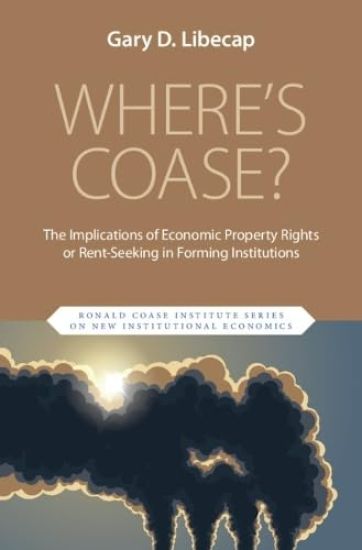
Ronald Coase's Nobel work outlined gains by reducing transaction costs and promoting property rights and markets to confront externalities. Countering market failure assertions and calls for centralized government intervention, Coase retorted that decentralized market negotiations could be welfare-improving by promoting collaborative, efficient problem solving, and releasing resources to the general economy. Despite this, his approach is not central to any US environmental law implemented after 1970. Federal government mandates dominate. Where's Coase? explains why. The private objectives of political agents lead to policies that are likely to be too costly and inequitable, despite provision of public goods. Citizens face high collective action costs and lack information to distinguish between public goods and private agent benefits. Examining three major environmental laws: the Clean Air Act, the Magnuson Stevens Fishery Act, and the Endangered Species Act, the book explores policy development and assesses the resulting costs relative to Coase's framework.
Where's Coase?

Where's Coase?

Gary D. Libecap

Cambridge University Press
2026
pokkari
Ronald Coase's Nobel work outlined gains by reducing transaction costs and promoting property rights and markets to confront externalities. Countering market failure assertions and calls for centralized government intervention, Coase retorted that decentralized market negotiations could be welfare-improving by promoting collaborative, efficient problem solving, and releasing resources to the general economy. Despite this, his approach is not central to any US environmental law implemented after 1970. Federal government mandates dominate. Where's Coase? explains why. The private objectives of political agents lead to policies that are likely to be too costly and inequitable, despite provision of public goods. Citizens face high collective action costs and lack information to distinguish between public goods and private agent benefits. Examining three major environmental laws: the Clean Air Act, the Magnuson Stevens Fishery Act, and the Endangered Species Act, the book explores policy development and assesses the resulting costs relative to Coase's framework.
Environmental Markets

Environmental Markets

Terry L. Anderson; Gary D. Libecap

Cambridge University Press
2014
sidottu
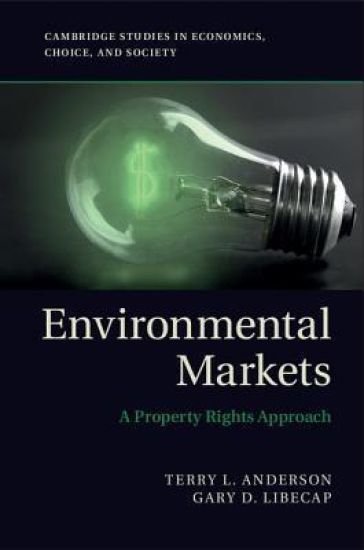
Environmental Markets explains the prospects of using markets to improve environmental quality and resource conservation. No other book focuses on a property rights approach using environmental markets to solve environmental problems. This book compares standard approaches to these problems using governmental management, regulation, taxation, and subsidization with a market-based property rights approach. This approach is applied to land, water, wildlife, fisheries, and air and is compared to governmental solutions. The book concludes by discussing tougher environmental problems such as ocean fisheries and the global atmosphere, emphasizing that neither governmental nor market solutions are a panacea.
Environmental Markets

Environmental Markets

Terry L. Anderson; Gary D. Libecap

Cambridge University Press
2014
pokkari
Environmental Markets explains the prospects of using markets to improve environmental quality and resource conservation. No other book focuses on a property rights approach using environmental markets to solve environmental problems. This book compares standard approaches to these problems using governmental management, regulation, taxation, and subsidization with a market-based property rights approach. This approach is applied to land, water, wildlife, fisheries, and air and is compared to governmental solutions. The book concludes by discussing tougher environmental problems such as ocean fisheries and the global atmosphere, emphasizing that neither governmental nor market solutions are a panacea.
Owens Valley Revisited

Owens Valley Revisited

Gary D. Libecap

Stanford University Press
2007
sidottu
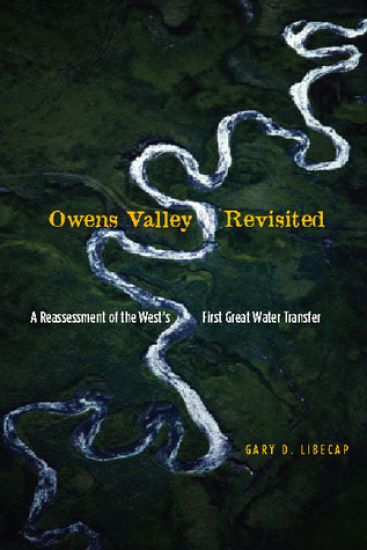
In the contemporary West, pressures to more effectively reallocate water to meet growing urban and environmental demands are increasing as environmental awareness grows and climate change threatens existing water supplies. The legacy of Owens Valley raises concerns about how reallocation can occur. Although it took place over seventy years ago, the water transfer from Owens Valley to Los Angeles still plays an important role in perceptions of how water markets work. The memory of Owens Valley transfer is one of theft and environmental destruction at the hands of Los Angeles. In reassessing the infamous transfer, one could say that there was no "theft." Owens Valley landowners fared well in their land and water sales, earning more than if they had stayed in agriculture. In another sense, however, "theft" did occur. The water was not literally stolen, but there was a sharp imbalance in gains from the trade—with most of the benefits going to Los Angeles. Owens Valley, then, demonstrates the importance of distributional issues in water trades when the stakes are large. Los Angeles water rights in the Owens Valley and Mono Basin have again been a front-page issue since 1970. New environmental and recreational values and air pollution concerns have ushered in demands to curtail the shipment of water from source regions for urban use. Owen's Valley Revisited: A Reassesment of the West's First Great Water Transfer carefully explores how these sagas were addressed, considering the costs involved, and alternative approaches that might have resulted in more rapid and less contentious remedies. This analysis offers insights to guide the ongoing conversation about water politics and the future thereof.
Owens Valley Revisited

Owens Valley Revisited

Gary D. Libecap

Stanford University Press
2007
pokkari
In the contemporary West, pressures to more effectively reallocate water to meet growing urban and environmental demands are increasing as environmental awareness grows and climate change threatens existing water supplies. The legacy of Owens Valley raises concerns about how reallocation can occur. Although it took place over seventy years ago, the water transfer from Owens Valley to Los Angeles still plays an important role in perceptions of how water markets work. The memory of Owens Valley transfer is one of theft and environmental destruction at the hands of Los Angeles. In reassessing the infamous transfer, one could say that there was no "theft." Owens Valley landowners fared well in their land and water sales, earning more than if they had stayed in agriculture. In another sense, however, "theft" did occur. The water was not literally stolen, but there was a sharp imbalance in gains from the trade—with most of the benefits going to Los Angeles. Owens Valley, then, demonstrates the importance of distributional issues in water trades when the stakes are large. Los Angeles water rights in the Owens Valley and Mono Basin have again been a front-page issue since 1970. New environmental and recreational values and air pollution concerns have ushered in demands to curtail the shipment of water from source regions for urban use. Owen's Valley Revisited: A Reassesment of the West's First Great Water Transfer carefully explores how these sagas were addressed, considering the costs involved, and alternative approaches that might have resulted in more rapid and less contentious remedies. This analysis offers insights to guide the ongoing conversation about water politics and the future thereof.
The Federal Civil Service System and the Problem of Bureaucracy

The Federal Civil Service System and the Problem of Bureaucracy

Ronald N. Johnson; Gary D. Libecap

University of Chicago Press
1994
nidottu
Examining the political and economic forces that have shaped the civil service system from the Pendleton Act of 1883 through today, the authors explain why, despite efforts to overhaul the federal bureaucracy (most recently by Vice President Al Gore), significant change remains a formidable challenge. Although politicians criticize the unwieldiness of the bureaucracy, this volume shows how they have been largely responsible for its design. The authors examine the development of federal employee interest groups and their negotiations with the president and Congress over hiring policies, salaries and conditions for terminating employment. Using transaction cost analysis and public choice theory, this book aims to provide a new understanding of the growth of the federal bureaucracy and the political and economic obstacles to reforming it.
Contracting for Property Rights

Contracting for Property Rights

Gary D. Libecap

Cambridge University Press
1994
pokkari
In this book the author examines the problems encountered in negotiations among claimants and the political and economic considerations that influence property rights arrangements. The histories of mineral rights, rights to range and timber land, and fishery and crude oil production rights in the United States are examined and reveal a surprising variety of contractual negotiations and economic outcomes. The author concludes that in addition to an analysis of distributional outcomes, an examination of the details of the political bargaining underlying property rights contracts is essential to an understanding of why rights emerge as they do. The book is an important contribution to both property rights theory and to American economic history.