Kirjojen hintavertailu. Mukana 12 390 323 kirjaa ja 12 kauppaa.

Kirjailija

Gary McLeod

Kirjat ja teokset yhdessä paikassa: 5 kirjaa, julkaisuja vuosilta 2000-2024, suosituimpien joukossa Resilient Partnerships for U.S. Military Satellite Communication Missions. Vertaile teosten hintoja ja tarkista saatavuus suomalaisista kirjakaupoista.

5 kirjaa

Kirjojen julkaisuhaarukka 2000-2024.

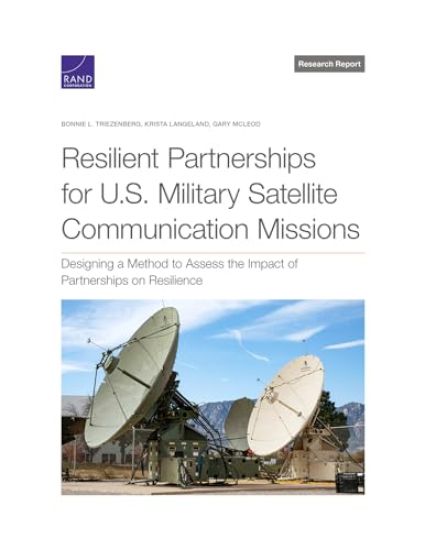
Resilient Partnerships for U.S. Military Satellite Communication Missions

Resilient Partnerships for U.S. Military Satellite Communication Missions

Bonnie L Triezenberg; Krista Langeland; Gary McLeod

RAND Corporation
2024
pokkari
This report documents the authors' development of a methodology to define, assess, and evaluate resilience criteria over time, with a focus on the qualitative assessments of subject matter experts. The methodology is applied to a specific approach to building resilience: integrating coalition and commercial partners into the U.S. military satellite communications mission.
Gaming Space

Gaming Space

Forrest E Morgan; Gary McLeod; Michael Nixon

RAND
2018
nidottu
This report introduces and explains a game-theoretic methodology to help decisionmakers assess the potential effects of alternative approaches to space control. Specifically, we sought to develop a methodology to identify those defensive space control options that would likely contribute to deterrence without increasing political costs and risks of escalation.
Enhancing Space Resilience Through Non-Materiel Means

Enhancing Space Resilience Through Non-Materiel Means

Gary McLeod; George Nacouzi; Paul Dreyer; Mel Eisman; Myron Hura; Krista S. Langeland; David Manheim; Geoffrey Torrington

RAND
2016
pokkari
Space is now a congested, contested, and competitive environment. Space systems must become more resilient to potential adversary actions and system failures, but changes to space systems are costly. To reduce costs, the Air Force asked RAND to identify non-materiel means doctrine, organization, training, leadership and education, personnel, facilities, and policy to enhance space resilience over the near and far terms."
How Civil Institutions Build Resilience

How Civil Institutions Build Resilience

Krista S. Langeland; David Manheim; Gary McLeod; George Nacouzi

RAND
2016
pokkari
In an effort to support U.S. Air Force space community resilience objectives, researchers conducted a review of the academic literature defining and describing resiliency in various domains, and case-study reports about how organizations build resilient missions. This report summarizes key findings from this review that have broad application to organizations seeking to enhance resilience, which includes the space community.
Interoperability: a Continuing Challenge in Coalition Air Operations

Interoperability: a Continuing Challenge in Coalition Air Operations

Myron Hura; Gary McLeod; Eric R. Larson; William Little

RAND
2000
pokkari
The United States is incrcasingly participating in coalition military operations. Coalition support may be required for successful military operations and in most such operations the United States desires to share the burden. U.S. allies recognize the increased security that coalition operations can bring. Because interoperability is a key element in coalitions, RAND undertook research to help the Air Force identify potential interoperability problems that may arise in coalition air operations and to suggest nonmateriel and technology-based solutions. The research focus is on command, control, communications, intelligence, surveillance, and reconnaissance (C3ISR) systems in out-of-NATO-area operations. The authors' review of recent coalition air operations found that interoperability problems arose because of differences in doctrine, incompatible communications, different planning and execution systems, and different weapon system capabilities. For example, allies may lack sufficient all-weather, day and night precision-guided weapons.The authors suggest the following to increase interoperability in coalition operations: (1) common or harmonized doctrine for combined joint task force operations, from planning through assessment, (2) compatible or adaptable concepts of operation for airborne surveillance and control, (3) common information-sharing standards and compatible tactical communication systems, and (4) expert, experienced personnel who understand the capabilities of coalition partners. From a technology perspective and cost considerations, C3ISR initiatives appear to offer the best opportunities for interoperability enhancements.