Kirjailija
Gary Scharnhorst
Kirjat ja teokset yhdessä paikassa: 22 kirjaa, julkaisuja vuosilta 1981-2026, suosituimpien joukossa Bret Harte. Vertaile teosten hintoja ja tarkista saatavuus suomalaisista kirjakaupoista.
22 kirjaa
Kirjojen julkaisuhaarukka 1981-2026.
Bret Harte was the best-known and highest-paid writer in America in the early 1870s, yet his vexed attempts to earn a living by his pen led to the failure of his marriage and, in 1878, his departure for Europe. Gary Scharnhorst's biography of Harte traces the growing commercial appeal of western fiction and drama on both sides of the Atlantic during the Gilded Age, a development in which Harte played a crucial role.Harte's pioneering use of California local color in such stories as ""The Outcasts of Poker Flat"" challenged genteel assumptions about western writing and helped open eastern papers to contributions by Mark Twain and others. The popularity of Bret Harte's writings was driven largely by a literary market that his western stories helped create.The first Harte biography in nearly seventy years to be written entirely from primary sources, this book documents Harte's personal relationships and, in addition, his negotiations with various publishers, agents, and theatrical producers as he exploited popular interest in the American West.
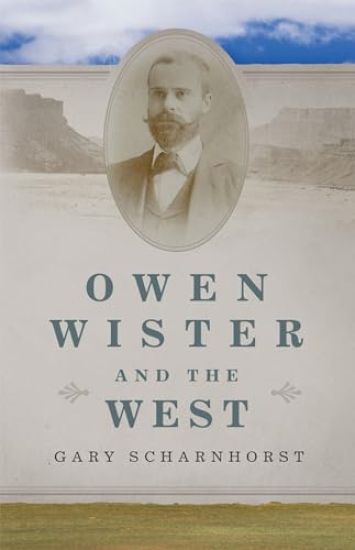
Westerns are rarely only about the West. From the works of James Fenimore Cooper to Gary Cooper, stories set in the American West have served as vehicles for topical commentary. More than any other pioneer of the genre, Owen Wister turned the Western into a form of social and political critique, touching on such issues as race, the environment, women’s rights, and immigration. In Owen Wister and the West, a biographical-literary account of Wister’s life and writings, Gary Scharnhorst shows how the West shaped Wister’s career and ideas, even as he lived and worked in the East.The Virginian, Wister’s claim to literary fame, was published in 1902, but his writing career actually began in 1891 and continued for twenty-five years after the publication of his masterpiece. Scharnhorst traces Wister’s western connections up to and through the publication of The Virginian and shows that the author remained deeply connected to the American West until his death in 1938. Like his Harvard friend Theodore Roosevelt, Wister was the sickly scion of an eastern family who recuperated in the West before returning to his home and inherited social position. His life story is punctuated with appearances by such contemporaries as Frederic Remington, Rudyard Kipling, and Ernest Hemingway. Scharnhorst thoroughly discusses Wister’s experiences in the West, including a detailed chronology of his travels and the writings that grew out of them. He offers numerous insights into Wister’s adroit use of sources, and provides revealing comparisons between Wister’s western works and the writings of other authors treating the same region. The West, Scharnhorst shows, was the crucible in which Wister tested and expressed his political opinions, most of them startlingly conservative by present standards. Yet The Virginian remains the template for the western novel today. More than any other Western writer of the past century and a half, Wister's career merits resurrection.
Westerns are rarely only about the West. From the works of James Fenimore Cooper to Gary Cooper, stories set in the American West have served as vehicles for topical commentary. More than any other pioneer of the genre, Owen Wister turned the Western into a form of social and political critique, touching on such issues as race, the environment, women's rights, and immigration. In Owen Wister and the West, a biographical-literary account of Wister's life and writings, Gary Scharnhorst shows how the West shaped Wister's career and ideas, even as he lived and worked in the East.The Virginian, Wister's claim to literary fame, was published in 1902, but his writing career actually began in 1891 and continued for twenty-five years after the publication of his masterpiece. Scharnhorst traces Wister's western connections up to and through the publication of The Virginian and shows that the author remained deeply connected to the American West until his death in 1938. Like his Harvard friend Theodore Roosevelt, Wister was the sickly scion of an eastern family who recuperated in the West before returning to his home and inherited social position. His life story is punctuated with appearances by such contemporaries as Frederic Remington, Rudyard Kipling, and Ernest Hemingway. Scharnhorst thoroughly discusses Wister's experiences in the West, including a detailed chronology of his travels and the writings that grew out of them. He offers numerous insights into Wister's adroit use of sources, and provides revealing comparisons between Wister's western works and the writings of other authors treating the same region. The West, Scharnhorst shows, was the crucible in which Wister tested and expressed his political opinions, most of them startlingly conservative by present standards. Yet The Virginian remains the template for the western novel today. More than any other Western writer of the past century and a half, Wister's career merits resurrection.
Mark Twain's career was characterized by a complicated relationship with literary fraud. While he argued that all writing was a form of rewriting, his perspective fueled controversy and left him vulnerable to critics, rivals, and publishers who wanted to exploit his fame. From accusations of plagiarism to the piracy of his works abroad, questions of authorship and originality accompanied his craft throughout his career. In this work, the author examines Mark Twain's career in depth, tracing acts of plagiarism, false attributions, imposters posing as Twain or his associates, and the widespread piracy of his writing in countries without copyright enforcement. The study also highlights Twain's own allegations against other writers, his defenses of accused authors, and "visual plagiarisms" of images tied to his books, bringing to light how literary fraud both shaped and distorted Twain's legacy.
Cartoons and Caricatures of Mark Twain in Context
Leslie Diane Myrick; Gary Scharnhorst
THE UNIVERSITY OF ALABAMA PRESS
2023
sidottu
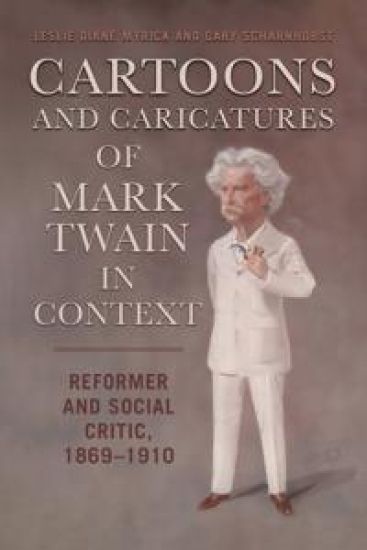
The first book-length treatment of Mark Twain’s public persona as depicted in newspaper and magazine illustrationsCartoons and Caricatures of Mark Twain: Reformer and Social Critic, 1869–1910 reproduces for students and scholars of Twain and American literature a provocative series of visual texts that illustrate the growth of Twain’s reputation as a social and political satirist. Myrick and Scharnhorst trace the evolution of Twain’s depiction across more than forty years and seventy illustrations—from portrayals of the famous author as a court jester adorned with cap and bells, to a regally haloed king with a royal train—offering a new perspective on his influence. Although he was among the most photographed figures of the nineteenth century, Myrick and Scharnhorst focus on a medium that Twain, a genius of self-promotion and an expert at brand management, could not control. As a result, Myrick and Scharnhorst have compiled an innovative and incisive type of reception history. This initial volume of Cartoons and Caricatures of Mark Twain emphasizes Twain’s reputation as a political satirist. It illustrates the popular response to many famous and infamous episodes in his career, such as the storm of controversy that surrounded the publication of his anti-imperialist writings at the turn of the twentieth century. Routinely depicted with hair like a fright wig, a beak-like nose, and a cigar in hand, no matter the context or the costume, Twain was not only the greatest writer in American literary history but perhaps the most iconic figure in American popular culture.
Cartoons and Caricatures of Mark Twain in Context
Leslie Diane Myrick; Gary Scharnhorst
THE UNIVERSITY OF ALABAMA PRESS
2023
nidottu
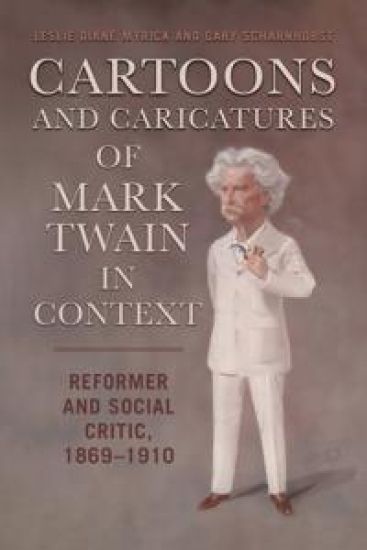
The first book-length treatment of Mark Twain’s public persona as depicted in newspaper and magazine illustrationsCartoons and Caricatures of Mark Twain: Reformer and Social Critic, 1869–1910 reproduces for students and scholars of Twain and American literature a provocative series of visual texts that illustrate the growth of Twain’s reputation as a social and political satirist. Myrick and Scharnhorst trace the evolution of Twain’s depiction across more than forty years and seventy illustrations—from portrayals of the famous author as a court jester adorned with cap and bells, to a regally haloed king with a royal train—offering a new perspective on his influence. Although he was among the most photographed figures of the nineteenth century, Myrick and Scharnhorst focus on a medium that Twain, a genius of self-promotion and an expert at brand management, could not control. As a result, Myrick and Scharnhorst have compiled an innovative and incisive type of reception history. This initial volume of Cartoons and Caricatures of Mark Twain emphasizes Twain’s reputation as a political satirist. It illustrates the popular response to many famous and infamous episodes in his career, such as the storm of controversy that surrounded the publication of his anti-imperialist writings at the turn of the twentieth century. Routinely depicted with hair like a fright wig, a beak-like nose, and a cigar in hand, no matter the context or the costume, Twain was not only the greatest writer in American literary history but perhaps the most iconic figure in American popular culture.
Mark Twain and the Critics, 1891-1910
Gary Scharnhorst; Leslie Diane Myrick
MCFARLAND CO INC
2023
pokkari
Over the last twenty years of his life, Mark Twain was a controversial figure. He evolved from the "clown prince of American literature" into a biting social critic and political observer. While some pundits hailed him as a satirist equal to Cervantes and Jonathan Swift, others excoriated him as a "degenerate literary freak" who wielded a "scurrilous and venomous pen." This volume traces the evolution of Mark Twain's public image between 1891 and his death in 1910. It features hundreds of reviews and other critical notices in magazines and newspapers across the U.S. and other English-speaking countries. The selected samples represent the full range of critical opinion, whether favorable or hostile, about his late writings. Sources reflect geographical differences in Twain's reputation, such as the conflicted responses in the British colonies towards his anti-imperialism and the pious disapproval in the American heartland of his attacks on foreign missions.
This three-volume, hardcover set of Gary Scharnhorst's biography of Samuel Clemens includes The Life of Mark Twain: The Early Years, 1835-1871; The Life of Mark Twain: The Middle Years, 1871-1891; and The Life of Mark Twain: The Final Years, 1891-1910.
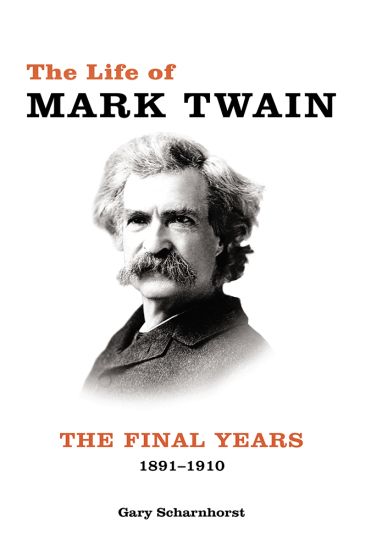
The last installment of Scharnhorst’s three-volume biography chronicles the life of Samuel Clemens between his family’s extended trip to Europe in 1891 and his death in 1910. During this period, Clemens was one of the most famous people in the world. He also grapples with bankruptcy, returns to the lecture circuit, loses two daughters and his wife, and writes some of his darkest, most critical works in the last years of his life.
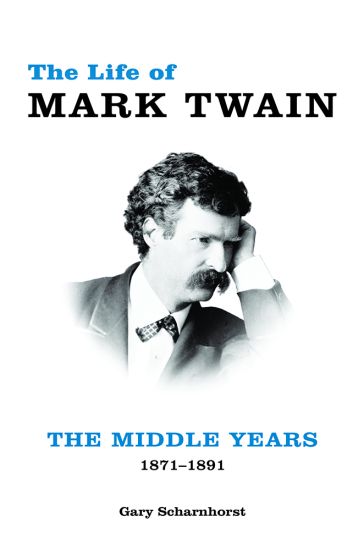
Following on the heels of the first volume, The Life of Mark Twain: The Middle Years, 1871–1891, is the second of three volumes in this critically acclaimed autobiography. This volume chronicles events in Samuel Langhorne Clemens's life between his departure with his family from Buffalo for Elmira and Hartford in spring 1871 and his departure with his family from Hartford for Europe in mid-1891.This is the first multi-volume biography of Samuel Clemens to appear in over a century. In the succeeding years, Clemens biographers have either tailored their narratives to fit the parameters of a single volume or focused on a particular period or aspect of Clemens's life, because the whole of that epic life cannot be compressed into a single volume. In The Life of Mark Twain, Gary Scharnhorst has chosen to write a complete biography plotted from beginning to end, from a single point of view, on an expansive canvas.With dozens of Mark Twain biographies available, what is left unsaid? On average, a hundred Clemens letters and a couple of Clemens interviews surface every year. Scharnhorst has located documents relevant to Clemens's life in Missouri, along the Mississippi River, and in the West, including some which have been presumed lost. Over three volumes, Scharnhorst elucidates the life of arguably the greatest American writer and reveals the alchemy of his gifted imagination.
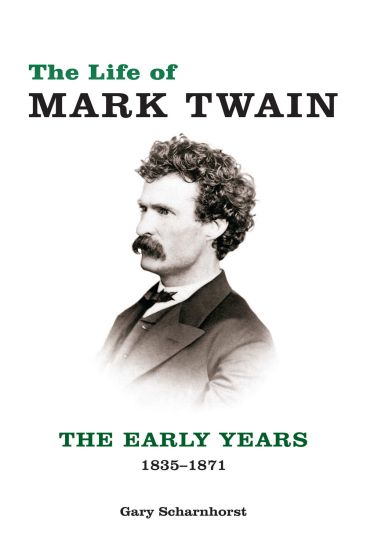
This book begins the first multi-volume biography of Samuel Clemens to appear in over a century. In the succeeding years, Clemens biographers have either tailored their narratives to fit the parameters of a single volume or focused on a particular period or aspect of Clemens’s life, because the whole of that epic life cannot be compressed into a single volume. In The Life of Mark Twain, Gary Scharnhorst has chosen to write a complete biography plotted from beginning to end, from a single point of view, on an expansive canvas. With dozens of Mark Twain biographies available, what is left unsaid? On average, a hundred Clemens letters and a couple of Clemens interviews surface every year. Scharnhorst has located documents relevant to Clemens’s life in Missouri, along the Mississippi River, and in the West, including some which have been presumed lost. Over three volumes, Scharnhorst elucidates the life of arguably the greatest American writer and reveals the alchemy of his gifted imagination.
Mark Twain at Home
Michael J. Kiskis; Laura Skandera Trombley; Gary Scharnhorst
The University of Alabama Press
2016
sidottu
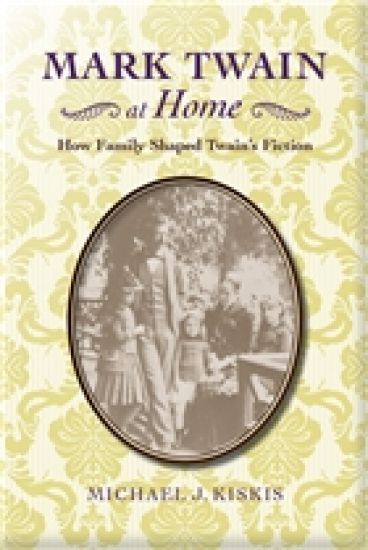
Twain scholar Michael Kiskis opens this fascinating new exploration of Twain with the observation that most readers have no idea that Samuel Clemens was the father of four and that he lived through the deaths of three of his children as well as his wife. In Mark Twain at Home: How Family Shaped Twain’s Fiction, Kiskis persuasively argues that not only was Mark Twain not, as many believe, “antidomestic,” but rather the home and family were the muse and core message of his writing.Mark Twain was the child of a loveless marriage and a homelife over which hovered the constant specter of violence. Informed by his difficult childhood, orthodox readings of The Adventures of Tom Sawyer and Adventures of Huckleberry Finn frame these canonical literary figures as nostalgic—autobiographical fables of heroic individualists slipping the bonds of domestic life.Kiskis, however, presents a wealth of biographical details about Samuel Clemens and his family that reinterpret Twain’s work as a robust affirmation of domestic spheres of life. Among Kiskis’s themes are that, as the nineteenth century witnessed high rates of orphanhood and childhood mortality, Clemens’s work often depicted unmoored children seeking not escape from home but rather seeking the redemption and safety available only in familial structures. Similarly, Mark Twain at Home demonstrates that, following the birth of his first daughter, Twain began to exhibit in his writing an anxiety with social ills, notably those that affected children.In vigorous and accessible descriptions of Twain’s life as it became reflected in his prose, Kiskis offers a compelling and fresh understanding of this work of this iconic American author.
This is a comprehensive collection of authentic recipes, some 500 in all, for drinks and dishes that more than 150 American authors since the late 18th century are known to have enjoyed. The book should appeal to amateur chefs and so-called "foodies" who may want to test some of the recipes in their kitchens; to American literature instructors and scholars who may use it as a teaching tool; and general readers who will read it for pleasure. In effect, this is a celebrity cookbook to which many literary celebrities, living and dead, have contributed, among them Harriet Beecher Stowe, Rudolfo Anaya, Denise Chavez, Emily Dickinson, William Faulkner, Harlan Ellison, Ursula Le Guin, Benjamin Franklin, Charlotte Perkins Gilman, Jack London, Allen Ginsberg, Lafcadio Hearn, Ernest Hemingway, Jack Kerouac, Elmore Leonard, Bobbie Ann Mason, Marjorie Kinnan Rawlings, Leslie Marmon Silko, Gertrude Stein, Onoto Watanna, Eudora Welty, Walt Whitman, and Gerald Vizenor.
Julian Hawthorne (1846-1934), Nathaniel Hawthorne's only son, lived a long and influential life marked by bad circumstances and worse choices. Raised among luminaries such as Thoreau, Emerson, and the Beecher family, Julian became a promising novelist in his twenties, but his writing soon devolved into mediocrity. What talent the young Hawthorne had was spent chasing across the changing literary and publishing landscapes of the period in search of a paycheck, writing everything from potboilers to ad copy. Julian was consistently short of funds because--as biographer Gary Scharnhorst is the first to reveal--he was supporting two households: his wife in one and a longtime mistress in the other. The younger Hawthorne's name and work ethic gave him influence in spite of his haphazard writing. Julian helped to found Cosmopolitan and Collier's Weekly. As a Hearst stringer, he covered some of the era's most important events: McKinley's assassination, the Galveston hurricane, and the Spanish-American War, among others. When Julian died at age 87, he had written millions of words and more than 3,000 pieces, out-publishing his father by a ratio of twenty to one. Gary Scharnhorst, after his own long career including works on Mark Twain, Oscar Wilde, and other famous writers, became fascinated by the leaps and falls of Julian Hawthorne. This biography shows why.
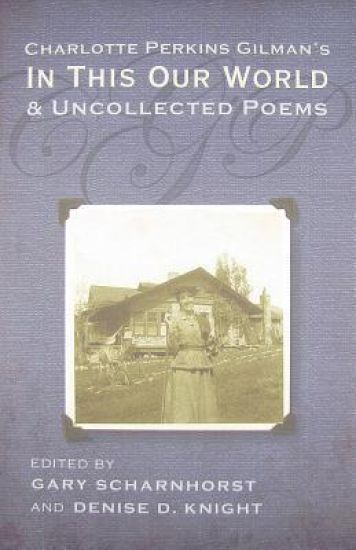
Charlotte Perkins Gilman's in This Our World and Uncollected Poems
Gary Scharnhorst
Syracuse University Press
2012
sidottu
Prominent American author, lecturer, and social reformer Charlotte Perkins Gilman (1860–1935) is best known for her 1898 treatise Women and Economics, which traced gender inequality to women’s economic dependence upon men, and for her 1892 short story ""The Yellow Wall-Paper,"" which depicts a woman’s descent into madness. However, she began her career as a poet. Her first authored book, a collection of verse entitled In This Our World, was issued in four different editions between 1893 and 1898. While virtually all of Gilman’s later poems appeared in her monthly magazine, The Forerunner (1909–1916), or in The Later Poetry of Charlotte Perkins Gilman (1996), Gilman’s early verse has been largely inaccessible to modern readers, and dozens of her poems have never been collected. This volume, co-edited by Scharnhorst and Knight, includes all 149 poems in the 1898 edition of In This Our World as well as 79 vagrant poems that appeared in a variety of newspapers and magazines. This critical volume features a comprehensive introduction, appendixes, and extensive notes. Gilman devotees and a new generation of readers will find this edition an indispensable resource.
Kate Field was among the first celebrity journalists. A literary and cultural sensation, she reported the news while frequently becoming news herself because of her sharp wit and vibrant presence. She wrote for several prestigious newspapers, such as the ""Boston Post"", ""Chicago Tribune"", and ""New York Herald"", as well her own ""Kate Field's Washington"". Field's friends and professional acquaintances included Charles Dickens, Robert Browning, Elizabeth Barrett Browning, Anthony Trollope, and George Eliot. Legendary novelist Henry James patterned the character of Henrietta Stackpole after her in ""The Portrait of a Lady"".In this eloquent and immensely readable biography, Gary Scharnhorst offers a fascinating, often poignant portrait of a fiercely intelligent and enormously independent woman who contributed significantly to America's intellectual and social life in the late nineteenth century. Kate Field was an outspoken advocate for the rights of black Americans and founder of the first women's club in America. She campaigned to make Yosemite a national park and saved John Brown's Adirondack farm for the nation. Field's activities will interest students and scholars of nineteenth-century American literature, women's studies, and journalism, as well as patrons of public and academic libraries.
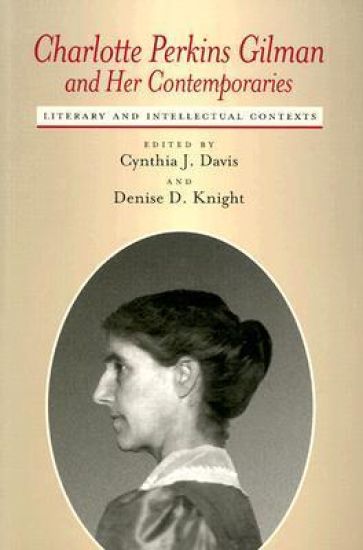
Charlotte Perkins Gilman and Her Contemporaries
Gary Scharnhorst
The University of Alabama Press
2004
nidottu
By placing Charlotte Perkins Gilman in the company of her contemporaries, this collection seeks to correct misunderstandings of the feminist writer and lecturer as an isolated radical. Gilman believed and preached that no life is ever led in isolation; indeed, the cornerstone of her philosophy was the idea that ""humanity is a relation."" Gilman's highly public and combative stances as a critic and social activist brought her into contact and conflict with many of the major thinkers and writers of the period, including Mary Austin, Margaret Sanger, Ambrose Bierce, Grace Ellery Channing, Lester Ward, Inez Haynes Gillmore, William Randolph Hearst, Karen Horney, William Dean Howells, Catharine Beecher, George Bernard Shaw, and Owen Wister. Gilman wrote on subjects as wide ranging as birth control, eugenics, race, women's rights and suffrage, psychology, Marxism, and literary aesthetics. Her many contributions to social, intellectual, and literary life at the turn of the 20th century raised the bar for future discourse, but at great personal and professional cost.
A reception history of the writings of Henry David Thoreau, author of Walden. Professor Scharnhorst's survey of trends in Thoreau criticism over the past century and a half shows that Thoreau's elevation to literary sainthood was the result of a distinct, if not wholly conscious, process of critical resurrection and revival. Each of Scharnhost's five chapters covers approximately thirty years of critical commentary on Thoreau's works, including his contemporary reputation, his postumous revival at the end of the century, his 'packaging' as a literary property early in the 20th century, and his vogue since the Great Depression as a darling of both formalist and political critics. Scharnhorst comments on the enduring division of critical opinion over Thoreau and his work, attributing it to the different audiences attracted by his subject matter - issues such as war, racial justice and environmental ethics - and the refinement of his literary achievement.
American Literary Scholarship is published in annual volumes (since 1963) that cover current critical analysis of American literature. Bibliographic essays are arranged by writers and time periods, from pre-18 to the present. Among the writers discussed are Poe, Dickinson, Emerson, Whitman, Fitzgerald, and Pound.
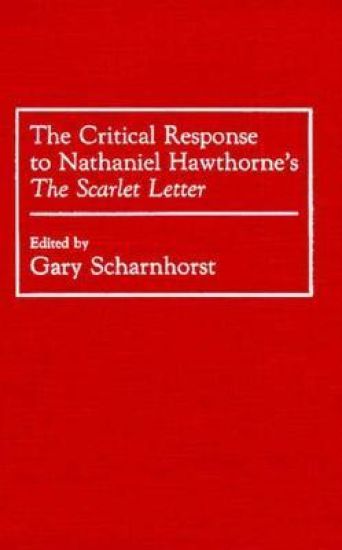
The Critical Response to Nathaniel Hawthorne's The Scarlet Letter
Gary Scharnhorst
Greenwood Press
1992
sidottu
The Scarlet Letter is virtually unique among works of American fiction because it has not lapsed from print in over 140 years. The history of its reception, which is fully articulated in the volume introduction, may be read as a case study in canon formation. The collection of documents in the volume outline the highs and lows of Nathaniel Hawthorne's literary reputation and the elevation of his first and best-known romance to the rank of masterpiece and classic. Also included is a selective bibliography of modern scholarship. Among the early documents reprinted are contemporary news accounts of Hawthorne's dismissal from the Salem Custom House in June 1849, which provide the immediate background to The Custom House introduction in the story, the publisher James T. Fields's anecdotal version of the book's composition history, and a generous sheaf of notices from both American and British newspapers upon its publication in March, 1850. Of special value are the various essays and other materials that trace the institutionalization of the romance within the genteel tradition of American letters in the late nineteenth century. More recently, The Scarlet Letter has become something of an academic shibboleth, inspiring dozens of New Critical, psychoanalytical, feminist, and other readings, which are also represented in this collection. Prominent among modern critics whose essays appear are Neal Frank Doubleday, Darrel Abel, and Nina Baym. A number of reviews of theatrical and cinematic adaptations of the story also underscore its stature as a cultural icon. This volume is essential for serious research on Nathaniel Hawthorne and provides a convenient body of valuable commentary accessible even to the student reading The Scarlet Letter for the first time.