Kirjojen hintavertailu. Mukana 12 595 353 kirjaa ja 12 kauppaa.

Kirjailija

Gary Snyder

Kirjat ja teokset yhdessä paikassa: 54 kirjaa, julkaisuja vuosilta 1969-2026, suosituimpien joukossa Wind Crossing Grasses. Vertaile teosten hintoja ja tarkista saatavuus suomalaisista kirjakaupoista.

54 kirjaa

Kirjojen julkaisuhaarukka 1969-2026.

Tidlige dikt

Tidlige dikt

Gary Snyder

Bokvennen
2015
sidottu
Tidlige dikt dekker de første elleve årene av Gary Snyders forfatterskap, 1955-1967. For første gang foreligger dette på norsk, og ikke minst, gjendiktet på trøndersk. For mange er Snyder mest kjent som modell for karakteren Japhy Ryder i Jack Kerouacs Dharma Bums fra 1958. Her tegnes et bilde av poeten som en ung vismann som veileder den litt eldre prosaisten. Dette bildet av Snyder har mange ment stemmer godt med personen og den rollen han hadde i Beat-miljøet. Men det er først og fremst som poet og essayist Gary Snyder har gått inn den amerikanske litteraturhistorien. Han er en klar arvtager av Ezra Pound, Charles Olson og William Carlos Williams. Diktene fra Snyders tre første samlinger dekker og samtaler med en periode i amerikansk historie, som var preget av store sosiale og politiske omveltninger. Snyders tekster var et viktig bidrag til den litterære samtalen i sin samtid, og speiler en poets liv, på siden, og midt i et opprør, litterært og sosialt.
Distant Neighbors

Distant Neighbors

Gary Snyder; Wendell Berry

Counterpoint
2015
nidottu
In 1969 Gary Snyder returned from a long residence in Japan to northern California, to a homestead in the Sierra foothills where he intended to build a house and settle on the land with his wife and young sons. He had just published his first book of essays, Earth House Hold. A few years before, after a long absence, Wendell Berry left New York City to return to land near his grandfather's farm in Port Royal, Kentucky, where he built a small studio and lived there with his wife as they restored an old house on their newly acquired homestead. In 1969 Berry had just published Long-Legged House. These two founding members of the counterculture and of the new environmental movement had yet to meet, but they knew each other's work, and soon they began a correspondence. Neither man could have imagined the impact their work would have on American political and literary culture, nor could they have appreciated the impact they would have on one another.Snyder had thrown over all vestiges of Christianity in favor of becoming a devoted Buddhist and Zen practitioner, and had lived in Japan for a prolonged period to develop this practice. Berry's discomfort with the Christianity of his native land caused him to become something of a renegade Christian, troubled by the church and organized religion, but grounded in its vocabulary and its narrative. Religion and spirituality seemed like a natural topic for the two men to discuss, and discuss they did.They exchanged more than 240 letters from 1973 to 2013, remarkable letters of insight and argument. The two bring out the best in each other, as they grapple with issues of faith and reason, discuss ideas of home and family, worry over the disintegration of community and commonwealth, and share the details of the lives they've chosen to live with their wives and children. Contemporary American culture is the landscape they reside on. Environmentalism, sustainability, global politics and American involvement, literature, poetry and progressive ideals, these two public intellectuals address issues as broad as are found in any exchange in literature.No one can be unaffected by the complexity of their relationship, the subtlety of their arguments, and the grace of their friendship. This is a book for the ages.
Songs of Gods, Songs of Humans

Songs of Gods, Songs of Humans

Donald L. Phillipi; Gary Snyder

Princeton University Press
2015
pokkari
As an especially beautiful and pure example of the archaic epic styles that were once current among the hunting and fishing peoples of northern Asia, the Ainu epic folklore is of immense literary value. This collection and English translation by Donald Philippi contains thirty-three representative selections from a number of epic genres including mythic epics, culture hero epics, women's epics, and heroic epics. This is the first time, outside of Japan, that the Ainu epic folklore has been treated in a comprehensive manner. Originally published in 1979. The Princeton Legacy Library uses the latest print-on-demand technology to again make available previously out-of-print books from the distinguished backlist of Princeton University Press. These editions preserve the original texts of these important books while presenting them in durable paperback and hardcover editions. The goal of the Princeton Legacy Library is to vastly increase access to the rich scholarly heritage found in the thousands of books published by Princeton University Press since its founding in 1905.
Nobody Home

Nobody Home

Gary Snyder; Julia Martin

Trinity University Press,U.S.
2014
pokkari
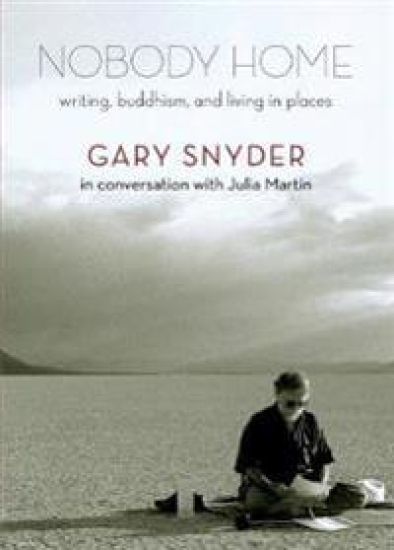
In this thoughtful, affectionate collection of interviews and letters spanning three decades, beloved poet Gary Snyder talks with South African writer and scholar Julia Martin. Over this period many things changed decisively--globally, locally, and in their personal lives--and these changing conditions provide the back story for a long conversation. It begins in the early 1980s as an intellectual exchange between an earnest graduate student and a generous distinguished writer, and becomes a long-distance friendship and an exploration of spiritual practice. At the project's heart is Snyder's understanding of Buddhism. Again and again, the conversations return to an explication of the teachings. Snyder's characteristic approach is to articulate a direct experience of Buddhist practice rather than any kind of abstract philosophy. In the version he describes here, this practice finds expression not primarily as an Asian import or a monastic ideal, but in the specificities of a householder's life as lived creatively in a particular location at a particular moment in history. This means that whatever "topic" a dialogue explores, there is a sense that all of it is about practice--the spiritual-social practice of a contemporary poet.
Danger On Peaks

Danger On Peaks

Gary Snyder

Counterpoint
2014
sidottu
We are proud to continue our project of publishing Deluxe Audio Editions of the poems of Gary Snyder, read by him. When first published in 2004, it was the poet s first new collection of poems in twenty years. Perhaps his most personal, autobiographical collection, it begins with the young poet ascending Mt. St. Helens in 1945, a climb accidentally timed with the bombing of Hiroshima and Nagasaki. He was 15 years old. Almost sixty years later, after the great Buddhas at Bamiyan Valley were bombed and with the victims of the World Trade Center also turned to dust, the poet composed a prayer while at Short Grass Temple in Senso-ji, a pilgrim on the path of Kannon, Goddess of Mercy. This remarkable collection was greeted with broad praise, and as Julia Martin proclaimed, Moving between relative and absolute ways of seeing, [Snyder] responds to the experience of global conflict and personal pain by reminding readers of the continuity of wildness, affirming the value of art, and invoking an ancient practice of wisdom and compassion. "
The High Sierra of California

The High Sierra of California

Gary Snyder

Heyday Books
2014
muu
The High Sierra of California is a brilliant tribute to the bold, jagged peaks that have inspired generations of naturalists, artists, and writers. Using traditional Japanese and European woodcut techniques, Killion has created stunning visual images of the Sierra that focus on the backcountry above nine thousand feet, accessible only on foot. Accompanying these riveting images are the journals of Gary Snyder, chronicling more than forty years of travels through the High Sierra backcountry.
Ring of Bone: Collected Poems

Ring of Bone: Collected Poems

Lew Welch; Gary Snyder

City Lights Books
2012
pokkari
**A San Francisco Chronicle Best Book of 2012** Lew Welch was a brilliant and troubled poet, legendary among his Beat peers. Ring of Bone collects poems, songs, and even a few drawings, documenting the full sweep of his creative output, from his early years until just before his death. This new edition includes a biographic timeline and a statement of poetics gleaned from Welch's own writing. Welch entered Reed College in 1948, and the following year moved into a house with Gary Snyder; they were soon joined by Philip Whalen. With the emergence of the Beat movement, Welch's friends began receiving national attention and his desire to devote himself completely to his poetry was galvanized. He soon became a part of the San Francisco poetry scene. Legendary editor Donald Allen included Welch's poetry in The New American Poetry -- the seminal anthology published in 1960. That same year Welch's first book, Wobbly Rock, was released. He continued to write extensively, and in 1965 published three books. Despite his burgeoning success, Welch suffered from bouts with depression, and on May 23, 1971, Gary Snyder went up to Welch's campsite in the Sierra Nevada mountains and found a suicide note. Despite an extensive search, Welch's body was never recovered. "Lew Welch writes lyrical poems of clarity, humor, and dark probings ...jazz musical phrasings of American speech is one of Welch's clearest contributions." --Gary Snyder "...Music permeates his poems, which range from scored lyrics to epistolary correspondence to formal villanelles...It's fascinating to trace the evolution of this artist, from his early, lax, exultant style to his later, less jubilant work, characterized by benedictions, invocations, and requests. This is a necessary read for anyone interested in the greater Beat movement and its progenitors."--Booklist "His luminous poems feel as vibrant today as when they first burst from the wellsprings of creativity in his own head...A postmodern Walt Whitman..."--San Francisco Chronicle "In the poet's own words, [Ring of Bone] is a spiritual autobiography ...no better description of him exists than that which came in his own vision, deep in the wilds of the Klamath Mountains, the poem after which the collection is titled. ..These 40 years later, Lew, you are missed."--The Rumpus "Ring of Bone: Collected Poems is Welch's major work. Exuberant, funny, dark, hypnotic, Welch's poems are as infused with nature as [Gary] Snyder's and as spiritually alive as [Philip] Whalen's. They're technically brilliant, grounded in form and wildly experimental..."--The Oregonion
Pharmako/Poeia, Revised and Updated

Pharmako/Poeia, Revised and Updated

Dale Pendell; Gary Snyder

North Atlantic Books,U.S.
2010
pokkari
This is the first volume of North Atlantic Books' updated paperback edition of Dale Pendell's Pharmako trilogy, an encyclopedic study of the history and uses of psychoactive plants and related synthetics first published between 1995 and 2005. The books form an interrelated suite of works that provide the reader with a unique, reliable, and often personal immersion in this medically, culturally, and spiritually fascinating subject. All three books are beautifully designed and illustrated, and are written with unparalleled authority, erudition, playfulness, and range. Pharmako/Poeia: Plant Powers, Poisons, and Herbcraft includes a new introduction by the author and as in previous editions focuses on familiar psychoactive plant-derived substances and related synthetics, ranging from the licit (tobacco, alcohol) to the illicit (cannabis, opium) and the exotic (absinthe, salvia divinorum, nitrous oxide). Each substance is explored in detail, not only with information on its history, pharmacology, preparation, and cultural and esoteric correspondences, but also the subtleties of each plant's effect on consciousness in a way that only poets can do. The whole concoction is sprinkled with abundant quotations from famous writers, creating a literary brew as intoxicating as its subject.The Pharmako series is continued in Pharmako/Dynamis (focusing on stimulants and empathogens) and Pharmako/Gnosis (which addresses psychedelics and shamanic plants).
Riprap And Cold Mountain Poems

Riprap And Cold Mountain Poems

Gary Snyder

Counterpoint
2010
nidottu
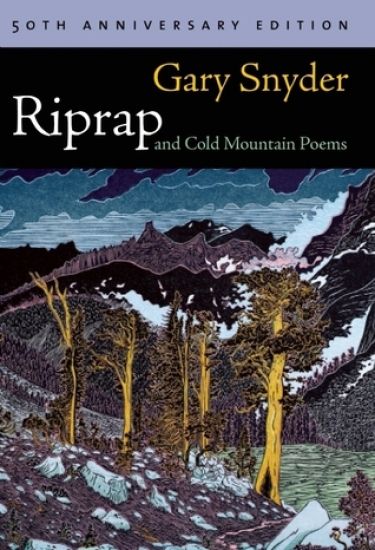
By any measure, Gary Snyder is one of the greatest poets in America in the last century. From his first book of poems to his latest collection of essays, his work and his example, standing between Tu Fu and Thoreau, have been influential all over the world. Riprap, his first book of poems, was published in Japan in 1959 by Origin Press, and it is the fiftieth anniversary of that groundbreaking book we celebrate with this edition. A small press reprint of that book included Snyder's translations of Han Shan's Cold Mountain Poems, perhaps the finest translations of that remarkable poet ever made into English. Reintroducing one of the twentieth century's foremost collections of poetry, this edition will please those already familiar with this work and excite a new generation of readers with its profound simplicity and spare elegance.
Loputtomat vuoret ja joet

Loputtomat vuoret ja joet

Gary Snyder

Palladium Kirjat
2010
nidottu
Neljänkymmenen vuoden mittaisen kirjoittamisen ja elämisen tulos, Gary Snyderin amerikkalainen eeppinen runo ilmestyi ensimmäisen kerran vuonna 1996. Teosta inspiroi alunperin itäaasialainen maisemamaalaus, sekä hänen oma kokemuksensa "kaoottisesta kaikkeudesta jossa kaikella on paikkansa". Teos on huima maan ja taivaan, kallion ja veden, luonnon ja ihmisyyden ylistys.
The Selected Letters Of Allen Ginsberg And Gary Snyder

The Selected Letters Of Allen Ginsberg And Gary Snyder

Gary Snyder; Allen Ginsberg

Counterpoint
2009
nidottu
One of the central relationships in the Beat scene was the long-lasting friendship of Allen Ginsberg and Gary Snyder. Ginsberg introduced Snyder to the East Coast Beat writers, including Jack Kerouac, while Snyder himself became the model for the serious poet that Ginsberg so wanted to become. Snyder encouraged Ginsberg to explore the beauty of the West Coast and, even more lastingly, introduced Ginsberg to Buddhism, the subject of so many long letter exchanges between them.Beginning in 1956 and continuing through 1995, the two men exchanged more than 850 letters. Bill Morgan, Ginsberg's biographer and an important editor of his papers, has selected the most significant correspondence from this long friendship. The letters themselves paint the biographical and poetic portraits of two of America's most important  and most fascinating  poets.
Passage Through India

Passage Through India

Gary Snyder

Counterpoint
2009
nidottu
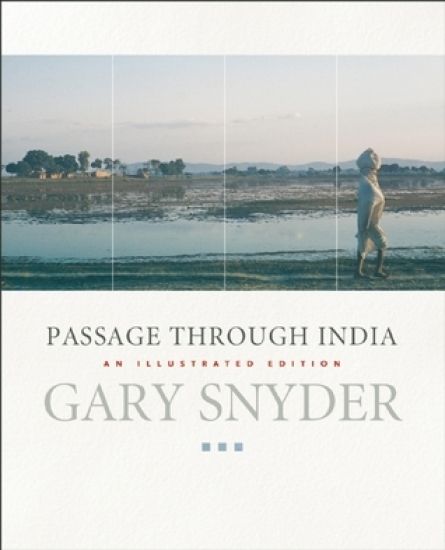
In 1962, after studying Buddhism in Japan, Gary Snyder, with his former wife, the poet Joanne Kyger, joined Allen Ginsberg and his companion Peter Orlovsky for a long trip to India  to see the hearth-land of the Buddha's teachings."Snyder kept extensive journals of his travels and, in this particular case, also wrote the whole account in one long letter to his sister. Passage Through India brings both together in celebration of and reverence for India and its teachings. As Snyder writes in his original preface,  I honor India for many things: those neolithic cattle breeders who sang daily songs of love to God and Cow, as a family, and whose singing is echoed even today . . . The finest love poetry and love sculpture on earth . . . But most, the spectacle of a high civilization that accomplished art, literature, and ceremony without imposing a narrow version of itself on every tribe and village." Complete with over a hundred photos from Snyder's personal collection, Passage Through India is an opportunity to join one of our most heralded and beloved poets on a great spiritual journey under  an eternal sky of stars, and on a beginningless earth."
A Place in Space

A Place in Space

Gary Snyder

Counterpoint
2008
pokkari
In this classic collection of 29 pieces that span half a century, Gary Snyder explores humans' complex, ever-evolving attitudes toward the environment. He argues that nature is not separate from humanity, but intrinsic to it, and that since societies are natural constructs, it's imperative to go beyond racial, ethnic, and religious identities to find a shared concern for acts that benefit humans and nonhumans alike. Included in the collection is his 1971 environmental manifesto  Four Changes," which, as he writes in a postscript, is unfortunately truer than ever. In this new edition, Snyder sends out a call-to-action that challenges all beings to take moral responsibility, a call that resounds with readers discovering the book for the first time or those returning to an old favorite.
Mountains And Rivers Without End

Mountains And Rivers Without End

Gary Snyder

Counterpoint
2008
nidottu
In simple, striking verse, legendary poet Gary Snyder weaves an epic discourse on the topics of geology, prehistory, and mythology. First published in 1996, this landmark work encompasses Asian artistic traditions, as well as Native American storytelling and Zen Buddhist philosophy, and celebrates the disparate elements of the Earth  sky, rock, water  while exploring the human connection to nature with stunning wisdom. Winner of the Bollingen Poetry Prize, the Robert Kirsch Lifetime Achievement Award, and the Orion Society's John Hay Award, among others, Gary Snyder finds his quiet brilliance celebrated in this new edition of one of his most treasured works.
Back On The Fire

Back On The Fire

Gary Snyder

Counterpoint
2008
nidottu
This collection of essays by Gary Snyder, now in paperback, blazes with insight. In his most autobiographical writing to date, Snyder employs fire as a metaphor for the crucial moment when deeply held viewpoints yield to new experiences, and our spirits and minds broaden and mature. Snyder here writes and riffs on a wide range of topics, from our sense of place and a need to review forestry practices, to the writing life and Eastern thought. Surveying the current wisdom that fires are in some cases necessary for ecosystems of the wild, he contemplates the evolution of his view on the practice, while exploring its larger repercussions on our perceptions of nature and the great landscapes of the West. These pieces include recollections of his boyhood, his involvement with the literary community of the Bay Area, his travels to Japan, as well as his thoughts on American culture today. All maintain Snyder's reputation as an intellect to be reckoned with, while often revealing him at his most emotionally vulnerable. The final impression is holistic: We perceive not a collection of essays, but a cohesive presentation of Snyder's life and work expressed in his characteristically straightforward prose.
Zen Pioneer

Zen Pioneer

Isabel Stirling; Gary Snyder

Counterpoint
2007
nidottu
Ruth Fuller Sasaki, who died in 1967, was a pivotal figure in the emergence and development of Zen Buddhism in the United States. She is the only Westerner and the only woman to be made a priest of a Daitoku-ji temple and was mentor to Burton Watson, Philip Yampolsky, and Gary Snyder, and mother-in-law of Alan Watts. This is the first biography of her remarkable life.Few devoted their lives to Zen Buddhism as Ruth Fuller did. As a senior student of Sokei-an Sasaki in New York, Ruth helped him develop the infrastructure of what would eventually become The First Zen Institute in New York City. She married Sasaki in 1944, and it was her mission to maintain The First Zen Institute and later, to establish The First Zen Institute of America in Japan. Her legacy remains today in the Zen facilities she helped build in New York and abroad and in the many texts she saw through translation, published from the 1950s to the 1970s. For the first time in book form, three of her writings are included here Zen: A Religion, Zen: A Method for Religious Awakening, and Rinzai Zen Study for Foreigners in Japan.
He Who Hunted Birds In His Father's Village

He Who Hunted Birds In His Father's Village

Gary Snyder; Robert Bringhurst

Counterpoint
2007
nidottu
In 1951, as a student of anthropology in Oregon, Gary Snyder set himself to the task of analyzing the many levels of meaning a single Native American myth might hold. He Who Hunted Birds in His Father's Village is the result of Snyder's critical look at a Haida tale that was told by the great oral poet Ghandl (Walter McGregor) to John Swanton sometime before 1905. A version of the ubiquitous  swan maiden" story, it tells of a chief's son who falls in love with a wild goose-girl, loses her, follows her into the sky, and returns to land as a seagull. Snyder goes deep into the transformations that occur in the myth, considering versions of myth from around the world, and explaining how the story might apply here and now. He writes:To go beyond and become what-a seagull on a reef? Why not. Our nature is no particular nature; look out across the beach at the gulls. For an empty moment while their soar and cry enters your heart like sunshaft through water, you are that, totally. We do this every day. So this is the aspect of mind that gives art, style, and self-transcendence to the inescapable human plantedness in a social and ecological nexus. The challenge is to do it well, by your neighbors and by the trees, and that maybe once in a great while we can get where we see through the same eye at the same time, for a moment. That would be doing it well. Old tales and myths and stories are the k_ans of the human race.
Opening The Mountain

Opening The Mountain

Matthew Davis; Michael Farrell Scott; Gary Snyder

Counterpoint
2006
nidottu
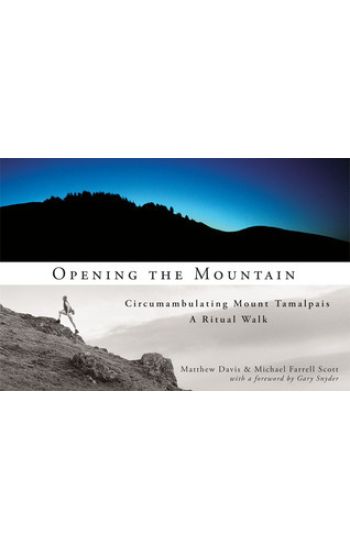
In 1965, Allen Ginsberg, Gary Snyder and Philip Whalen gathered at the base of Mt. Tamalpais, a lovely small mountain in Marin County that anchors the San Francisco Bay on its northwest side. Inspired by Tibetan and Indian practices of walking clockwise  the way of the sun"  around a venerated object, they  opened the mountain" by completing the first circumambulation. They did it again two years later, a month after the  Human Be-in" in Golden Gate Park, and with greater company as they invited the public to join them. The practice has continued almost uninterrupted for forty years, with Matthew Davis finding an organizing role on April 8, 1971, the Buddha's birthday, when he first led the walk. He has led the celebrations more than 140 times since.The ritual walk  slightly less than 15 miles in length  marks the four quarters of the year. Ten way stations have been established for ceremonial chanting and prayer. With 80 remarkable photographs by Michael Farrell Scott, lovely drawings and maps, chants and poems, this book documents not only this particular spiritual practice but offers guidance for others wishing to establish similar practices in their own areas.