Kirjojen hintavertailu. Mukana 12 484 732 kirjaa ja 12 kauppaa.

Kirjailija

Gary Watt

Kirjat ja teokset yhdessä paikassa: 15 kirjaa, julkaisuja vuosilta 2009-2025, suosituimpien joukossa Shakespeare and the Law. Vertaile teosten hintoja ja tarkista saatavuus suomalaisista kirjakaupoista.

15 kirjaa

Kirjojen julkaisuhaarukka 2009-2025.

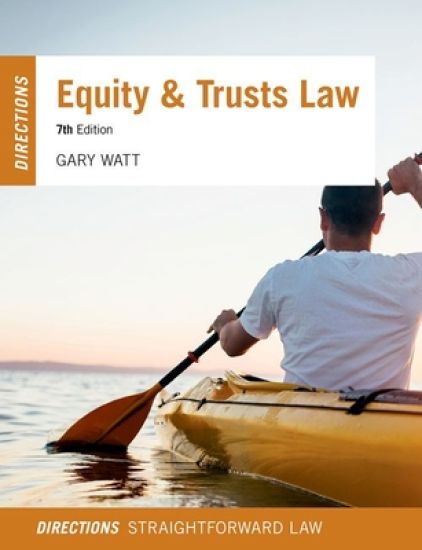
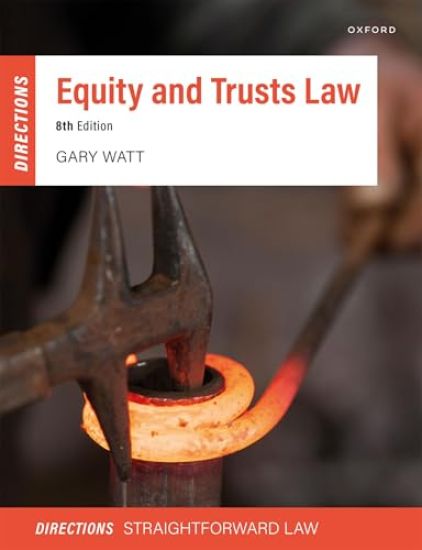
Equity & Trusts Law Directions

Equity & Trusts Law Directions

Gary Watt

Oxford University Press
2025
nidottu
This is the most student-friendly guide to the subject; empowering students to evaluate the law, understand its practical application, and approach assessments with confidence. Watt's Equity & Trusts Law Directions presents students with a considered balance of depth, detail, context, and critique on the topic. Key features · Gain a balanced understanding of the topic: the right amount of detail conveyed clearly · Understand the law in context: with scene-setting introductions and highlighted case extracts the practical importance of the law becomes clear · Identify when and how to critically evaluate the law: the key areas of debate are set out, with support to confidently question the law · Direct and consolidate knowledge: self-testing features aid understanding and help students tackle assessments with confidence · Elevate learning: inspiring students to take their learning to the next level, the author provides direction on going further · Also available as an e-book with functionality, navigation features, and links that offer extra learning support New to this edition · Discusses the implications of cryptocurrency for the specific performance of agreements and the tracing of funds in equity · Reviews the use of 'massively discretionary trusts' and sham trusts to hide wealth from the tax authorities · Covers ethical investment of trusts and the implications of political controversies for the funding of charitable trusts · References the Court of Appeal on the relationship between the fiduciary duty and the duty care, as well as remedies where fiduciary gains and careless losses arise from the same transaction · Includes updates from the Supreme Court on a claimant's ability to recover in an action tainted by their illegality and an innocent claimant’s recovery of wrongful fiduciary gains that the CPS wants to confiscate for criminality Digital formats and resources The eighth edition is available for students and institutions to purchase in a variety of formats: the e-book and Law Trove offer a mobile experience and convenient access along with video lectures by the author, sample essay questions and problem scenarios with guidance on answering, self-test questions, functionality tools, navigation features, and links that offer extra learning support.
Shakespeare and the Law

Shakespeare and the Law

Gary Watt

Oxford University Press
2024
nidottu
Shakespeare and the Law appreciates Shakespeare and his works as expressions of an English early modern culture in which the shared rhetorical practices of dramatists and lawyers were informed by the renaissance of classical practice. It argues that Shakespeare was not primarily concerned with the technical accuracy of law, legal ideas, and legal performances, but with their capacity to generate dramatic interest through dispute, trial, the breaking of bonds, and the bending of rules. It follows that all Shakespeare's plays are in a sense “law plays”. Rhetorical practices can emerge as performances of power, but in Shakespeare's works they show more as instances of the human instinct to challenge power by playing with rules. Shakespeare employs the special magic of legal language, actions, and materials to conjure playgoers to act as a critical jury to events transacted on stage. This calls for close attention to Shakespeare's poetic sound effects and the ways they prompt audiences to confer a fair hearing.
Shakespeare and the Law

Shakespeare and the Law

Gary Watt

Oxford University Press
2024
sidottu
Shakespeare and the Law appreciates Shakespeare and his works as expressions of an English early modern culture in which the shared rhetorical practices of dramatists and lawyers were informed by the renaissance of classical practice. It argues that Shakespeare was not primarily concerned with the technical accuracy of law, legal ideas, and legal performances, but with their capacity to generate dramatic interest through dispute, trial, the breaking of bonds, and the bending of rules. It follows that all Shakespeare's plays are in a sense “law plays”. Rhetorical practices can emerge as performances of power, but in Shakespeare's works they show more as instances of the human instinct to challenge power by playing with rules. Shakespeare employs the special magic of legal language, actions, and materials to conjure playgoers to act as a critical jury to events transacted on stage. This calls for close attention to Shakespeare's poetic sound effects and the ways they prompt audiences to confer a fair hearing.
The Making Sense of Politics, Media, and Law

The Making Sense of Politics, Media, and Law

Gary Watt

Cambridge University Press
2023
sidottu
From Trump's 'make America great again' to Johnson's 'build back better', performative politicians use The Making Sense to persuade their public audiences. Law 'makers' do it too: A courtroom trial is a 'truth factory' in which facts are not found but forged. The 'court of popular opinion' is another such factory, though its processes are often flawed and its products faulty. Where courts of law aim to make civil peace, 'trial by Twitter' makes civil strife. Even in 'mainstream' media, journalists make news for public consumption, so that all news is to an extent 'fake news'. In a world of making, how can we separate craft from craftiness? With insights from disciplines including law, politics, rhetoric, media studies, psychology, sociology, marketing, and performance studies, The Making Sense of Politics, Media, and Law offers a constructive way to approach controversies from transgender identity to cancel culture. This title is also available as open access on Cambridge Core.
The Making Sense of Politics, Media, and Law

The Making Sense of Politics, Media, and Law

Gary Watt

Cambridge University Press
2023
pokkari
From Trump's 'make America great again' to Johnson's 'build back better', performative politicians use The Making Sense to persuade their public audiences. Law 'makers' do it too: A courtroom trial is a 'truth factory' in which facts are not found but forged. The 'court of popular opinion' is another such factory, though its processes are often flawed and its products faulty. Where courts of law aim to make civil peace, 'trial by Twitter' makes civil strife. Even in 'mainstream' media, journalists make news for public consumption, so that all news is to an extent 'fake news'. In a world of making, how can we separate craft from craftiness? With insights from disciplines including law, politics, rhetoric, media studies, psychology, sociology, marketing, and performance studies, The Making Sense of Politics, Media, and Law offers a constructive way to approach controversies from transgender identity to cancel culture. This title is also available as open access on Cambridge Core.
Trusts & Equity

Trusts & Equity

Gary Watt

Oxford University Press
2023
nidottu
Trusts & Equity continues to offer a comprehensive and user-friendly approach, providing a concise route through what can be a challenging area of the law. Drawing on years of experience, Gary Watt encourages students to actively engage with the subject and think critically about its central issues, outlining the key perspectives with clarity and rigour. Digital formats and resources This edition is available for students and institutions to purchase in a variety of formats, and is supported by online resources. - The e-book offers a mobile experience and convenient access along with functionality tools, navigation features, and links that offer extra learning support: www.oxfordtextbooks.co.uk/ebooks - The online resources include: · Video lectures presented by Gary Watt, providing an introduction to key areas of debate within the subject · Essay questions and problem scenarios with accompanying answer guidance, along with general guidance on answering these kinds of questions to enable you to improve · Web links to further primary sources and commentary to aid your understanding · Flashcard glossary to help test your knowledge of key terms
Equity & Trusts Law Directions

Equity & Trusts Law Directions

Gary Watt

Oxford University Press
2021
nidottu
A considered balance of depth, detail, context, and critique, Equity & Trusts Law Directions offers the most student-friendly guide to the subject; empowering students to evaluate the law, understand its practical application, and approach assessments with confidence. · Gain a complete understanding of the topic: we won't overload or leave your students short, just the right amount of detail conveyed clearly · Understand the law in context: with scene-setting introductions and highlighted case extracts, the practical importance of the law becomes clear · Identify when and how to evaluate the law critically: we'll introduce the key areas of debate and give your students the confidence to question the law · Direct and consolidate their knowledge: visually engaging learning and self-testing features aid understanding and help students tackle assessments with confidence · Elevate their learning: with the ground-work in place you can aspire to take learning to the next level, the authors provide direction on going further Digital formats and resources The seventh edition is available for students and institutions to purchase in a variety of formats, and is supported by online resources. · The e-book offers a mobile experience and convenient access along with functionality tools, navigation features · Three video lectures presented by Gary Watt introduce key areas of debate within the subject · General guidance on answering essay questions and problem scenarios · Sample essay questions and problem scenarios, along with answer guidance · Web links to further primary sources and commentary to aid understanding · Flashcard glossary to help test knowledge of key terms · Self-test questions per chapter with instance feedback
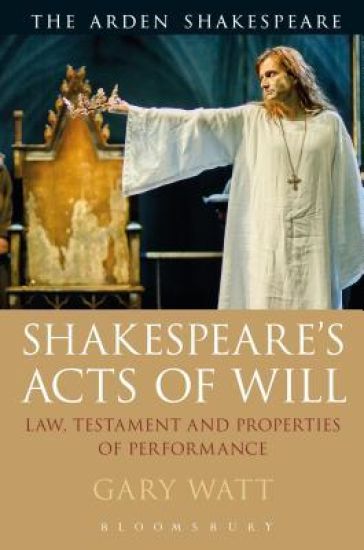
Shakespeare's Acts of Will

Shakespeare's Acts of Will

Gary Watt

The Arden Shakespeare
2018
nidottu
Shakespeare was born into a new age of will, in which individual intent had the potential to overcome dynastic expectation. The 1540 Statute of Wills had liberated testamentary disposition of land and thus marked a turning point from hierarchical feudal tradition to horizontal free trade. Focusing on Shakespeare’s late Elizabethan plays, Gary Watt demonstrates Shakespeare’s appreciation of testamentary tensions and his ability to exploit the inherent drama of performing will.Drawing on years of experience delivering rhetoric workshops for the Royal Shakespeare Company and as a prize-winning teacher of law, Gary Watt shows that Shakespeare is playful with legal technicality rather than obedient to it. The author demonstrates how Shakespeare transformed lawyers’ manual book rhetoric into powerful drama through a stirring combination of word, metre, movement and physical stage material, producing a mode of performance that was truly testamentary in its power to engage the witnessing public.Published on the 400th anniversary of Shakespeare’s last will and testament, this is a major contribution to the growing interdisciplinary field of law and humanities.
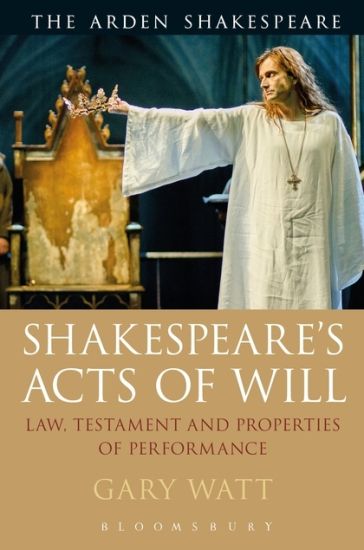
Shakespeare's Acts of Will

Shakespeare's Acts of Will

Gary Watt

The Arden Shakespeare
2016
sidottu
Shakespeare was born into a new age of will, in which individual intent had the potential to overcome dynastic expectation. The 1540 Statute of Wills had liberated testamentary disposition of land and thus marked a turning point from hierarchical feudal tradition to horizontal free trade. Focusing on Shakespeare’s late Elizabethan plays, Gary Watt demonstrates Shakespeare’s appreciation of testamentary tensions and his ability to exploit the inherent drama of performing will.Drawing on years of experience delivering rhetoric workshops for the Royal Shakespeare Company and as a prize-winning teacher of law, Gary Watt shows that Shakespeare is playful with legal technicality rather than obedient to it. The author demonstrates how Shakespeare transformed lawyers’ manual book rhetoric into powerful drama through a stirring combination of word, metre, movement and physical stage material, producing a mode of performance that was truly testamentary in its power to engage the witnessing public.Published on the 400th anniversary of Shakespeare’s last will and testament, this is a major contribution to the growing interdisciplinary field of law and humanities.
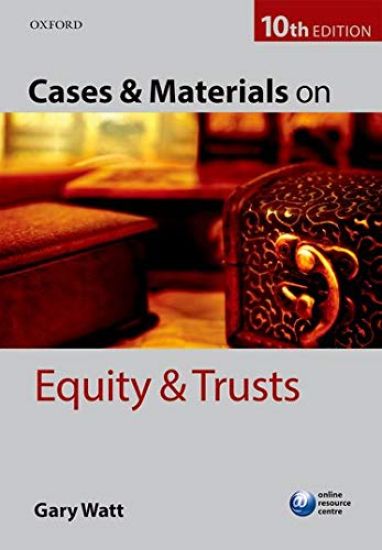
Cases & Materials on Equity & Trusts

Cases & Materials on Equity & Trusts

Gary Watt

Oxford University Press
2016
nidottu
In a subject heavily reliant on the specifics of case law, Cases & Materials on Equity & Trusts provides an essential reference source for students. The tenth edition contains a diverse range of relevant and interesting cases, statutory material, academic writing, and official proposals for law reform. Where appropriate, legal materials are accompanied by non-legal literary texts with a view to making legal points more interesting and memorable. Gary Watt continues to combine the highly-regarded, rigorous scholarship and student-focused approach established through previous editions in his expertly-selected choice of materials and commentary. Utilizing key features as tools to assist students' learning and revision, including questions, suggestions for further reading, and notes, Gary Watt threads the broad spectrum of equity case law together with his unique flair, making it an engaging and insightful companion to a course in trusts. Online Resource Centre The tenth edition is supported by an Online Resource Centre, offering: - Suggested answers to questions in the book - Video lectures presented by Gary Watt, introducing key areas of debate within the subject - General guidance on answering essay questions - General guidance on answering problem scenarios - Flashcard glossary of key legal terms - Updates to the law post-publication - Web links to useful websites
Dress, Law and Naked Truth

Dress, Law and Naked Truth

Gary Watt

Bloomsbury Academic
2015
nidottu
This book is available as open access through the Bloomsbury Open Access programme and is available on www.bloomsburycollections.com.Why are civil authorities in so-called liberal democracies affronted by public nudity and the Islamic full-face ‘veil’? Why is law and civil order so closely associated with robes, gowns, suits, wigs and uniforms? Why is law so concerned with the ‘evident’ and the need for justice to be ‘seen’ to be done? Why do we dress and obey dress codes at all? In this, the first ever study devoted to the many deep cultural connections between dress and law, the author addresses these questions and more. His responses flow from the radical thesis that ‘law is dress and dress is law’.Engaging with sources from The Epic of Gilgamesh to Shakespeare, Carlyle, Dickens and Damien Hirst, Professor Watt draws a revealing history of dress and civil order and offers challenging conclusions about the nature of truth and the potential for individuals to fit within the forms of civil life.
Living in a Law Transformed

Living in a Law Transformed

Gary Watt; Julen Etxabe

Michigan Publishing Services
2014
nidottu
In 2013, an international group of jurists gathered in London to mark the 40th anniversary of the publication of James Boyd White’s The Legal Imagination, the book that is widely credited with instigating and inspiring the modern “law and literature” and “law and humanities” movements in university teaching and research. The authors of each of the twelve essays in this collection offer a personal reflection on teaching, researching, and practicing law in the light of White’s invitation to reimagine the law and our own relationship with it. Each is therefore a personal response to the challenge of bringing legal work to life and life to legal work. Topics covered range from rhetoric to human rights, from silence to slow reading, from film to material culture, and from the natural world to the realm of religious experience. This book hopes to make life in the law more meaningful for the scholar, the judge, the attorney, and the student, following the sometimes hard path that James Boyd White set for himself to follow.
Dress, Law and Naked Truth

Dress, Law and Naked Truth

Gary Watt

Bloomsbury Academic
2013
sidottu
This book is available as open access through the Bloomsbury Open Access programme and is available on www.bloomsburycollections.com.Why are civil authorities in so-called liberal democracies affronted by public nudity and the Islamic full-face ‘veil’? Why is law and civil order so closely associated with robes, gowns, suits, wigs and uniforms? Why is law so concerned with the ‘evident’ and the need for justice to be ‘seen’ to be done? Why do we dress and obey dress codes at all? In this, the first ever study devoted to the many deep cultural connections between dress and law, the author addresses these questions and more. His responses flow from the radical thesis that ‘law is dress and dress is law’.Engaging with sources from The Epic of Gilgamesh to Shakespeare, Carlyle, Dickens and Damien Hirst, Professor Watt draws a revealing history of dress and civil order and offers challenging conclusions about the nature of truth and the potential for individuals to fit within the forms of civil life.
How to Moot

How to Moot

John Snape; Gary Watt

Oxford University Press
2010
nidottu
How to Moot is essential reading for student mooters at all levels. Written by lecturers with many years' experience of supporting students and judging at internal and national mooting competitions, you can be sure that this book contains everything you need to know about preparing for and participating in moots, plus numerous tips to help you stand out from the crowd. The book is written in a uniquely user-friendly style: it is divided into 100 Q&As and structured in short, accessible chapters, so you can find what you need quickly and easily. Chapter summaries allow you to check you have covered the key points in each area, and diagrams clearly set out the procedural aspects of mooting. There are example moot problems and an entire transcript of a moot, so you can see exactly what happens at each stage. Online Resource Centre An Online Resource Centre accompanies the book, providing video clips of mooting, additional moot problems, useful web links, and details of inter-university mooting competitions.
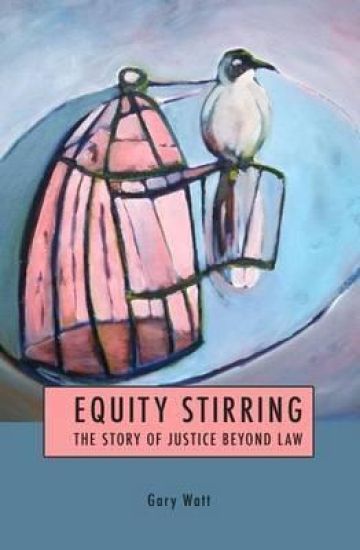
Equity Stirring

Equity Stirring

Gary Watt

Hart Publishing
2009
sidottu
Sir Frederick Pollock wrote that 'English-speaking lawyers ...have specialised the name of Equity'. It is typical for legal textbooks on the law of equity to acknowledge the diverse ways in which the word 'equity' is used and then to focus on the legal sense of the word to the exclusion of all others. There may be a professional responsibility on textbook writers to do just that. If so, there is a counterpart responsibility to read the law imaginatively and to read what non-lawyers have said of equity with an open mind. This book is an exploration of the meaning of equity as artists and thinkers have portrayed it within the law and without. Watt finds in law and literature an equity that is necessary to good life and good law but which does not require us to subscribe to a moral or 'natural law' ideal. It is an equity that takes a principled and practical stand against rigid formalism and unthinking routine in law and life, and so provides timely resistance to current forces of extremism and entitlement culture. The project is an educational one in the true etymological sense of leading the reader out into new territory. The book will provide the legal scholar with deep insight into the rhetorical, literary and historical foundations of the idea of equity in law, and it will provide the law student with a cultural history of, and an imaginative introduction to, the technical law of equity and trusts. Scholars and students of such disciplines as literature, classics, history, theology, theatre and rhetoric will discover new insights into the art of equity in the law and beyond. Along the way, Watt offers a new theory on the naming of Dickens' chancery case Jarndyce and Jarndyce and suggests a new connection between Shakespeare and the origin of equity in modern law. 'This beautiful book, deeply learned in the branch of jurisprudence we call equity and deeply engaged with the western literary tradition, gives new life to equity in the legal sense by connecting it with equity in the larger sense: as it is defined both in ordinary language and experience and by great writers, especially Dickens and Shakespeare. Equity Stirring transforms our sense of what equity is and can be and demonstrates in a new and graceful way the importance of connecting law with other arts of mind and language.' James Boyd White, author of Living Speech: Resisting the Empire of Force 'Equity Stirring' is a fine example of interdisciplinary legal scholarship at its best. Watt has managed to produce a book that is fresh and innovative, and thoroughly accessible. Deploying a range of familiar, and not so familiar, texts from across the humanities, Watt has presented a fascinating historical and literary commentary on the evolution of modern ideas of justice and equity. Ian Ward, Professor of Law at the University of Newcastle upon Tyne. "this is an important, compendious, and thought-provoking work that should be on the shelves of everyone interested in equity studies." Mark Fortier, Law and Literature "there is much of interest to the legal historian...the book's insights and erudition did engage this rather sceptical reader, who would like to believe that equity could achieve justice, but fears rather that it can only be as fair as the court dispensing it." Rosemary Auchmuty, The Journal of Legal History "With luck, Equity Stirring will stir...taxonomic positivists from their culture of entitlement, waking them to the possibility that law and justice do not form the perfect quadration". Nick Piska, Social & Legal Studies "a highly imaginative, original and refreshing foray into the legal and ethical import of concepts too often thought to be difficult, archaic and obscure...Watt gives us a way into the subject which is forceful in its imaginative reach and its ethical import..." David Gurnham, Law, Culture and the Humanities