Kirjojen hintavertailu. Mukana 12 595 353 kirjaa ja 12 kauppaa.

Kirjailija

Gautam Bhan

Kirjat ja teokset yhdessä paikassa: 4 kirjaa, julkaisuja vuosilta 2016-2024, suosituimpien joukossa Cities Rethought. Vertaile teosten hintoja ja tarkista saatavuus suomalaisista kirjakaupoista.

4 kirjaa

Kirjojen julkaisuhaarukka 2016-2024.

Cities Rethought

Cities Rethought

Gautam Bhan; Michael Keith; Susan Parnell; Edgar Pieterse

JOHN WILEY AND SONS LTD
2024
sidottu
In a world of disruptions and seemingly endless complexity, cities have become central to thinking about the future of humanity. Yet the study of cities is fragmented among different silos of expertise, diverse genres of scholarship, and widening chasms between theory and practice. How can we do better? Cities Rethought suggests that we need to remake the way we see and know cities in order to rethink how we act and intervene within them. To this end, it offers the contours of a new urban disposition. Its normative, analytical, and operational elements offer an opportunity for scholars, practitioners, and citizens alike to approach the complexity of cities anew. Written collectively for a wide audience, the text draws from cities across the global north and south, speaks across diverse genres of ideas, and reflects on the lived experience of the authors as both researchers and practitioners. It is an essential text for anyone committed to knowing their own cities as well as finding ways to meaningfully intervene in them.
Cities Rethought

Cities Rethought

Gautam Bhan; Michael Keith; Susan Parnell; Edgar Pieterse

JOHN WILEY AND SONS LTD
2024
nidottu
In a world of disruptions and seemingly endless complexity, cities have become central to thinking about the future of humanity. Yet the study of cities is fragmented among different silos of expertise, diverse genres of scholarship, and widening chasms between theory and practice. How can we do better? Cities Rethought suggests that we need to remake the way we see and know cities in order to rethink how we act and intervene within them. To this end, it offers the contours of a new urban disposition. Its normative, analytical, and operational elements offer an opportunity for scholars, practitioners, and citizens alike to approach the complexity of cities anew. Written collectively for a wide audience, the text draws from cities across the global north and south, speaks across diverse genres of ideas, and reflects on the lived experience of the authors as both researchers and practitioners. It is an essential text for anyone committed to knowing their own cities as well as finding ways to meaningfully intervene in them.
In the Public's Interest

In the Public's Interest

Gautam Bhan

University of Georgia Press
2016
nidottu
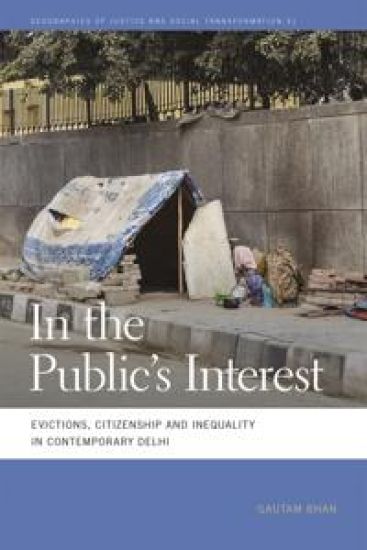
This book studies the recent legacy of basti “evictions” in Delhi—mass clearings of some of the city’s poorest neighborhoods as a way to understand how the urban poor are disenfranchised in the name of “public interest” and, in the case of Delhi, by the very courts meant to empower and protect them. Studying bastis, says Gautam Bhan, provokes six clear lines of inquiry applicable to studies of urbanism across the global south.The first is the long-standing debate over urban informality and illegality: the debate’s impact on conceptions and practices of urban planning, the production of space, and the regulation of value. The second is a set of debates on “good governance,” read through their intersections with ideas of “planned development” within rapidly transforming cities. The third is the political field of urban citizenship and the possibilities of substantive rights and belonging in the city. The fourth is resistance and the ability of a city’s subaltern residents to struggle against exclusion. The two remaining inquiries both cut across and unify the first four. One of these is the role of the judiciary and the relationships between law and urbanism in cities of the global south. The other is the relationship between democracy and inequality in the city.What emerges about Delhi in particular is a multilayered double standard in attention to, and enforcement of, property laws. Rights are lost, citizenship is unequal and differentiated, the promise of development is refused, and poverty and inequality are reproduced and deepened. The task at hand, says Bhan, is not just to explain evictions but also to listen to what they are telling us about “the city that is as well as the city that can be.”
In the Public's Interest

In the Public's Interest

Gautam Bhan

University of Georgia Press
2016
sidottu
This book studies the recent legacy of basti “evictions” in Delhi—mass clearings of some of the city’s poorest neighborhoods as a way to understand how the urban poor are disenfranchised in the name of “public interest” and, in the case of Delhi, by the very courts meant to empower and protect them. Studying bastis, says Gautam Bhan, provokes six clear lines of inquiry applicable to studies of urbanism across the global south.The first is the long-standing debate over urban informality and illegality: the debate’s impact on conceptions and practices of urban planning, the production of space, and the regulation of value. The second is a set of debates on “good governance,” read through their intersections with ideas of “planned development” within rapidly transforming cities. The third is the political field of urban citizenship and the possibilities of substantive rights and belonging in the city. The fourth is resistance and the ability of a city’s subaltern residents to struggle against exclusion. The two remaining inquiries both cut across and unify the first four. One of these is the role of the judiciary and the relationships between law and urbanism in cities of the global south. The other is the relationship between democracy and inequality in the city.What emerges about Delhi in particular is a multilayered double standard in attention to, and enforcement of, property laws. Rights are lost, citizenship is unequal and differentiated, the promise of development is refused, and poverty and inequality are reproduced and deepened. The task at hand, says Bhan, is not just to explain evictions but also to listen to what they are telling us about “the city that is as well as the city that can be.”