Kirjojen hintavertailu. Mukana 12 657 676 kirjaa ja 12 kauppaa.

Kirjailija

Geert Roskam

Kirjat ja teokset yhdessä paikassa: 5 kirjaa, julkaisuja vuosilta 2005-2021, suosituimpien joukossa Live unnoticed. Vertaile teosten hintoja ja tarkista saatavuus suomalaisista kirjakaupoista.

5 kirjaa

Kirjojen julkaisuhaarukka 2005-2021.

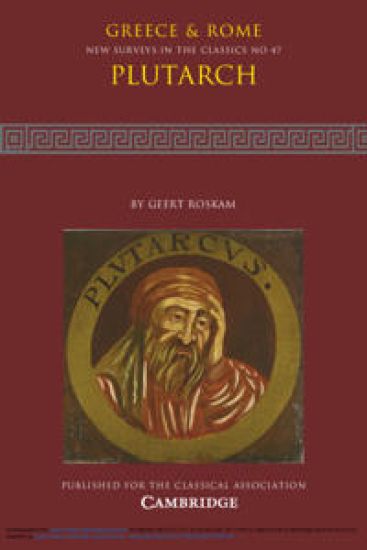
Plutarch: Volume 47

Plutarch: Volume 47

Geert Roskam

Cambridge University Press
2021
pokkari
Plutarch of Chaeronea is one of the most influential and fascinating authors of antiquity. His Parallel Lives and Moralia are storehouses of challenging questions, valuable insights and interesting observations. Moreover, they contain a wealth of quotations from and references to earlier writers and traditions, and thus provide one of the richest gateways to the ancient world. This book introduces the reader to Plutarch's life and to the different facets of his variegated thinking and writing, such as his tremendous erudition, his Platonism and (moral) philosophy, his interpretation of history and his view of God. Above all, Plutarch stands out as a particularly clever and subtle thinker, driven by a spirit of painstaking enquiry (zetesis) that shows authentic and impressive intellectual honesty and sincere love of the truth. In this respect, as in many others, he remains an inspiring model even for us today.
Plutarch's "Maxime cum principibus philosopho esse disserendum"
The question of the political relevance of philosophy, and of the role which the philosopher should play in the government of his state, was often discussed in Antiquity. Plato’s ideal of the philosopher-king is well-known, but was precisely his failure to realise his political ideal in Syracuse not the best argument against the philosopher’s political engagement? Nevertheless, Plato’s ideal remained attractive for later Greek thinkers. This is illustrated, for instance, by one of Plutarch’s short political works, in which he tries to demonstrate that the philosopher should especially associate with powerful rulers, because he can in this way exert the greatest positive influence on his society and at the same time maximise his personal pleasure. This study provides a thorough analysis of Plutarch’s Maxime cum principibus philosopho esse disserendum. A lengthy general introduction deals with the author and the text and discusses each step in Plutarch’s argumentation in detail. A systematic lemmatic commentary then provides a systematic complement to the previous analysis of the work, dealing with many problems of textual criticism, explaining all kinds of realia, and discussing a great number of passages through parallels from Plutarch’s own oeuvre and from other authors.
A Commentary on Plutarch's "De latenter vivendo"

A Commentary on Plutarch's "De latenter vivendo"

Geert Roskam

Leuven University Press
2007
pokkari
Plutarch's De latenter vivendo is the only extant work from Antiquity in which Epicurus' famous ideal of an 'unnoticed life' (lathe biosas) is thematised as such. Moreover, the short rhetorical work provides a lot of interesting information about Plutarch's polemical strategies and about his own philosophical convictions in the domains of ethics, politics, metaphysics, and eschatology. In this book, Plutarch's anti-Epicurean polemic is understood against the background of the previous philosophical tradition. An examination of Epicurus' own position is followed by a discussion of Plutarch's polemical predecessors (Timocrates, Cicero, the early Stoics, and Seneca) and contemporaries (Epictetus), and by a systematical and detailed analysis of Plutarch's own arguments. The lemmatic commentary offers additional information and parallel passages (both from Plutarch's own works and from others authors) that cast a new light on the text.
Live unnoticed

Live unnoticed

Geert Roskam

BRILL
2007
sidottu
Against the background of age-old Greek wisdom, Epicurus' advice to 'live unnoticed' (lathe biosas) was particularly provocative and scandalous. Why, after all, would an unknown Greek soldier in Agamemnon's army have been happier than famous Achilles? Or why should an ordinary Athenian be regarded as more blessed and enviable than Pericles? Yet Epicurus' ideal was far from unattractive, guaranteeing as it did a quiet and untroubled existence far from the dangerous turmoil of public life. This book casts new light on Epicurus' socio-political philosophy through a careful analysis of his arguments. It also shows how the ideal of an 'unnoticed life' was received during the later history of Epicureanism and how it occasionally occurs in ancient Latin poetry.
On the Path to Virtue

On the Path to Virtue

Geert Roskam

Leuven University Press
2005
sidottu
In the first part about the specific Stoic doctrine on moral progress (prokope) attention is first given to the subtle view developed by the early Stoics, who categorically denied the existence of any mean between vice and virtue, and yet succeeded in giving moral progress a logical and meaningful place within their ethical thinking. Subsequently, the position of later Stoics (Panaetius, Hecato, Posidonius, Seneca, Musonius Rufus, Epictetus and Marcus Aurelius) is examined. Most of them appear to adopt a basically 'orthodox' view, although each one of them lays his own accents and deals with Chrysippus' tenets from his own personal perspective. Occasionally, the 'heterodox' position of Aristo of Chios proves to have remained influential too. The second part of the study deals with the polemical reception of the Stoic doctrine of moral progress in (Middle-)Platonism. The first author who is discussed is Philo of Alexandria. Philo deals with the Stoic doctrine in a very ideosyncratical way. He never explicitly attacked the Stoic view on moral progress, although it is clear from various passages in his work that he favoured the Platonic-Peripatetic position rather than the Stoic one.Next, Plutarch's position is examined, through a detailed analysis of his treatise 'De profectibus in virtute'. Finally, attention is given to two school handbooks dating from the period of Middle-Platonism (Alcinous and Apuleius). In both of them, the Stoic doctrine is rejected without many arguments, which shows that a correct (and anti-Stoic) conception of moral progress was regarded in Platonic circles as a basic knowledge for beginning students.The whole discussion is placed into a broader philosophical-historical perspective by the introduction (on the philosophical tradition before the Stoa) and the epilogue (about later discussions in Neo-Platonism and early Christianity).