Kirjojen hintavertailu. Mukana 12 283 566 kirjaa ja 12 kauppaa.

Kirjailija

Geeta Batra

Kirjat ja teokset yhdessä paikassa: 4 kirjaa, julkaisuja vuosilta 2021-2023, suosituimpien joukossa Environmental Evaluation and Global Development Institutions. Vertaile teosten hintoja ja tarkista saatavuus suomalaisista kirjakaupoista.

4 kirjaa

Kirjojen julkaisuhaarukka 2021-2023.

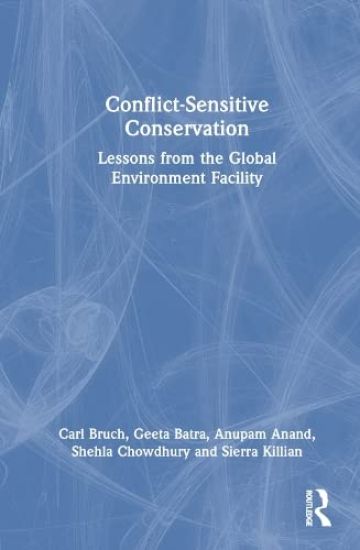
Conflict-Sensitive Conservation

Conflict-Sensitive Conservation

Carl Bruch; Geeta Batra; Anupam Anand; Shehla Chowdhury; Sierra Killian

TAYLOR FRANCIS LTD
2023
sidottu
This book provides an empirically formulated foundation for conflict-sensitive conservation, a field in which the existing literature relies primarily on anecdotal evidence.Seeking to better understand the impact of conflict on the implementation and outcomes of environmental projects, the Global Environment Facility (GEF) Independent Evaluation Office and the Environmental Law Institute undertook an evaluation of GEF support to fragile and conflict-affected contexts. Following a qualitative and quantitative analysis of documents from more than 4,000 projects, the research team discovered a statistically significant negative correlation between a country’s Fragile States Index score and the implementation quality of environmental projects in that country. In this book, the evaluation and research team explain these groundbreaking findings in detail, highlighting seven key case studies: Afghanistan, Albertine Rift, Balkans, Cambodia, Colombia, Lebanon, and Mali. Drawing upon additional research and interviews with GEF project implementation staff, the volume illustrates the pathways through which conflict and fragility frequently impact environmental projects. It also examines how practitioners and sponsoring institutions can plan and implement their projects to avoid or mitigate these issues and find opportunities to promote peacebuilding through their environmental interventions.Examining data from 164 countries and territories, this innovative book will be of great interest to students and scholars of environmental management, conservation, international development, and the fast-growing field of environmental peacebuilding. It will also be a great resource for practitioners working in these important fields.The Open Access version of this book, available at www.taylorfrancis.com, has been made available under a Creative Commons Attribution-Non Commercial-No Derivatives 4.0 license.

Conflict-Sensitive Conservation

Conflict-Sensitive Conservation

Carl Bruch; Geeta Batra; Anupam Anand; Shehla Chowdhury; Sierra Killian

TAYLOR FRANCIS LTD
2023
nidottu
This book provides an empirically formulated foundation for conflict-sensitive conservation, a field in which the existing literature relies primarily on anecdotal evidence.Seeking to better understand the impact of conflict on the implementation and outcomes of environmental projects, the Global Environment Facility (GEF) Independent Evaluation Office and the Environmental Law Institute undertook an evaluation of GEF support to fragile and conflict-affected contexts. Following a qualitative and quantitative analysis of documents from more than 4,000 projects, the research team discovered a statistically significant negative correlation between a country’s Fragile States Index score and the implementation quality of environmental projects in that country. In this book, the evaluation and research team explain these groundbreaking findings in detail, highlighting seven key case studies: Afghanistan, Albertine Rift, Balkans, Cambodia, Colombia, Lebanon, and Mali. Drawing upon additional research and interviews with GEF project implementation staff, the volume illustrates the pathways through which conflict and fragility frequently impact environmental projects. It also examines how practitioners and sponsoring institutions can plan and implement their projects to avoid or mitigate these issues and find opportunities to promote peacebuilding through their environmental interventions.Examining data from 164 countries and territories, this innovative book will be of great interest to students and scholars of environmental management, conservation, international development, and the fast-growing field of environmental peacebuilding. It will also be a great resource for practitioners working in these important fields.The Open Access version of this book, available at www.taylorfrancis.com, has been made available under a Creative Commons Attribution-Non Commercial-No Derivatives 4.0 license.
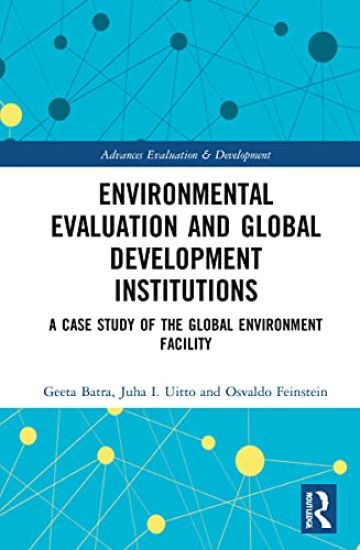
Environmental Evaluation and Global Development Institutions

Environmental Evaluation and Global Development Institutions

Geeta Batra; Juha I. Uitto; Osvaldo N. Feinstein

TAYLOR FRANCIS LTD
2023
nidottu
Evaluation is increasingly important for finding sustainable solutions for the people and the planet, based on a systematic analysis of what works, for whom, and under what circumstances, and to contribute to the achievement of the Sustainable Development Goals, as they pertain to the environment.This book explores why the Global Environment Facility (GEF) invests in evaluation for accountability and learning to inform its decision-making on programming priorities, and how this leads to wiser funding decisions and better program performance on the ground. The book is based on real-life experiences of how to make evaluation count for international environmental action. Drawing upon comprehensive evaluations of the GEF, it provides unique insights from authors responsible for designing, implementing, and disseminating the findings of the evaluations. No other multilateral development or environment agency places evaluation fully at the center of their decision-making. The book outlines the trends in the global environment and the changing landscape of international environmental finance. It defines the role of the GEF and explains its institutional framework and the unique partnership that involves donor and recipient countries, multilateral development banks, UN agencies, nongovernmental organizations (NGOs), and national agencies in the developing countries. Further, it provides useful pointers to other organizations wishing to enhance evidence-based decision-making for improving their relevance, performance, and impact.The book will be most suitable for graduate-level, specialized study in a variety of disciplines such as environmental and development economics, political science, international relations, geography, sociology, and social anthropology.The Open Access version of this book, available at http://www.taylorfrancis.com, has been made available under a Creative Commons Attribution-Non Commercial-No Derivatives 4.0 license.
Environmental Evaluation and Global Development Institutions

Environmental Evaluation and Global Development Institutions

Geeta Batra; Juha I. Uitto; Osvaldo N. Feinstein

Taylor Francis Ltd
2021
sidottu
Evaluation is increasingly important for finding sustainable solutions for the people and the planet, based on a systematic analysis of what works, for whom, and under what circumstances, and to contribute to the achievement of the Sustainable Development Goals, as they pertain to the environment.This book explores why the Global Environment Facility (GEF) invests in evaluation for accountability and learning to inform its decision-making on programming priorities, and how this leads to wiser funding decisions and better program performance on the ground. The book is based on real-life experiences of how to make evaluation count for international environmental action. Drawing upon comprehensive evaluations of the GEF, it provides unique insights from authors responsible for designing, implementing, and disseminating the findings of the evaluations. No other multilateral development or environment agency places evaluation fully at the center of their decision-making. The book outlines the trends in the global environment and the changing landscape of international environmental finance. It defines the role of the GEF and explains its institutional framework and the unique partnership that involves donor and recipient countries, multilateral development banks, UN agencies, nongovernmental organizations (NGOs), and national agencies in the developing countries. Further, it provides useful pointers to other organizations wishing to enhance evidence-based decision-making for improving their relevance, performance, and impact.The book will be most suitable for graduate-level, specialized study in a variety of disciplines such as environmental and development economics, political science, international relations, geography, sociology, and social anthropology.The Open Access version of this book, available at http://www.taylorfrancis.com, has been made available under a Creative Commons Attribution-Non Commercial-No Derivatives 4.0 license.