Kirjojen hintavertailu. Mukana 12 595 353 kirjaa ja 12 kauppaa.

Kirjailija

Geir Evensen

Kirjat ja teokset yhdessä paikassa: 6 kirjaa, julkaisuja vuosilta 2009-2025, suosituimpien joukossa Data Assimilation Fundamentals. Vertaile teosten hintoja ja tarkista saatavuus suomalaisista kirjakaupoista.

6 kirjaa

Kirjojen julkaisuhaarukka 2009-2025.

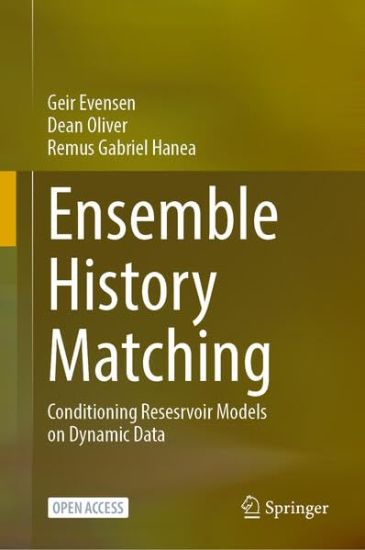
Ensemble History Matching

Ensemble History Matching

Geir Evensen; Dean Oliver; Remus Gabriel Hanea

Springer International Publishing AG
2025
sidottu
This open-access book aims to formulate the history-matching problem consistently and present state-of-the-art ensemble solution methods. The content aims to help practitioners in the field understand the properties of ensemble methods better when used to history-match reservoir models. The book provides educational information for graduate students and researchers in petroleum, geothermal, and hydrological engineering and sciences. It introduces and explains various algorithms used in data assimilation and parameter estimation, focusing on ensemble methods, particularly the most popular ones in the petroleum community. It discusses challenges associated with these techniques, such as dealing with high-dimensional models, finite number of realizations, parameterization, and handling uncertainties in the observations and model parameters.
Data Assimilation Fundamentals

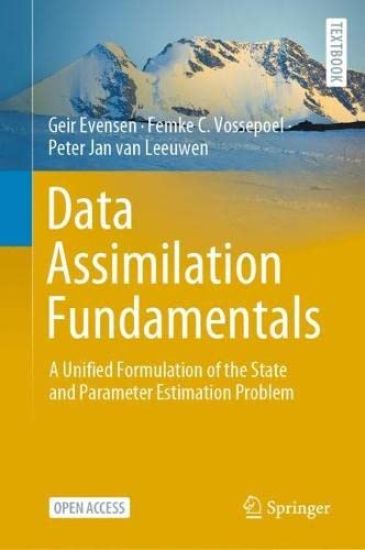
Data Assimilation Fundamentals

Geir Evensen; Femke C. Vossepoel; Peter Jan van Leeuwen

Springer Nature Switzerland AG
2023
nidottu
This open-access textbook's significant contribution is the unified derivation of data-assimilation techniques from a common fundamental and optimal starting point, namely Bayes' theorem. Unique for this book is the "top-down" derivation of the assimilation methods. It starts from Bayes theorem and gradually introduces the assumptions and approximations needed to arrive at today's popular data-assimilation methods. This strategy is the opposite of most textbooks and reviews on data assimilation that typically take a bottom-up approach to derive a particular assimilation method. E.g., the derivation of the Kalman Filter from control theory and the derivation of the ensemble Kalman Filter as a low-rank approximation of the standard Kalman Filter. The bottom-up approach derives the assimilation methods from different mathematical principles, making it difficult to compare them. Thus, it is unclear which assumptions are made to derive an assimilation method and sometimes even which problem it aspires to solve. The book's top-down approach allows categorizing data-assimilation methods based on the approximations used. This approach enables the user to choose the most suitable method for a particular problem or application. Have you ever wondered about the difference between the ensemble 4DVar and the "ensemble randomized likelihood" (EnRML) methods? Do you know the differences between the ensemble smoother and the ensemble-Kalman smoother? Would you like to understand how a particle flow is related to a particle filter? In this book, we will provide clear answers to several such questions. The book provides the basis for an advanced course in data assimilation. It focuses on the unified derivation of the methods and illustrates their properties on multiple examples. It is suitable for graduate students, post-docs, scientists, and practitioners working in data assimilation.
Data Assimilation Fundamentals

Data Assimilation Fundamentals

Geir Evensen; Femke C. Vossepoel; Peter Jan van Leeuwen

Springer Nature Switzerland AG
2022
sidottu
This open-access textbook's significant contribution is the unified derivation of data-assimilation techniques from a common fundamental and optimal starting point, namely Bayes' theorem. Unique for this book is the "top-down" derivation of the assimilation methods. It starts from Bayes theorem and gradually introduces the assumptions and approximations needed to arrive at today's popular data-assimilation methods. This strategy is the opposite of most textbooks and reviews on data assimilation that typically take a bottom-up approach to derive a particular assimilation method. E.g., the derivation of the Kalman Filter from control theory and the derivation of the ensemble Kalman Filter as a low-rank approximation of the standard Kalman Filter. The bottom-up approach derives the assimilation methods from different mathematical principles, making it difficult to compare them. Thus, it is unclear which assumptions are made to derive an assimilation method and sometimes even which problem it aspires to solve. The book's top-down approach allows categorizing data-assimilation methods based on the approximations used. This approach enables the user to choose the most suitable method for a particular problem or application. Have you ever wondered about the difference between the ensemble 4DVar and the "ensemble randomized likelihood" (EnRML) methods? Do you know the differences between the ensemble smoother and the ensemble-Kalman smoother? Would you like to understand how a particle flow is related to a particle filter? In this book, we will provide clear answers to several such questions. The book provides the basis for an advanced course in data assimilation. It focuses on the unified derivation of the methods and illustrates their properties on multiple examples. It is suitable for graduate students, post-docs, scientists, and practitioners working in data assimilation.
Sikker klatring; hvorfor skjer ulykker og hvordan unngå at det skjer deg?
Dette er den nye håndboka alle klatrere må ha! Uansett om du er fersk eller erfaren og uansett hvilken gren av klatring du driver med, er "Sikker klatring" en nyttig bok for deg. Geir Evensen, bokens forfatter, har jobbet med "Sikker klatring" i over halvannet år, og han ble ironisk nok selv utsatt for en klatreulykke underveis i arbeidet. Boken er bygget på nitidig gjennomgang av over 1000 registrerte klatreulykker i Norge fra de siste 20 årene. I gjennomgangen av dette materialet fant forfatteren ut at klatrere kan havne i farlige situasjoner på grunn av manglende kunnskap, menneskelig svikt eller sløve rutiner. Boken mener å rette på dette! Med økt kunnskap og bevissthet om sikkerhet i klatring, kan både nye og rutinerte klatrere heve sikkerheten, selvtillitten og eget nivå på klatringen. Boken har et eget kapittel om førstehjelp og redning og et om familieklatring. Boken har rikelig med informasjon om ulykker og bakgrunnskunnskap og statistikk. Den dekker over alle aspekter ved utstyr og bruk av tau, bremser, bolter og karabiner. Den bruker betydelig med plass på menneskelig faktor og psykologiaspektet ved klatreulykker. Den har også dedikerte kapitler for alle klatredisipliner: Inneklatring, buldring, fjellklatring, sports-, trad- eller isklatring. "Sikker klatring" er et oppslagsverk og en lærebok som lærer deg å klatre på en tryggere og dermed mer effektiv måte. Alle aktive klatrere kan regne med å heve nivået sitt noen hakk med riktig bakgrunnskunnskap, gode vaner og rutiner, og detaljert praktisk informasjon.
Data Assimilation

Data Assimilation

Geir Evensen

Springer-Verlag Berlin and Heidelberg GmbH Co. K
2014
nidottu
Data Assimilation comprehensively covers data assimilation and inverse methods, including both traditional state estimation and parameter estimation. This text and reference focuses on various popular data assimilation methods, such as weak and strong constraint variational methods and ensemble filters and smoothers. It is demonstrated how the different methods can be derived from a common theoretical basis, as well as how they differ and/or are related to each other, and which properties characterize them, using several examples. Rather than emphasize a particular discipline such as oceanography or meteorology, it presents the mathematical framework and derivations in a way which is common for any discipline where dynamics is merged with measurements. The mathematics level is modest, although it requires knowledge of basic spatial statistics, Bayesian statistics, and calculus of variations. Readers will also appreciate the introduction to the mathematical methods used and detailed derivations, which should be easy to follow, are given throughout the book. The codes used in several of the data assimilation experiments are available on a web page. In particular, this webpage contains a complete ensemble Kalman filter assimilation system, which forms an ideal starting point for a user who wants to implement the ensemble Kalman filter with his/her own dynamical model. The focus on ensemble methods, such as the ensemble Kalman filter and smoother, also makes it a solid reference to the derivation, implementation and application of such techniques. Much new material, in particular related to the formulation and solution of combined parameter and state estimation problems and the general properties of the ensemble algorithms, is available here for the first time. The 2nd edition includes a partial rewrite of Chapters 13 an 14, and the Appendix. In addition, there is a completely new Chapter on "Spurious correlations, localization and inflation", and an updated and improved sampling discussion in Chap 11.
Data Assimilation

Data Assimilation

Geir Evensen

Springer-Verlag Berlin and Heidelberg GmbH Co. K
2009
sidottu
Data Assimilation comprehensively covers data assimilation and inverse methods, including both traditional state estimation and parameter estimation. This text and reference focuses on various popular data assimilation methods, such as weak and strong constraint variational methods and ensemble filters and smoothers. It is demonstrated how the different methods can be derived from a common theoretical basis, as well as how they differ and/or are related to each other, and which properties characterize them, using several examples. Rather than emphasize a particular discipline such as oceanography or meteorology, it presents the mathematical framework and derivations in a way which is common for any discipline where dynamics is merged with measurements. The mathematics level is modest, although it requires knowledge of basic spatial statistics, Bayesian statistics, and calculus of variations. Readers will also appreciate the introduction to the mathematical methods used and detailed derivations, which should be easy to follow, are given throughout the book. The codes used in several of the data assimilation experiments are available on a web page. In particular, this webpage contains a complete ensemble Kalman filter assimilation system, which forms an ideal starting point for a user who wants to implement the ensemble Kalman filter with his/her own dynamical model. The focus on ensemble methods, such as the ensemble Kalman filter and smoother, also makes it a solid reference to the derivation, implementation and application of such techniques. Much new material, in particular related to the formulation and solution of combined parameter and state estimation problems and the general properties of the ensemble algorithms, is available here for the first time. The 2nd edition includes a partial rewrite of Chapters 13 an 14, and the Appendix. In addition, there is a completely new Chapter on "Spurious correlations, localization and inflation", and an updated and improved sampling discussion in Chap 11.