

Kirjailija
Geoffrey Brennan
Kirjat ja teokset yhdessä paikassa: 13 kirjaa, julkaisuja vuosilta 1980-2028, suosituimpien joukossa Die Begründung von Regeln. Vertaile teosten hintoja ja tarkista saatavuus suomalaisista kirjakaupoista.
13 kirjaa
Kirjojen julkaisuhaarukka 1980-2028.
Explaining Norms
Geoffrey Brennan; Lina Eriksson; Robert E. Goodin; Nicholas Southwood
Oxford University Press
2016
nidottu
Norms are a pervasive yet mysterious feature of social life. In Explaining Norms, four philosophers and social scientists team up to grapple with some of the many mysteries, offering a comprehensive account of norms: what they are; how and why they emerge, persist and change; and how they work. Norms, they argue, should be understood in non-reductive terms as clusters of normative attitudes that serve the function of making us accountable to one another--with the different kinds of norms (legal, moral, and social norms) differing in virtue of being constituted by different kinds of normative attitudes that serve to make us accountable in different ways. Explanations of and by norms should be seen as thoroughly pluralist in character. Explanations of norms should appeal to the ways that norms help us to pursue projects and goals, individually and collectively, as well as to enable us to constitute social meanings. Explanations by norms should recognise the multiplicity of ways in which norms may bear upon the actions we perform, the attitudes we form and the modes of deliberation in which we engage: following, merely conforming with, and even breaching norms. While advancing novel and distinctive positions on all of these topics, Explaining Norms will also serve as a sourcebook with a rich array of arguments and illustrations for others to reassemble in ways of their own choosing.
The only book on the market to include classical and contemporary readings from key authors in Philosophy, Politics, and Economics (PPE), this unique anthology provides a comprehensive overview of the central topics in this rapidly expanding field. Each chapter opens with an introduction that helps students understand the central arguments and key concepts in the readings. The selections encourage students to think about the extent to which the three disciplines offer complementary or contradictory ways of approaching the relevant issues. Philosophy, Politics, and Economics: An Anthology is ideal for undergraduate PPE programs and courses in political philosophy and political economy.
Explaining Norms
Geoffrey Brennan; Lina Eriksson; Robert E. Goodin; Nicholas Southwood
Oxford University Press
2013
sidottu
Norms are a pervasive yet mysterious feature of social life. In Explaining Norms, four philosophers and social scientists team up to grapple with some of the many mysteries, offering a comprehensive account of norms: what they are; how and why they emerge, persist and change; and how they work. Norms, they argue, should be understood in non-reductive terms as clusters of normative attitudes that serve the function of making us accountable to one another--with the different kinds of norms (legal, moral, and social norms) differing in virtue of being constituted by different kinds of normative attitudes that serve to make us accountable in different ways. Explanations of and by norms should be seen as thoroughly pluralist in character. Explanations of norms should appeal to the ways that norms help us to pursue projects and goals, individually and collectively, as well as to enable us to constitute social meanings. Explanations by norms should recognise the multiplicity of ways in which norms may bear upon the actions we perform, the attitudes we form and the modes of deliberation in which we engage: following, merely conforming with, and even breaching norms. While advancing novel and distinctive positions on all of these topics, Explaining Norms will also serve as a sourcebook with a rich array of arguments and illustrations for others to reassemble in ways of their own choosing.
Societies function on the basis of rules. These rules, rather like the rules of the road, coordinate the activities of individuals who have a variety of goals and purposes. Whether the rules work well or ill, and how they can be made to work better, is a matter of major concern. Appropriately interpreted, the working of social rules is also the central subject matter of modern political economy. This book is about rules - what they are, how they work, and how they can be properly analysed. The authors' objective is to understand the workings of alternative political institutions so that choices among such institutions (rules) can be more fully informed. Thus, broadly defined, the methodology of constitutional political economy is the subject matter of The Reason of Rules. The authors have examined how rules for political order work, how such rules might be chosen, and how normative criteria for such choices might be established.

Should government's power to tax be limited? The events of the late 1970s in the wake of California's Proposition 13 brought this question very sharply into popular focus. Whether the power to tax should be restricted, and if so how, are issues of immediate policy significance. Providing a serious analysis of these issues, the authors of this 1980 book offer an approach to the understanding and evaluation of the fiscal system, one that yields profound implications. The central question becomes: how much 'power to tax' would the citizen voluntarily grant to government as a party to some initial social contract devising a fiscal constitution? Those in office are assumed to exploit the power assigned to them to the maximum possible extent: government is modelled as 'revenue-maximizing Leviathan'. Armed with such a model, the authors proceed to trace out the restrictions on the power to tax that might be expected to emerge from the citizen's constitutional deliberations.
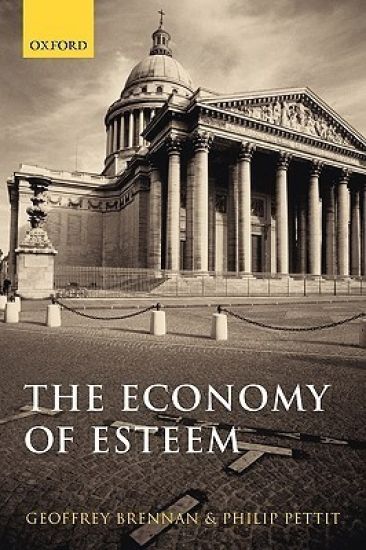
However much people want esteem, it is an untradable commodity-- there is no way that you can buy the good opinion of another or sell to others your good opinion of them. And yet esteem is allocated in society according to systematic determinants: people's performance, publicity, and presentation relative to others will help to fix how much esteem they enjoy and how much disesteem they avoid. In turn, rational individuals are bound to compete with one another, however tacitly, in the attempt to increase their chances of winning esteem and avoiding disesteem. And this competition shapes the environments in which they each pursue esteem, setting relevant comparators and benchmarks, and determining the cost that a person must bear for obtaining a given level of esteem. Hidden in the multifarious interactions and exchanges of social life, then, there is a quiet force at work -- a force as silent and powerful as gravity -- which molds the basic form of people's relationships and associations. This force was more or less routinely invoked in the writings of classical theorists like Aristotle and Plato, Locke and Montesquieu, Mandeville and Hume and Madison. Although Adam Smith himself gave it great credence, however, the rise of economics proper coincided with a sudden decline in the attention devoted to the economy of esteem. What had been a topic of compelling interest for earlier authors fell into relative neglect throughout the nineteenth and twentieth centuries. This book is designed to reverse the trend. It begins by outlining the psychology of esteem and the way the working of that psychology can give rise to an economy. It then shows how a variety of social patterns that are otherwise anomalous come to make a lot of sense within an economics of esteem. And it looks, finally, at the ways in which the economy of esteem may be reshaped to improve overall social outcomes. While making connections with older patterns of social theorising, it offers a novel orientation for contemporary thought about how society works and how it may be made to work. It puts the economy of esteem firmly on the agenda of economics and social science and of moral and political theory.
The text contends that people care about others' opinions of them and that the actions they take to raise the esteem they enjoy produce social patterns. They also point out that the actions taken to raise esteem affect individual economic behaviour.

Democratic Devices and Desires
Geoffrey Brennan; Alan Hamlin
Cambridge University Press
2000
pokkari
This book offers a novel account of key features of modern representative democracy. Working from the rational actor tradition, it builds a middle ground between orthodox political theory and the economic analysis of politics. Standard economic models of politics emphasise the design of the institutional devices of democracy as operated by essentially self-interested individuals. This book departs from that model by focusing on democratic desires alongside democratic devices, stressing that important aspects of democracy depend on the motivation of democrats and the interplay between devices and desires. Individuals are taken to be not only rational, but also somewhat moral. The authors argue that this approach provides access to aspects of the debate on democratic institutions that are beyond the narrowly economic model. They apply their analysis to voting, elections, representation, political departments and the separation and division of powers, providing a wide-ranging discussion of the design of democratic institutions.

Democratic Devices and Desires
Geoffrey Brennan; Alan Hamlin
Cambridge University Press
2000
sidottu
This book offers an account of key features of modern representative democracy. Working from the rational actor tradition, it builds a middle ground between orthodox political theory and the economic analysis of politics. Standard economic models of politics emphasise the design of the institutional devices of democracy as operated by essentially self-interested individuals. This book departs from that model by focusing on democratic desires alongside democratic devices, stressing that important aspects of democracy depend on the motivation of democrats and the interplay between devices and desires. Individuals are taken to be not only rational, but also somewhat moral. The authors argue that this approach provides access to aspects of the debate on democratic institutions that are beyond the narrowly economic model. They apply their analysis to voting, elections, representation, political departments and the separation and division of powers, providing a wide-ranging discussion of the design of democratic institutions.

Gender and Institutions: Welfare, Work and Citizenship
Moira Gatens; Alison MacKinnon; Geoffrey Brennan
Cambridge University Press
1998
sidottu
This important interdisciplinary volume explores what might constitute a feminist approach to institutional design and reshaping. What is the scope, it asks, in contemporary Australian society, for ensuring that institutions acknowledge gender difference and deliver more equitable outcomes? This feminist perspective on institutional design shows how gendered regulatory norms underpin and intersect with all other institutional settings. The leading team of writers includes Deborah Mitchell, Bettina Cass, Chilla Bulbeck, Carol Bacchi and Joan Eveline. Topics discussed include: institutions, embodiment and sexual difference; the welfare state; housing policy; household work; republicanism and citizenship; gender-based discrimination. This book makes a major contribution to debates about the reshaping of our institutions as we move towards the twenty-first century.


Should government's power to tax be limited? The events of the late 1970s in the wake of California's Proposition 13 brought this question very sharply into popular focus. Whether the power to tax should be restricted, and if so how, are issues of immediate policy significance. Providing a serious analysis of these issues, the authors of this 1980 book offer an approach to the understanding and evaluation of the fiscal system, one that yields profound implications. The central question becomes: how much 'power to tax' would the citizen voluntarily grant to government as a party to some initial social contract devising a fiscal constitution? Those in office are assumed to exploit the power assigned to them to the maximum possible extent: government is modelled as 'revenue-maximizing Leviathan'. Armed with such a model, the authors proceed to trace out the restrictions on the power to tax that might be expected to emerge from the citizen's constitutional deliberations.