Kirjojen hintavertailu. Mukana 12 595 353 kirjaa ja 12 kauppaa.

Kirjailija

Geoffrey Cantor

Kirjat ja teokset yhdessä paikassa: 12 kirjaa, julkaisuja vuosilta 1993-2016, suosituimpien joukossa Science in the Nineteenth-Century Periodical. Vertaile teosten hintoja ja tarkista saatavuus suomalaisista kirjakaupoista.

12 kirjaa

Kirjojen julkaisuhaarukka 1993-2016.

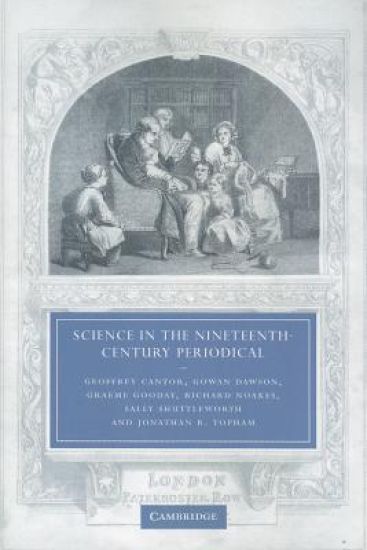
Science in the Nineteenth-Century Periodical

Science in the Nineteenth-Century Periodical

Geoffrey Cantor; Gowan Dawson; Graeme Gooday; Richard Noakes; Sally Shuttleworth; Jonathan R. Topham

Cambridge University Press
2004
sidottu
For the Victorian reading public, periodicals played a far greater role than books in shaping their understanding of new discoveries and theories in science, technology and medicine. Such understandings were formed not merely by serious scientific articles, but also by glancing asides in political reports, fictional representations, or humorous attacks in comic magazines. Ranging across diverse forms of periodicals, from top-selling religious and juvenile magazines through to popular fiction-based periodicals, and from the campaigning 'new journalism' of the late century to the comic satire of Punch, this book explores the ways in which scientific ideas and developments were presented to a variety of Victorian audiences. In addition, it offers three case studies of the representation of particular areas of science: 'baby science', scientific biography, and electricity. This intriguing collaborative volume sheds light on issues relating to history and history of science, literature, book history, and cultural and media studies.
Culture and Science in the Nineteenth-Century Media

Culture and Science in the Nineteenth-Century Media

Louise Henson; Geoffrey Cantor; Gowan Dawson; Richard Noakes; Sally Shuttleworth; Jonathan R. Topham

Ashgate Publishing Limited
2004
sidottu
Written by literary scholars, historians of science, and cultural historians, the twenty-two original essays in this collection explore the intriguing and multifaceted interrelationships between science and culture through the periodical press in nineteenth-century Britain. Ranging across the spectrum of periodical titles, the six sections comprise: 'Women, Children, and Gender', 'Religious Audiences', 'Naturalizing the Supernatural', 'Contesting New Technologies', 'Professionalization and Journalism', and 'Evolution, Psychology, and Culture'. The essays offer some of the first 'samplings and soundings' from the emergent and richly interdisciplinary field of scholarship on the relations between science and the nineteenth-century media.
Culture and Science in the Nineteenth-Century Media

Culture and Science in the Nineteenth-Century Media

Louise Henson; Geoffrey Cantor; Gowan Dawson; Richard Noakes; Sally Shuttleworth; Jonathan R. Topham

Routledge
2016
nidottu
Written by literary scholars, historians of science, and cultural historians, the twenty-two original essays in this collection explore the intriguing and multifaceted interrelationships between science and culture through the periodical press in nineteenth-century Britain. Ranging across the spectrum of periodical titles, the six sections comprise: 'Women, Children, and Gender', 'Religious Audiences', 'Naturalizing the Supernatural', 'Contesting New Technologies', 'Professionalization and Journalism', and 'Evolution, Psychology, and Culture'. The essays offer some of the first 'samplings and soundings' from the emergent and richly interdisciplinary field of scholarship on the relations between science and the nineteenth-century media.
Science in the Nineteenth-Century Periodical

Science in the Nineteenth-Century Periodical

Geoffrey Cantor; Gowan Dawson; Graeme Gooday; Richard Noakes; Sally Shuttleworth; Jonathan R. Topham

Cambridge University Press
2007
pokkari
For the Victorian reading public, periodicals played a far greater role than books in shaping their understanding of new discoveries and theories in science, technology and medicine. Such understandings were formed not merely by serious scientific articles, but also by glancing asides in political reports, fictional representations, or humorous attacks in comic magazines. Ranging across diverse forms of periodicals, from top-selling religious and juvenile magazines through to popular fiction-based periodicals, and from the campaigning 'new journalism' of the late century to the comic satire of Punch, this book explores the ways in which scientific ideas and developments were presented to a variety of Victorian audiences. In addition, it offers three case studies of the representation of particular areas of science: 'baby science', scientific biography, and electricity. This intriguing collaborative volume sheds light on issues relating to history and history of science, literature, book history, and cultural and media studies.
The Great Exhibition

The Great Exhibition

Geoffrey Cantor

Pickering Chatto (Publishers) Ltd
2013
muu
The Great Exhibition of 1851 was the outstanding public event of the Victorian era. Housed in Joseph Paxton’s Crystal Palace, it presented a vast array of objects, technologies and works of art from around the world. The sources in this edition provide a depth of context for study into the Exhibition.
The Great Exhibition Vol 2

The Great Exhibition Vol 2

Geoffrey Cantor

Routledge
2013
sidottu
The Great Exhibition of 1851 was the outstanding public event of the Victorian era. Housed in Joseph Paxton’s Crystal Palace, it presented a vast array of objects, technologies and works of art from around the world. The sources in this edition provide a depth of context for study into the Exhibition.
The Great Exhibition Vol 4

The Great Exhibition Vol 4

Geoffrey Cantor

Routledge
2013
sidottu
The Great Exhibition of 1851 was the outstanding public event of the Victorian era. Housed in Joseph Paxton’s Crystal Palace, it presented a vast array of objects, technologies and works of art from around the world. The sources in this edition provide a depth of context for study into the Exhibition.
The Great Exhibition Vol 3

The Great Exhibition Vol 3

Geoffrey Cantor

Routledge
2013
sidottu
The Great Exhibition of 1851 was the outstanding public event of the Victorian era. Housed in Joseph Paxton’s Crystal Palace, it presented a vast array of objects, technologies and works of art from around the world. The sources in this edition provide a depth of context for study into the Exhibition.
The Great Exhibition Vol 1

The Great Exhibition Vol 1

Geoffrey Cantor

Routledge
2013
sidottu
The Great Exhibition of 1851 was the outstanding public event of the Victorian era. Housed in Joseph Paxton’s Crystal Palace, it presented a vast array of objects, technologies and works of art from around the world. The sources in this edition provide a depth of context for study into the Exhibition.
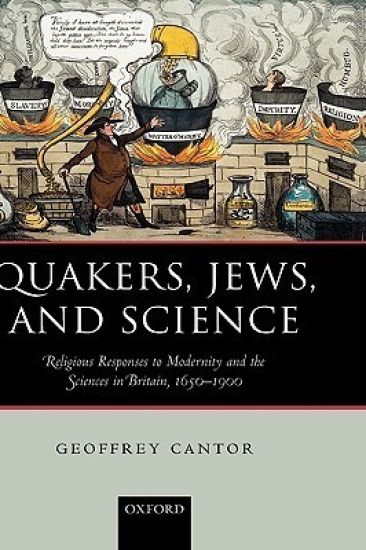
Quakers, Jews, and Science

Quakers, Jews, and Science

Geoffrey Cantor

Oxford University Press
2005
sidottu
How do science and religion interact? This study examines the ways in which two minorities in Britain - the Quaker and Anglo-Jewish communities - engaged with science. Drawing on a wealth of documentary material, much of which has not been analysed by previous historians, Geoffrey Cantor charts the participation of Quakers and Jews in many different aspects of science: scientific research, science education, science-related careers, and scientific institutions. The responses of both communities to the challenge of modernity posed by innovative scientific theories, such as the Newtonian worldview and Darwin's theory of evolution, are of central interest.
Reconstructing Nature: The Engagement of Science and Religion

Reconstructing Nature: The Engagement of Science and Religion

John Brooke; Geoffrey Cantor

Oxford University Press
2000
nidottu
This book, first published in the U.K. by T&T Clark, expands on the authors' prestigious Glasgow Gifford Lectures of 1995-6. Brooke and Cantor herein examine the many different ways in which the relationship between science and religion has been presented throughout history. They contend that, in fact, neither science nor religion is reducible to some timeless "essence"--and they deftly criticize the various master-narratives that have been put forward in support of such "essentialist" theses. Along the way, they repeatedly demolish the clich s so typical of popular histories of the science and religion debate, demonstrating the impossibility of reducing these debates to a single narrative, or of narrowing this relationship to a paradigm of conflict.
Michael Faraday: Sandemanian and Scientist

Michael Faraday: Sandemanian and Scientist

Geoffrey Cantor

Palgrave Macmillan
1993
nidottu
'Deserves to be as popular with non-specialists as with those who have a science background...I can think of sixth-formers I would offer it to, and I know of an eighty-year-old (non-specialist) who would not let me finish my copy in peace' - Elspeth Crawford, Physics Education 'Cantor...achieves a level of insight into Farday's life which far surpasses all other biographies. It will form the basis on which future studies of all aspects of Faraday's life and work will have to be built' - Frank A.J.James, British Journal for the History of Science 'A sympathetic and accessible treatment of Faraday's life and work' - David Gooding, Physics World 'For those who want to know more about one of the UK's greatest figures, it is essential reading' - A.R.Butler, Chemistry in Britain 'Excellent Biography' - John Kerr, Scientific and Medical Network Newsletter This book locates Faraday and his science in the context of the Sandemanians. We gain both a new interpretation of one of the most important scientists of the nineteenth century and a fascinating insight into the relation between science and religion.