Kirjojen hintavertailu. Mukana 12 390 323 kirjaa ja 12 kauppaa.

Kirjailija

Geoffrey Grimmett

Kirjat ja teokset yhdessä paikassa: 8 kirjaa, julkaisuja vuosilta 2010-2020, suosituimpien joukossa Probability and Random Processes. Vertaile teosten hintoja ja tarkista saatavuus suomalaisista kirjakaupoista.

8 kirjaa

Kirjojen julkaisuhaarukka 2010-2020.

Probability and Random Processes

Probability and Random Processes

Geoffrey Grimmett; David Stirzaker

Oxford University Press
2020
sidottu
The fourth edition of this successful text provides an introduction to probability and random processes, with many practical applications. It is aimed at mathematics undergraduates and postgraduates, and has four main aims. US BL To provide a thorough but straightforward account of basic probability theory, giving the reader a natural feel for the subject unburdened by oppressive technicalities. BE BL To discuss important random processes in depth with many examples.BE BL To cover a range of topics that are significant and interesting but less routine.BE BL To impart to the beginner some flavour of advanced work.BE UE OP The book begins with the basic ideas common to most undergraduate courses in mathematics, statistics, and science. It ends with material usually found at graduate level, for example, Markov processes, (including Markov chain Monte Carlo), martingales, queues, diffusions, (including stochastic calculus with Itô's formula), renewals, stationary processes (including the ergodic theorem), and option pricing in mathematical finance using the Black-Scholes formula. Further, in this new revised fourth edition, there are sections on coupling from the past, Lévy processes, self-similarity and stability, time changes, and the holding-time/jump-chain construction of continuous-time Markov chains. Finally, the number of exercises and problems has been increased by around 300 to a total of about 1300, and many of the existing exercises have been refreshed by additional parts. The solutions to these exercises and problems can be found in the companion volume, One Thousand Exercises in Probability, third edition, (OUP 2020).CP
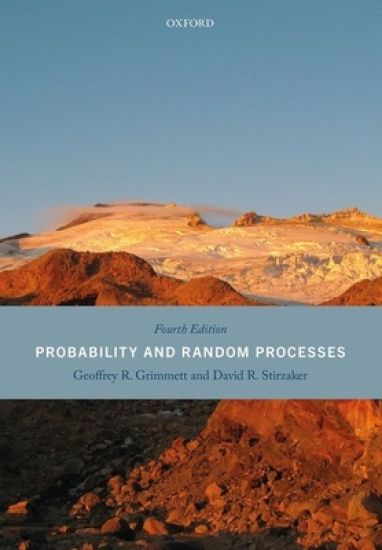
Probability and Random Processes

Probability and Random Processes

Geoffrey Grimmett; David Stirzaker

Oxford University Press
2020
nidottu
The fourth edition of this successful text provides an introduction to probability and random processes, with many practical applications. It is aimed at mathematics undergraduates and postgraduates, and has four main aims. US BL To provide a thorough but straightforward account of basic probability theory, giving the reader a natural feel for the subject unburdened by oppressive technicalities. BE BL To discuss important random processes in depth with many examples.BE BL To cover a range of topics that are significant and interesting but less routine. BE BL To impart to the beginner some flavour of advanced work.BE UE OP The book begins with the basic ideas common to most undergraduate courses in mathematics, statistics, and science. It ends with material usually found at graduate level, for example, Markov processes, (including Markov chain Monte Carlo), martingales, queues, diffusions, (including stochastic calculus with Itô's formula), renewals, stationary processes (including the ergodic theorem), and option pricing in mathematical finance using the Black-Scholes formula. Further, in this new revised fourth edition, there are sections on coupling from the past, Lévy processes, self-similarity and stability, time changes, and the holding-time/jump-chain construction of continuous-time Markov chains. Finally, the number of exercises and problems has been increased by around 300 to a total of about 1300, and many of the existing exercises have been refreshed by additional parts. The solutions to these exercises and problems can be found in the companion volume, One Thousand Exercises in Probability, third edition, (OUP 2020).CP
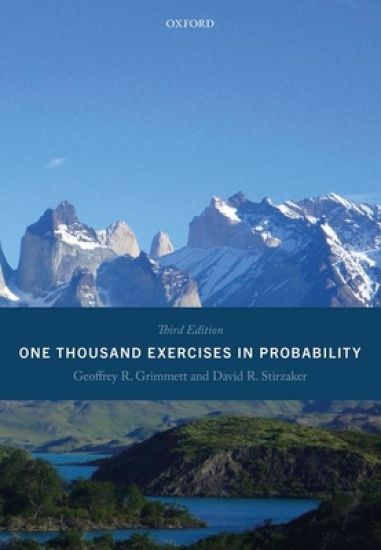
One Thousand Exercises in Probability

One Thousand Exercises in Probability

Geoffrey Grimmett; David Stirzaker

Oxford University Press
2020
nidottu
This third edition is a revised, updated, and greatly expanded version of previous edition of 2001. The 1300+ exercises contained within are not merely drill problems, but have been chosen to illustrate the concepts, illuminate the subject, and both inform and entertain the reader. A broad range of subjects is covered, including elementary aspects of probability and random variables, sampling, generating functions, Markov chains, convergence, stationary processes, renewals, queues, martingales, diffusions, Lévy processes, stability and self-similarity, time changes, and stochastic calculus including option pricing via the Black-Scholes model of mathematical finance. The text is intended to serve students as a companion for elementary, intermediate, and advanced courses in probability, random processes and operations research. It will also be useful for anyone needing a source for large numbers of problems and questions in these fields. In particular, this book acts as a companion to the authors' volume, Probability and Random Processes, fourth edition (OUP 2020).
Probability and Random Processes with One Thousand Exercises in Probability

Probability and Random Processes with One Thousand Exercises in Probability

Geoffrey Grimmett; David Stirzaker

Oxford University Press
2020
muu
Probability and Random Processes begins with the basic ideas common to most undergraduate courses in mathematics, statistics, and science. It ends with material usually found at graduate level, for example, Markov processes, (including Markov chain Monte Carlo), martingales, queues, diffusions, (including stochastic calculus with Itô's formula), renewals, stationary processes (including the ergodic theorem), and option pricing in mathematical finance using the Black-Scholes formula. Further, in this new revised fourth edition, there are sections on coupling from the past, Lévy processes, self-similarity and stability, time changes, and the holding-time/jump-chain construction of continuous-time Markov chains. Finally, the number of exercises and problems has been increased by around 300 to a total of about 1317, and many of the existing exercises have been refreshed by additional parts. The solutions to these exercises and problems can be found in the companion volume, One Thousand Exercises in Probability, third edition. One Thousand Exercises in Probability, third edition is a revised, updated, and greatly expanded version of previous edition of 2001. The 1300+ exercises contained within are not merely drill problems, but have been chosen to illustrate the concepts, illuminate the subject, and both inform and entertain the reader. A broad range of subjects is covered, including elementary aspects of probability and random variables, sampling, generating functions, Markov chains, convergence, stationary processes, renewals, queues, martingales, diffusions, Lévy processes, stability and self-similarity, time changes, and stochastic calculus including option pricing via the Black-Scholes model of mathematical finance.
Probability on Graphs

Probability on Graphs

Geoffrey Grimmett

Cambridge University Press
2018
pokkari
This introduction to some of the principal models in the theory of disordered systems leads the reader through the basics, to the very edge of contemporary research, with the minimum of technical fuss. Topics covered include random walk, percolation, self-avoiding walk, interacting particle systems, uniform spanning tree, random graphs, as well as the Ising, Potts, and random-cluster models for ferromagnetism, and the Lorentz model for motion in a random medium. This new edition features accounts of major recent progress, including the exact value of the connective constant of the hexagonal lattice, and the critical point of the random-cluster model on the square lattice. The choice of topics is strongly motivated by modern applications, and focuses on areas that merit further research. Accessible to a wide audience of mathematicians and physicists, this book can be used as a graduate course text. Each chapter ends with a range of exercises.
Probability

Probability

Geoffrey Grimmett; Dominic Welsh

Oxford University Press
2014
nidottu
Probability is an area of mathematics of tremendous contemporary importance across all aspects of human endeavour. This book is a compact account of the basic features of probability and random processes at the level of first and second year mathematics undergraduates and Masters' students in cognate fields. It is suitable for a first course in probability, plus a follow-up course in random processes including Markov chains. A special feature is the authors' attention to rigorous mathematics: not everything is rigorous, but the need for rigour is explained at difficult junctures. The text is enriched by simple exercises, together with problems (with very brief hints) many of which are taken from final examinations at Cambridge and Oxford. The first eight chapters form a course in basic probability, being an account of events, random variables, and distributions - discrete and continuous random variables are treated separately - together with simple versions of the law of large numbers and the central limit theorem. There is an account of moment generating functions and their applications. The following three chapters are about branching processes, random walks, and continuous-time random processes such as the Poisson process. The final chapter is a fairly extensive account of Markov chains in discrete time. This second edition develops the success of the first edition through an updated presentation, the extensive new chapter on Markov chains, and a number of new sections to ensure comprehensive coverage of the syllabi at major universities.
Probability

Probability

Geoffrey Grimmett; Dominic Welsh

Oxford University Press
2014
sidottu
Probability is an area of mathematics of tremendous contemporary importance across all aspects of human endeavour. This book is a compact account of the basic features of probability and random processes at the level of first and second year mathematics undergraduates and Masters' students in cognate fields. It is suitable for a first course in probability, plus a follow-up course in random processes including Markov chains. A special feature is the authors' attention to rigorous mathematics: not everything is rigorous, but the need for rigour is explained at difficult junctures. The text is enriched by simple exercises, together with problems (with very brief hints) many of which are taken from final examinations at Cambridge and Oxford. The first eight chapters form a course in basic probability, being an account of events, random variables, and distributions - discrete and continuous random variables are treated separately - together with simple versions of the law of large numbers and the central limit theorem. There is an account of moment generating functions and their applications. The following three chapters are about branching processes, random walks, and continuous-time random processes such as the Poisson process. The final chapter is a fairly extensive account of Markov chains in discrete time. This second edition develops the success of the first edition through an updated presentation, the extensive new chapter on Markov chains, and a number of new sections to ensure comprehensive coverage of the syllabi at major universities.
Probability on Graphs

Probability on Graphs

Geoffrey Grimmett

Cambridge University Press
2010
sidottu
This introduction to some of the principal models in the theory of disordered systems leads the reader through the basics, to the very edge of contemporary research, with the minimum of technical fuss. Topics covered include random walk, percolation, self-avoiding walk, interacting particle systems, uniform spanning tree, random graphs, as well as the Ising, Potts, and random-cluster models for ferromagnetism, and the Lorentz model for motion in a random medium. Schramm–Löwner evolutions (SLE) arise in various contexts. The choice of topics is strongly motivated by modern applications and focuses on areas that merit further research. Special features include a simple account of Smirnov's proof of Cardy's formula for critical percolation, and a fairly full account of the theory of influence and sharp-thresholds. Accessible to a wide audience of mathematicians and physicists, this book can be used as a graduate course text. Each chapter ends with a range of exercises.