Kirjojen hintavertailu. Mukana 12 595 353 kirjaa ja 12 kauppaa.
Kirjailija
Geoffrey Nelson
Kirjat ja teokset yhdessä paikassa: 7 kirjaa, julkaisuja vuosilta 2001-2012, suosituimpien joukossa The Better Beginnings, Better Futures Project. Vertaile teosten hintoja ja tarkista saatavuus suomalaisista kirjakaupoista.
Ray DeV. Peters; Alison J. Bradshaw; Kelly Petrunka; Geoffrey Nelson; Yves Herry; Wendy M. Craig; Robert Arnold; Kevin C. H. Paker; Shahriar R. Khan; Jeffrey S. Hoch; S. Mark Pancer; Colleen Loomis; Jean-Marc Bélanger; Susan Evers; Claire Maltais; Katherine Thompson; Melissa D. Rossiter
Wiley-Blackwell (an imprint of John Wiley Sons Ltd)
Although comprehensive and ecological approaches to early childhood prevention are commonly advocated, there are few examples of long-term follow-up of such programs. In this monograph, we investigate the medium- and longterm effects of an ecological, community-based prevention project for primary school children and families living in three economically disadvantaged neighborhoods in Ontario, Canada. The Better Beginnings, Better Futures (BBBF) project is one of the most ambitious Canadian research projects on the long-term impacts of early childhood prevention programming to date.

The twentieth century has been marked by an unprecedented outburst of religious activity on a world-wide scale, and in particular by a mushrooming of numerous religious movements. This work, first published in 1987, takes a fresh approach to the understanding of this phenomenon, an approach which takes into account new concepts of human nature and of religion.
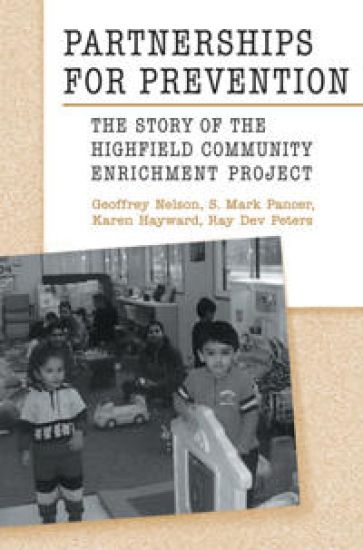
The Highfield Community Enrichment Project is one of eight demonstration sites for the ‘Better Beginnings, Better Futures’ initiative, a comprehensive, community-driven program dedicated to the prevention of children’s mental health problems in Ontario and the promotion of child, family, and community wellness. Drawing from this multi-method, longitudinal research project, authors Geoffrey Nelson, S. Mark Pancer, Karen Hayward, and Ray DeV. Peters have written Partnerships for Prevention, providing insights and lessons on how prevention programs can be planned, implemented, and managed in a low-income, multicultural context with a high degree of community involvement. The authors demonstrate not just that the program works, but how it works, and in so doing make a contribution to theory, research, and practice in primary prevention and mental health promotion for children. Partnerships for Prevention provides a great deal of knowledge that will be of interest and use to policy-makers, program planners, practitioners, and community residents, who wish to create prevention programs.
How can psychologists incorporate recent insights about power, values and inequality in their work? What is the role of social justice in the practice of psychology? In this highly readable book Prilleltensky and Nelson tackle these questions and propose workable solutions. This is the first book to translate into action the principles of critical psychology. Using a value-based framework the authors propose guidelines for training and critical practice in clinical, counselling, educational, health, community, and work settings.The authors base their approach on a combination of values for the promotion of personal, interpersonal, and collective well-being. They propose a set of values consisting of self determination, caring and compassion, health, respect for diversity, participation, community support and social justice. Because of its wide coverage, the book should be of interest to students and practitioners in psychology, mental health, and to users of psychological services in most fields of practice.Doing Psychology Critically: § translates critical psychology theory into practice§ applies to most fields of applied psychology§ is written in an accessible style § includes tables and diagrams that illustrate recommendations for practice§ follows a coherent framework§ is a useful resource for training programmes in health, clinical, counselling, educational, community, and organisational psychologyISAAC PRILLELTENSKY is Professor of Psychology and Director of the Wellness Promotion Unit at Victoria University in Melbourne. He is the author of The Morals and Politics of Psychology and co-editor of Critical Psychology: An Introduction (with Dennis Fox) and Promoting Family Wellness and Preventing Child Maltreatment (with Geoffrey Nelson and Leslea Peirson).GEOFFREY NELSON is Professor of Psychology at Wilfrid Laurier University in Canada. He has served as Editor of the Canadian Journal of Community Mental Health and is the author of Shifting the Paradigm in Community Mental Health (with John Lord and Joanna Ochocka) and co-editor of Promoting Family Wellness: Fundamentals for Thinking and Action (with Isaac Prilleltensky and Leslea Peirson).
This ground-breaking study examines changes in the values and related practices within community mental health that occurred between 1984 and 1998. During this period, a distinct shift in policy coincided with a new emphasis on mental health reform. Consumer/survivors and other mental health claims-makers played an active role in shaping mental health policy during this time and influenced the trend of consumer/survivor and family participation and empowerment in the policy and planning process. This unique two-and-a-half year study examined one community in depth by looking at the changes that occurred for individuals, organisations, and policy. While the three organizations under study followed their own unique path toward change, the authors contend that there were also common elements in the journey toward the "empowerment community-integration" paradigm. Central to this shift was the emphasis on building an organization based on consensually defined values and a vision for the future. Shifting The Paradigm in Community Mental Health is itself a valuable guide for future research and for the consumers and administrators within the mental health community as well as in other areas of human services. This is an important guide for anyone interested in innovation and social change.