Kirjojen hintavertailu. Mukana 12 540 672 kirjaa ja 12 kauppaa.

Kirjailija

Geoffrey Tweedale

Kirjat ja teokset yhdessä paikassa: 6 kirjaa, julkaisuja vuosilta 1987-2009, suosituimpien joukossa Steel City. Vertaile teosten hintoja ja tarkista saatavuus suomalaisista kirjakaupoista.

6 kirjaa

Kirjojen julkaisuhaarukka 1987-2009.

Sheffield Steel and America

Sheffield Steel and America

Geoffrey Tweedale

Cambridge University Press
2009
pokkari
The book provides an important contribution to the technological and commercial history of crucible and electric steelmaking by thoroughly examining its development in Sheffield and American centres such as Pittsburgh. It also discusses cutlery, saw and file manufacturing, where the Americans quickly shed Sheffield's traditional technologies and, with the help of superior marketing, established a word lead by 1900. It is also shown, however, that this did not free the US from its dependence on Sheffield steel. Sheffield's innovation in special steelmaking, which began with the Hunstman crucible process in 1742, continued with a series of brilliant 'firsts', which gave the world tool, manganese, silicon, vanadium and stainless steel alloys. Thus the US continued to draw from Sheffield know-how, even in the twentieth century - a transfer of technology that was facilitated by the foundation of Sheffield's own subsidiary firms in America, the history of which is recounted here.
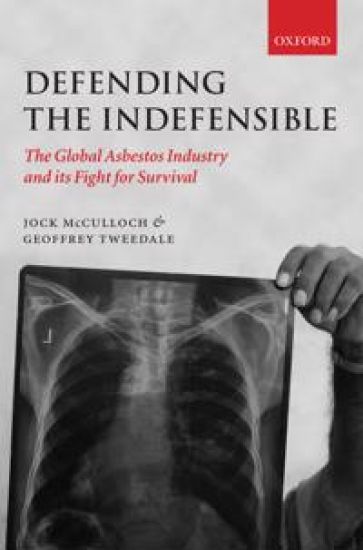
Defending the Indefensible

Defending the Indefensible

Jock McCulloch; Geoffrey Tweedale

Oxford University Press
2008
sidottu
In the early twentieth century, asbestos had a reputation as a lifesaver. In 1960, however, it became known that even relatively brief exposure to asbestos can cause mesothelioma, a virulent and lethal cancer. Yet the bulk of the world's asbestos was mined after 1960. Asbestos usage in many countries continued unabated. This is the first global history of how the asbestos industry and its allies in government, insurance, and medicine defended the product throughout the twentieth century. It explains how mining and manufacture could continue despite overwhelming medical evidence as to the risks. The argument advanced in this book is that asbestos has proved so enduring because the industry was able to mount a successful defense strategy for the mineral - a strategy that still operates in some parts of the world. This defence involved the shaping of the public debate by censoring, and sometimes corrupting, scientific research, nurturing scientific uncertainty, and using allies in government, insurance, and medicine. The book also discusses the problems of asbestos in the environment, compensating victims, and the continued use of asbestos in the developing world. Its global focus shows how asbestos can be seen as a model for many occupational diseases - indeed for a whole range of hazards produced by industrial societies. The book is based on a wealth of documentary material gained from legal discovery, supplemented by evidence from the authors' visits and researches in the US, the UK, Canada, Kazakhstan, Zimbabwe, Australia, Swaziland, and South Africa.
Magic Mineral to Killer Dust

Magic Mineral to Killer Dust

Geoffrey Tweedale

Oxford University Press
2001
nidottu
This is an account of the UK asbestos health problem, which provides an in-depth look at the occupational health experience of one of the world's leading asbestos companies - British asbestos giant, Turner and Newall.
Magic Mineral to Killer Dust

Magic Mineral to Killer Dust

Geoffrey Tweedale

Oxford University Press
2000
sidottu
Asbestos was once known as the 'magic mineral' because of its ability to withstand flames. Yet since the 1960s, it has become a notorious and feared 'killer dust' that is responsible for thousands of deaths and an epidemic that will continue into the millennium. This is the first comprehensive history of the UK asbestos health problem, which provides an in-depth look at the occupational health experience of one of the world's leading asbestos companies - British asbestos giant, Turner and Newall. Based on a vast company archive recently released in American litigation, Magic Mineral to Killer Dust gives an unprecedented insight into all aspects of the asbestos hazard - dust control, workmen's compensation, government regulation, and the development of medical knowledge. In particular, it looks at the role of industrialists, doctors, factory inspectors, and trade unionists, highlighting the failures in regulation that accompanied the commercial development of a material that was already known to be lethal at the start of the twentieth century.
Steel City

Steel City

Geoffrey Tweedale

Oxford University Press
1995
sidottu
The book focuses on the historical evolution of firms, and industry leaders and their strategies. Sheffield's experience is then related to current historical and economic debates about industrial structure, entrepreneurship and UK decline. Sheffield is revealed (with some important qualifications) as a remarkably enduring and successful centre; and also a highly complex one, which cannot be fitted easily into present theories of mass production and entrepreneurial failure.
Sheffield Steel and America

Sheffield Steel and America

Geoffrey Tweedale

Cambridge University Press
1987
sidottu
The book provides an important contribution to the technological and commercial history of crucible and electric steelmaking by thoroughly examining its development in Sheffield and American centres such as Pittsburgh. It also discusses cutlery, saw and file manufacturing, where the Americans quickly shed Sheffield's traditional technologies and, with the help of superior marketing, established a word lead by 1900. It is also shown, however, that this did not free the US from its dependence on Sheffield steel. Sheffield's innovation in special steelmaking, which began with the Hunstman crucible process in 1742, continued with a series of brilliant 'firsts', which gave the world tool, manganese, silicon, vanadium and stainless steel alloys. Thus the US continued to draw from Sheffield know-how, even in the twentieth century - a transfer of technology that was facilitated by the foundation of Sheffield's own subsidiary firms in America, the history of which is recounted here.