Kirjojen hintavertailu. Mukana 12 368 814 kirjaa ja 12 kauppaa.
Kirjailija
George A. Milliken
Kirjat ja teokset yhdessä paikassa: 8 kirjaa, julkaisuja vuosilta 1989-2019, suosituimpien joukossa Analysis of Messy Data, Volume III. Vertaile teosten hintoja ja tarkista saatavuus suomalaisista kirjakaupoista.
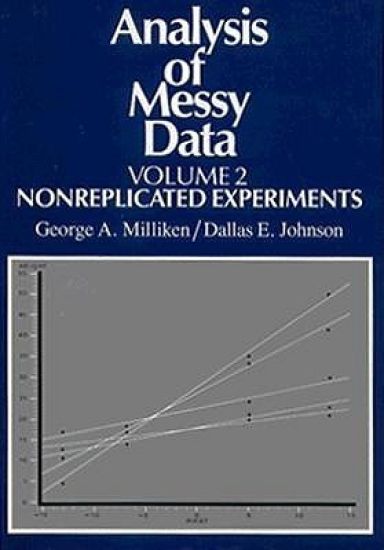
Researchers often do not analyze nonreplicated experiments statistically because they are unfamiliar with existing statistical methods that may be applicable. Analysis of Messy Data, Volume II details the statistical methods appropriate for nonreplicated experiments and explores ways to use statistical software to make the required computations feasible.
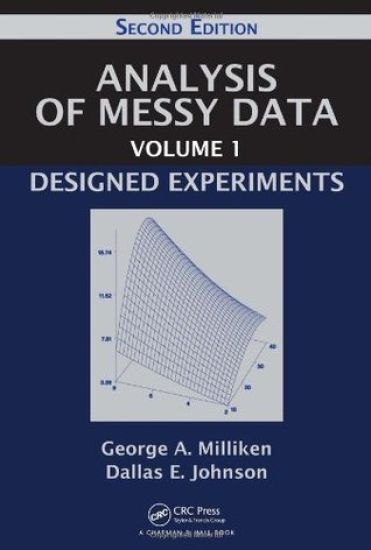
A bestseller for nearly 25 years, Analysis of Messy Data, Volume 1: Designed Experiments helps applied statisticians and researchers analyze the kinds of data sets encountered in the real world. Written by two long-time researchers and professors, this second edition has been fully updated to reflect the many developments that have occurred since the original publication.New to the Second Edition Several modern suggestions for multiple comparison proceduresAdditional examples of split-plot designs and repeated measures designsThe use of SAS-GLM to analyze an effects modelThe use of SAS-MIXED to analyze data in random effects experiments, mixed model experiments, and repeated measures experimentsThe book explores various techniques for multiple comparison procedures, random effects models, mixed models, split-plot experiments, and repeated measures designs. The authors implement the techniques using several statistical software packages and emphasize the distinction between design structure and the structure of treatments. They introduce each topic with examples, follow up with a theoretical discussion, and conclude with a case study. Bringing a classic work up to date, this edition will continue to show readers how to effectively analyze real-world, nonstandard data sets.
Analysis of covariance is a very useful but often misunderstood methodology for analyzing data where important characteristics of the experimental units are measured but not included as factors in the design. Analysis of Messy Data, Volume 3: Analysis of Covariance takes the unique approach of treating the analysis of covariance problem by looking at a set of regression models, one for each of the treatments or treatment combinations. Using this strategy, analysts can use their knowledge of regression analysis and analysis of variance to help attack the problem. The authors describe the strategy for one- and two-way treatment structures with one and multiple covariates in a completely randomized design structure. They present new methods for comparing models and sets of parameters, including beta-hat models. They carefully investigate the effect of blocking, explore mixed models, and present a new methodology for using covariates to analyze data from nonreplicated experiments. Analysis of covariance provides an invaluable set of strategies for analyzing data. With its careful balance of theory and examples, Analysis of Messy Data: Volume 3 provides a unique and outstanding guide to the strategy's techniques, theory, and application.
Discover the power of mixed models with SAS. Mixed models-now the mainstream vehicle for analyzing most research data-are part of the core curriculum in most master's degree programs in statistics and data science. In a single volume, this book updates both SAS(R) for Linear Models, Fourth Edition, and SAS(R) for Mixed Models, Second Edition, covering the latest capabilities for a variety of applications featuring the SAS GLIMMIX and MIXED procedures. Written for instructors of statistics, graduate students, scientists, statisticians in business or government, and other decision makers, SAS(R) for Mixed Models is the perfect entry for those with a background in two-way analysis of variance, regression, and intermediate-level use of SAS. This book expands coverage of mixed models for non-normal data and mixed-model-based precision and power analysis, including the following topics: Random-effect-only and random-coefficients models Multilevel, split-plot, multilocation, and repeated measures models Hierarchical models with nested random effects Analysis of covariance models Generalized linear mixed models This book is part of the SAS Press program.
From the Chapman & Hall Microbiology Series this unique resource offers specific experimental and practical applications of mathematical modeling in microbial ecology. The text presents a variety of systems, ranging from subcellular systems to ecosystems, and shows how to test whether the models provide a good representation of the system. The book also encourages further development and application of modeling to burgeoning problems associated with microbial ecology, such as the pollution and destruction of pesticides and herbicides.
From the Chapman & Hall Microbiology Series this unique resource offers specific experimental and practical applications of mathematical modeling in microbial ecology. The text presents a variety of systems, ranging from subcellular systems to ecosystems, and shows how to test whether the models provide a good representation of the system. The book also encourages further development and application of modeling to burgeoning problems associated with microbial ecology, such as the pollution and destruction of pesticides and herbicides.
Researchers often do not analyze nonreplicated experiments statistically because they are unfamiliar with existing statistical methods that may be applicable. Analysis of Messy Data, Volume II details the statistical methods appropriate for nonreplicated experiments and explores ways to use statistical software to make the required computations feasible.