Kirjojen hintavertailu. Mukana 12 390 323 kirjaa ja 12 kauppaa.

Kirjailija

George Fletcher

Kirjat ja teokset yhdessä paikassa: 11 kirjaa, julkaisuja vuosilta 2007-2025, suosituimpien joukossa The Life & Career of Dr. William Palmer of Rugeley Together with a Full Account of the Murder of John P. Cook and a Short Account of His Trial in May 1856. Vertaile teosten hintoja ja tarkista saatavuus suomalaisista kirjakaupoista.

11 kirjaa

Kirjojen julkaisuhaarukka 2007-2025.

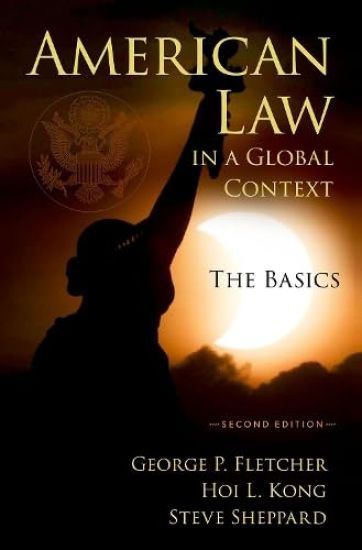
American Law in a Global Context

American Law in a Global Context

George Fletcher; Hoi L. Kong; Steve Sheppard

OXFORD UNIVERSITY PRESS INC
2025
sidottu
American Law in a Global Context: The Basics, now in a thoroughly revised edition, is an elegant and erudite introduction to the American legal system from a global perspective. Drawing on some comparative examples with a focus on American law, George P. Fletcher, Hoi L. Kong, and Steve Sheppard introduce underlying principles of common and civil law, constitutional, criminal, and public law, and property and procedure. The appendices include an introduction to the common law method, instruction on how to read a case, the interpretation of statutes, and an introduction to the Federal system and US courts systems. This revised edition offers a greater focus on American law itself and includes the addition of an easy-to-use Bibliography as well as a new Civil Procedure Appendix. Fletcher, Kong, and Sheppard provide a clear roadmap through essential areas of US law with in-depth analyses of well-known cases. These cases allow readers the opportunity to examine not only law as theory but as practice, while guiding them to further exploration through suggested readings. A must-own reference source for LLM students, undergraduates, and students of US law in other countries.
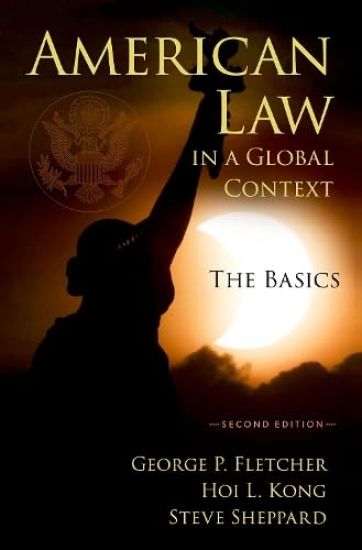
American Law in a Global Context

American Law in a Global Context

George Fletcher; Hoi L. Kong; Steve Sheppard

OXFORD UNIVERSITY PRESS INC
2025
nidottu
American Law in a Global Context: The Basics, now in a thoroughly revised edition, is an elegant and erudite introduction to the American legal system from a global perspective. Drawing on some comparative examples with a focus on American law, George P. Fletcher, Hoi L. Kong, and Steve Sheppard introduce underlying principles of common and civil law, constitutional, criminal, and public law, and property and procedure. The appendices include an introduction to the common law method, instruction on how to read a case, the interpretation of statutes, and an introduction to the Federal system and US courts systems. This revised edition offers a greater focus on American law itself and includes the addition of an easy-to-use Bibliography as well as a new Civil Procedure Appendix. Fletcher, Kong, and Sheppard provide a clear roadmap through essential areas of US law with in-depth analyses of well-known cases. These cases allow readers the opportunity to examine not only law as theory but as practice, while guiding them to further exploration through suggested readings. A must-own reference source for LLM students, undergraduates, and students of US law in other countries.

Querying Graphs

Querying Graphs

Angela Bonifati; George Fletcher; Hannes Voigt; Nikolay Yakovets

Springer International Publishing AG
2018
nidottu
Graph data modeling and querying arises in many practical application domains such as social and biological networks where the primary focus is on concepts and their relationships and the rich patterns in these complex webs of interconnectivity. In this book, we present a concise unified view on the basic challenges which arise over the complete life cycle of formulating and processing queries on graph databases. To that purpose, we present all major concepts relevant to this life cycle, formulated in terms of a common and unifying ground: the property graph data model—the pre-dominant data model adopted by modern graph database systems. We aim especially to give a coherent and in-depth perspective on current graph querying and an outlook for future developments. Our presentation is self-contained, covering the relevant topics from: graph data models, graph query languages and graph query specification, graph constraints, and graph query processing. We conclude by indicatingmajor open research challenges towards the next generation of graph data management systems.
Defending Humanity

Defending Humanity

George Fletcher; Jens Ohlin

Oxford University Press Inc
2013
nidottu
In Defending Humanity , internationally acclaimed legal scholar George P. Fletcher and Jens David Ohlin, a leading expert on international criminal law, tackle one of the most important and controversial questions of our time: When is war justified? When a nation is attacked, few would deny that it has the right to respond with force. But what about preemptive and preventive wars, or crossing another state's border to stop genocide? Was Israel justified in initiating the Six Day War, and was NATO's intervention in Kosovo legal? What about the U.S. invasion of Iraq? In their provocative new book, Fletcher and Ohlin offer a groundbreaking theory on the legality of war with clear guidelines for evaluating these interventions. The authors argue that much of the confusion on the subject stems from a persistent misunderstanding of the United Nations Charter. The Charter appears to be very clear on the use of military force: it is only allowed when authorized by the Security Council or in self-defense. Unfortunately, this has led to the problem of justifying force when the Security Council refuses to act or when self-defense is thought not to apply--and to the difficult dilemma of declaring such interventions illegal or ignoring the UN Charter altogether. Fletcher and Ohlin suggest that the answer lies in going back to the domestic criminal law concepts upon which the UN Charter was originally based, in particular, the concept of "legitimate defense," which encompasses not only self-defense but defense of others. Lost in the English-language version of the Charter but a vital part of the French and other non-English versions, the concept of legitimate defense will enable political leaders, courts, and scholars to see the solid basis under international law for states to intervene with force--not just to protect themselves against an imminent attack but also to defend other national groups.
Defending Humanity

Defending Humanity

George Fletcher; Jens Ohlin

Oxford University Press Inc
2008
sidottu
In Defending Humanity, internationally acclaimed legal scholars George P. Fletcher and Jens David Ohlin tackle one of the most important and controversial questions of our time: When is war justified? When a nation is attacked, few would deny that it has the right to respond with force. But what about preemptive and preventive wars, or crossing another state's border to stop genocide? Was Israel justified in initiating the Six Day War, and was NATO's intervention in Kosovo legal? What about the U.S. invasion of Iraq? In their provocative new book, Fletcher and Ohlin offer a groundbreaking theory on the legality of war with clear guidelines for evaluating these interventions. The authors argue that much of the confusion on the subject stems from a persistent misunderstanding of the United Nations Charter. The Charter appears to be very clear on the use of military force: it is only allowed when authorized by the Security Council or in self-defense. Unfortunately, this has led to the problem of justifying force when the Security Council refuses to act or when self-defense is thought not to apply--and to the difficult dilemma of declaring such interventions illegal or ignoring the U.N. Charter altogether. Fletcher and Ohlin suggest that the answer lies in going back to the domestic criminal law concepts upon which the U.N. Charter was originally based, in particular, the concept of "legitimate defense," which encompasses not only self-defense but defense of others. Lost in the English-language version of the Charter but a vital part of the French and other non-English versions, the concept of legitimate defense will enable political leaders, courts, and scholars to see the solid basis under international law for states to intervene with force--not just to protect themselves against an imminent attack but also to defend other national groups.