Kirjojen hintavertailu. Mukana 12 390 323 kirjaa ja 12 kauppaa.

Kirjailija

George G. Judge

Kirjat ja teokset yhdessä paikassa: 5 kirjaa, julkaisuja vuosilta 1985-2011, suosituimpien joukossa An Information Theoretic Approach to Econometrics. Vertaile teosten hintoja ja tarkista saatavuus suomalaisista kirjakaupoista.

5 kirjaa

Kirjojen julkaisuhaarukka 1985-2011.

An Information Theoretic Approach to Econometrics

An Information Theoretic Approach to Econometrics

George G. Judge; Ron C. Mittelhammer

Cambridge University Press
2011
pokkari
This book is intended to provide the reader with a firm conceptual and empirical understanding of basic information-theoretic econometric models and methods. Because most data are observational, practitioners work with indirect noisy observations and ill-posed econometric models in the form of stochastic inverse problems. Consequently, traditional econometric methods in many cases are not applicable for answering many of the quantitative questions that analysts wish to ask. After initial chapters deal with parametric and semiparametric linear probability models, the focus turns to solving nonparametric stochastic inverse problems. In succeeding chapters, a family of power divergence measure-likelihood functions are introduced for a range of traditional and nontraditional econometric-model problems. Finally, within either an empirical maximum likelihood or loss context, Ron C. Mittelhammer and George G. Judge suggest a basis for choosing a member of the divergence family.
An Information Theoretic Approach to Econometrics

An Information Theoretic Approach to Econometrics

George G. Judge; Ron C. Mittelhammer

Cambridge University Press
2011
sidottu
This book is intended to provide the reader with a firm conceptual and empirical understanding of basic information-theoretic econometric models and methods. Because most data are observational, practitioners work with indirect noisy observations and ill-posed econometric models in the form of stochastic inverse problems. Consequently, traditional econometric methods in many cases are not applicable for answering many of the quantitative questions that analysts wish to ask. After initial chapters deal with parametric and semiparametric linear probability models, the focus turns to solving nonparametric stochastic inverse problems. In succeeding chapters, a family of power divergence measure-likelihood functions are introduced for a range of traditional and nontraditional econometric-model problems. Finally, within either an empirical maximum likelihood or loss context, Ron C. Mittelhammer and George G. Judge suggest a basis for choosing a member of the divergence family.
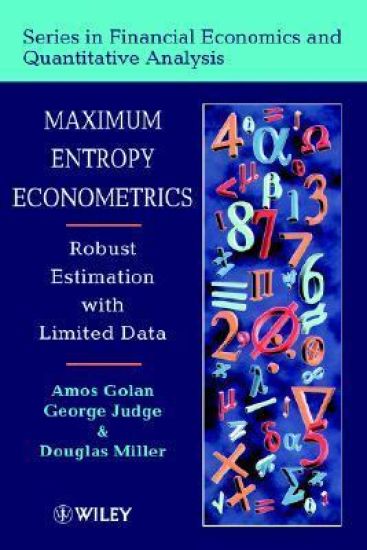
Maximum Entropy Econometrics

Maximum Entropy Econometrics

Amos Golan; George G. Judge; Douglas Miller

JOHN WILEY SONS INC
1996
sidottu
In the theory and practice of econometrics the model, the methodand the data are all interdependent links in informationrecovery-estimation and inference. Seldom, however, are theeconomic and statistical models correctly specified, the datacomplete or capable of being replicated, the estimation rulesoptimal and the inferences free of distortion. Faced with theseproblems, Maximum Entropy Economeirics provides a new basis forlearning from economic and statistical models that may benon-regular in the sense that they are ill-posed or underdeterminedand the data are partial or incomplete. By extending the maximumentropy formalisms used in the physical sciences, the authorspresent a new set of generalized entropy techniques designed torecover information about economic systems. The authors compare thegeneralized entropy techniques with the performance of the relevanttraditional methods of information recovery and clearly demonstratetheories with applications including * Pure inverse problems that include first order Markov processes,and input-output, multisectoral or SAM models to * Inverse problems with noise that include statistical modelssubject to ill-conditioning, non-normal errors, heteroskedasticity,autocorrelation, censored, multinomial and simultaneous responsedata, as well as model selection and non-stationary and dynamiccontrol problems Maximum Entropy Econometrics will be of interest to econometricianstrying to devise procedures for recovering information from partialor incomplete data, as well as quantitative economists in financeand business, statisticians, and students and applied researchersin econometrics, engineering and the physical sciences.
Learning and Practicing Econometrics

Learning and Practicing Econometrics

William E. Griffiths; R. Carter Hill; George G. Judge

John Wiley Sons Inc
1993
sidottu
Designed to promote students' understanding of econometrics and to build a more operational knowledge of economics through a meaningful combination of words, symbols and ideas. Each chapter commences in the way economists begin new empirical projects--with a question and an economic model--then proceeds to develop a statistical model, select an estimator and outline inference procedures. Contains a copious amount of problems, experimental exercises and case studies.
The Theory and Practice of Econometrics

The Theory and Practice of Econometrics

George G. Judge; William E. Griffiths; R. Carter Hill; Helmut Lütkepohl; Tsoung-Chao Lee

John Wiley Sons Inc
1985
sidottu
This broadly based graduate-level textbook covers the major models and statistical tools currently used in the practice of econometrics. It examines the classical, the decision theory, and the Bayesian approaches, and contains material on single equation and simultaneous equation econometric models. Includes an extensive reference list for each topic.