Kirjojen hintavertailu. Mukana 12 595 353 kirjaa ja 12 kauppaa.
Kirjailija
George Pullman
Kirjat ja teokset yhdessä paikassa: 6 kirjaa, julkaisuja vuosilta 2013-2015, suosituimpien joukossa Rulebook for Decision Making. Vertaile teosten hintoja ja tarkista saatavuus suomalaisista kirjakaupoista.
"Pullman offers his readers essential insights into how humans reason and make decisions. Both concise and far-reaching, his work teaches us how to challenge intuitive logic and examine the processes for deliberative reasoning. This text will prove foundational for students in their intellectual journey toward the development of real skills in critical thinking. By pointing to simple yet profound examples, Pullman's text is both readable and provocative as it challenges us to consider the very mechanisms by which we understand our own cognitive biases." --Bradley A. Hammer, Department of English and Comparative Literature, University of North Carolina, Chapel Hill
"Pullman offers his readers essential insights into how humans reason and make decisions. Both concise and far-reaching, his work teaches us how to challenge intuitive logic and examine the processes for deliberative reasoning. This text will prove foundational for students in their intellectual journey toward the development of real skills in critical thinking. By pointing to simple yet profound examples, Pullman's text is both readable and provocative as it challenges us to consider the very mechanisms by which we understand our own cognitive biases." --Bradley A. Hammer, Department of English and Comparative Literature, University of North Carolina, Chapel Hill
George Pullman's lively and accessible introduction to the study of persuasion is an ideal text for use in courses where the understanding and practice of argumentation, rhetoric, and critical thinking are central. Continually challenging his readers to seek and recognize sound evidence, to question the obvious, and to assess and reassess the credibility of claims made by others--including the author's own--Pullman shows the way to strong writing, effective speaking, and rigorous critical thinking.
This text shows how persuasion works and provides specific, detailed strategies forhoning argumentative and critical thinking skills. It includes a detailed overview of thetraditional canons of rhetoric along with updated versions for contemporarycommunication practices.
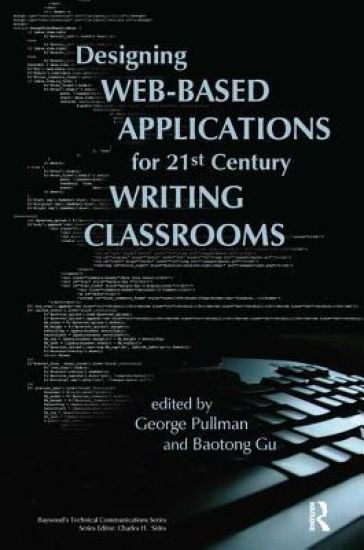
Designing Web-Based Applications for 21st Century Writing Classrooms brings together, for the first time, a group of scholars and teachers who have been developing, on their own initiative, web-based solutions to technical and professional writing instructional problems. In industry the perennial question is whether to buy or build, but in academia, for various reasons, buy is rarely an option. Individual faculty members do not have the money to pay for software solutions, and often their interests are too local or small-scale to warrant institutional-level involvement. In addition, the design of commercial applications from vendors typically does not take into account the unique needs and considerations of teachers of writing and often reflects a design ideology quite different from theirs. This is why so many writing teachers have turned to open source solutions and, in the process of learning how to tweak them to make them more responsive to their specific needs, why so many of these teachers have developed programming and design skills. Beyond exigency, the motivation for becoming proficient at interface and database design comes from the observation that the nature of writing is changing dramatically. Text is no longer an object. It has become a place of interaction; consumers are becoming producers. And the work of technical and professional communication, indeed the work of writing teachers more generally, is becoming increasingly involved in the design and implementation of places of interaction. Words have become data; texts are becoming communities.
Designing Web-Based Applications for 21st Century Writing Classrooms brings together, for the first time, a group of scholars and teachers who have been developing, on their own initiative, web-based solutions to technical and professional writing instructional problems. In industry the perennial question is whether to buy or build, but in academia, for various reasons, buy is rarely an option. Individual faculty members do not have the money to pay for software solutions, and often their interests are too local or small-scale to warrant institutional-level involvement. In addition, the design of commercial applications from vendors typically does not take into account the unique needs and considerations of teachers of writing and often reflects a design ideology quite different from theirs. This is why so many writing teachers have turned to open source solutions and, in the process of learning how to tweak them to make them more responsive to their specific needs, why so many of these teachers have developed programming and design skills. Beyond exigency, the motivation for becoming proficient at interface and database design comes from the observation that the nature of writing is changing dramatically. Text is no longer an object. It has become a place of interaction; consumers are becoming producers. And the work of technical and professional communication, indeed the work of writing teachers more generally, is becoming increasingly involved in the design and implementation of places of interaction. Words have become data; texts are becoming communities.