Kirjojen hintavertailu. Mukana 12 595 353 kirjaa ja 12 kauppaa.

Kirjailija

George Rude

Kirjat ja teokset yhdessä paikassa: 7 kirjaa, julkaisuja vuosilta 1967-2014, suosituimpien joukossa The Crowd in History. Vertaile teosten hintoja ja tarkista saatavuus suomalaisista kirjakaupoista.

Mukana myös kirjoitusasut: George Rudé

7 kirjaa

Kirjojen julkaisuhaarukka 1967-2014.

Captain Swing

Captain Swing

Eric Hobsbawm; George Rudé

Verso Books
2014
nidottu
Sir Your name is down amongst the Black hearts in the Black Book and this is to advise you and the like of you, who are Parson Justasses, to make your wills Ye have been the Blackguard Enemies of the People on all occasions, Ye have not yet done as ye ought - SwingIn our increasingly mechanized age, the Swing revolts are a timely record of the relationship between technological advance, labour and poverty. With the onset of the Industrial Revolution, capitalism swept from the cities into the countryside, and tensions mounted between agricultural workers and employers. From 1830 on, a series of revolts, known as the "Swing" shook England to its core. Landowners wanting to make their land more profitable started to use machinery to harvest crops, causing widespread misery among rural communities. Captain Swing reveals the background to that upheaval, from its rise to its fall, and shines a light on the people who tried to change the world and save their livelihoods.

Hanoverian London, 1714-1808

Hanoverian London, 1714-1808

George Rude

Sutton Publishing Ltd
2007
nidottu
In this survey of the life of London throughout the eighteenth century, Professor Rude outlines the main themes in the development of the metropolis, and deals with every aspect of the greatest capital city in Europe: the physical growth of the town both as a capital and as a residential area; economic life and communications; social classes, social life and the arts; the small traders, craftsmen wage-earners and the poor; religion and the churches; government and administration, and the bewildering medley of controlling and contending bodies; the role of London in the political and economic life of the nation; the machinery of political manipulation; the almost continuous opposition to the Court and government; the outbreaks of social protest from below; trades unions, strikes, industrial riots and the mob; the emergence of Radicalism and the phenomenon of Wilkes; the changing pattern of London during the French Wars and on the brink of the nineteenth century.
Revolutionary Europe

Revolutionary Europe

George Rude

JOHN WILEY AND SONS LTD
2000
nidottu
The new edition of this classic account of Revolutionary Europe brings to life many of the key issues that have fascinated historians since the fall of the Bastille and now includes a new introduction examining RudU's life and works and an updated list of readings.
Rethinking the French Revolution

Rethinking the French Revolution

George C Comninel; George Rudé

Verso Books
1991
nidottu
Historians generally-and Marxists in particular-have presented the revolution of 1789 as a bourgeois revolution: one which marked the ascendance of the bourgeois as a class, the defeat of a feudal aristocracy, and the triumph of capitalism. Recent revisionist accounts, however, have raised convincing arguments against the idea of the bourgeois class revolution, and the model on which it is based.In this provocative study, George Comninel surveys existing interpretations of the French Revolution and the methodological issues these raise for historians. He argues that the weaknesses of Marxist scholarship originate in Marx's own method, which has led historians to fall back on abstract conceptions of the transition from feudalism to capitalism. Comninel reasserts the principles of historical materialism that found their mature expression in Das Kapital; and outlines an interpretation which concludes that, while the revolution unified the nation and centralized the French state, it did not create a capitalist society.
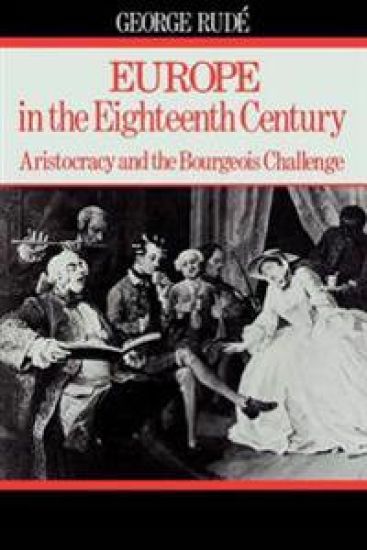
Europe in the Eighteenth Century

Europe in the Eighteenth Century

George Rude

Harvard University Press
1985
pokkari
Europe in the Eighteenth Century is a social history of Europe in all its aspects: economic, political, diplomatic military, colonial-expansionist. Crisply and succinctly written, it describes Europe not through a history of individual countries, but in a common context during the three quarters of a century between the death of Louis XIV and the industrial revolution in England and the social and political revolution in France. It presents the development of government, institutions, cities, economies, wars, and the circulation of ideas in terms of social pressures and needs, and stresses growth, interrelationships, and conflict of social classes as agents of historical change, paying particular attention to the role of popular, as well as upper- and middle-class, protest as a factor in that change.
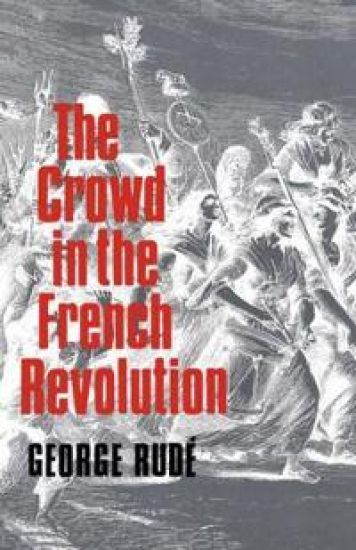
The Crowd in the French Revolution

The Crowd in the French Revolution

George Rude

Oxford University Press Inc
1967
nidottu
What kinds of people were in the crowds that stormed the Bastille, marched to Versailles to bring the king and queen back to Paris, overthrew the monarchy in August 1792, or impassively witnessed the downfall of Robespierre on 9 Thermidor? Who led these crowds or mobilized them to action? What did they hope to achieve, and how far were their aims realized? Earlier historians have tended to view the revolutionary crowd as an abstraction--"people" or "mob" according to the writer's prejudice--often even as the personification of good or evil. Professor Rudé's book, published originally in 1959, makes a first attempt to bring objectively to life each of the important Parisian crowds between 1787 and 1795. Using police records and other contemporary research materials, the author identifies the social groups represented in them, contrasts the crowds with their political leaders, relates their activities to underlying economic and psychological tensions, and compares the Parisian crowd "patterns" to those of other popular movements in France and Britain during the 18th and early 19th centuries.