Kirjojen hintavertailu. Mukana 12 595 353 kirjaa ja 12 kauppaa.

Kirjailija

Georges Gielen

Kirjat ja teokset yhdessä paikassa: 28 kirjaa, julkaisuja vuosilta 1991-2026, suosituimpien joukossa Design of Power-Efficient Highly Digital Analog-to-Digital Converters for Next-Generation Wireless Communication Systems. Vertaile teosten hintoja ja tarkista saatavuus suomalaisista kirjakaupoista.

28 kirjaa

Kirjojen julkaisuhaarukka 1991-2026.

Design of Power-Efficient Highly Digital Analog-to-Digital Converters for Next-Generation Wireless Communication Systems
This book discusses both architecture- and circuit-level design aspects of voltage-controlled-oscillator (VCO)-based analog-to-digital converters (ADCs), especially focusing on mitigation of VCO nonlinearity and the improvement of power efficiency. It shows readers how to develop power-efficient complementary-metal-oxide-semiconductor (CMOS) ADCs for applications such as LTE, 802.11n, and VDSL2+. The material covered can also be applied to other specifications and technologies. Design of Power-Efficient Highly Digital Analog-to-Digital Converters for Next-Generation Wireless Communication Systems begins with a general introduction to the applications of an ADC in communications systems and the basic concepts of VCO-based ADCs. The text addresses a wide range of converter architectures including open- and closed-loop technologies. Special attention is paid to the replacement of power-hungry analog blocks with VCO-based circuits and to the mitigation of VCO nonlinearity. Various MATLAB®/Simulink® models are provided for important circuit nonidealities, allowing designers and researchers to determine the required specifications for the different building blocks that form the systematic integrated-circuit design procedure. Five different VCO-based ADC design examples are presented, introducing innovations at both architecture and circuit levels. Of these designs, the best power efficiency of a high-bandwidth oversampling ADC is achieved in a 40 nm CMOS demonstration. This book is essential reading material for engineers and researchers working on low-power-analog and mixed-signal design and may be used by instructors teaching advanced courses on the subject. It provides a clear overview and comparison of VCO-based ADC architectures and gives the reader insight into the most important circuit imperfections.

Design of Power-Efficient Highly Digital Analog-to-Digital Converters for Next-Generation Wireless Communication Systems
This book discusses both architecture- and circuit-level design aspects of voltage-controlled-oscillator (VCO)-based analog-to-digital converters (ADCs), especially focusing on mitigation of VCO nonlinearity and the improvement of power efficiency. It shows readers how to develop power-efficient complementary-metal-oxide-semiconductor (CMOS) ADCs for applications such as LTE, 802.11n, and VDSL2+. The material covered can also be applied to other specifications and technologies. Design of Power-Efficient Highly Digital Analog-to-Digital Converters for Next-Generation Wireless Communication Systems begins with a general introduction to the applications of an ADC in communications systems and the basic concepts of VCO-based ADCs. The text addresses a wide range of converter architectures including open- and closed-loop technologies. Special attention is paid to the replacement of power-hungry analog blocks with VCO-based circuits and to the mitigation of VCO nonlinearity. Various MATLAB®/Simulink® models are provided for important circuit nonidealities, allowing designers and researchers to determine the required specifications for the different building blocks that form the systematic integrated-circuit design procedure. Five different VCO-based ADC design examples are presented, introducing innovations at both architecture and circuit levels. Of these designs, the best power efficiency of a high-bandwidth oversampling ADC is achieved in a 40 nm CMOS demonstration. This book is essential reading material for engineers and researchers working on low-power-analog and mixed-signal design and may be used by instructors teaching advanced courses on the subject. It provides a clear overview and comparison of VCO-based ADC architectures and gives the reader insight into the most important circuit imperfections.
A Computer-Aided Design and Synthesis Environment for Analog Integrated Circuits

A Computer-Aided Design and Synthesis Environment for Analog Integrated Circuits

Geert Van der Plas; Georges Gielen; Willy M.C. Sansen

Springer-Verlag New York Inc.
2013
nidottu
In the first part the AMGIE analog synthesis system is described. AMGIE is the first analog synthesis system that automates the full design process from specifications down to verified layout. It is targeted to the design of moderate-complexity circuits. It relies on design and circuit knowledge stored in the tool's libraries and can be used by both novice and experienced analog designers as well as system-level designers. The inner workings are explained in detail, with (practical) examples to demonstrate how the implemented algorithms and techniques work. Experimental results obtained with the AMGIE system are reported, including actual fabricated and measured circuits. The second approach, i.e. the systematic design of high-performance analog circuits, is discussed in the second part of the book. This approach is supported by tools to boost the productivity of the designer. An example of such a tool is Mondriaan, that is targeted towards the automatic layout generation of highly regular analog blocks. The proposed systematic design methodology is then applied to the design of high-accuracy current-steering digital to analog converters (DACs). The full design path is discussed in detail. Both complementary approaches increase analog design productivity. Design times of the different design experiments undertaken are reported throughout the book to demonstrate this.
Analog Layout Generation for Performance and Manufacturability

Analog Layout Generation for Performance and Manufacturability

Koen Lampaert; Georges Gielen; Willy M.C. Sansen

Springer-Verlag New York Inc.
2010
nidottu
Analog integrated circuits are very important as interfaces between the digital parts of integrated electronic systems and the outside world. A large portion of the effort involved in designing these circuits is spent in the layout phase. Whereas the physical design of digital circuits is automated to a large extent, the layout of analog circuits is still a manual, time-consuming and error-prone task. This is mainly due to the continuous nature of analog signals, which causes analog circuit performance to be very sensitive to layout parasitics. The parasitic elements associated with interconnect wires cause loading and coupling effects that degrade the frequency behaviour and the noise performance of analog circuits. Device mismatch and thermal effects put a fundamental limit on the achievable accuracy of circuits. For successful automation of analog layout, advanced place and route tools that can handle these critical parasitics are required. In the past, automatic analog layout tools tried to optimize the layout without quantifying the performance degradation introduced by layout parasitics. Therefore, it was not guaranteed that the resulting layout met the specifications and one or more layout iterations could be needed. In Analog Layout Generation for Performance and Manufacturability, the authors propose a performance driven layout strategy to overcome this problem. In this methodology, the layout tools are driven by performance constraints, such that the final layout, with parasitic effects, still satisfies the specifications of the circuit. The performance degradation associated with an intermediate layout solution is evaluated at runtime using predetermined sensitivities. In contrast with other performance driven layout methodologies, the tools proposed in this book operate directly on the performance constraints, without an intermediate parasitic constraint generation step. This approach makes a completeand sensible trade-off between the different layout alternatives possible at runtime and therefore eliminates the possible feedback route between constraint derivation, placement and layout extraction. Besides its influence on the performance, layout also has a profound impact on the yield and testability of an analog circuit. In Analog Layout Generation for Performance and Manufacturability, the authors outline a new criterion to quantify the detectability of a fault and combine this with a yield model to evaluate the testability of an integrated circuit layout. They then integrate this technique with their performance driven routing algorithm to produce layouts that have optimal manufacturability while still meeting their performance specifications. Analog Layout Generation for Performance and Manufacturability will be of interest to analog engineers, researchers and students.
A Computer-Aided Design and Synthesis Environment for Analog Integrated Circuits

A Computer-Aided Design and Synthesis Environment for Analog Integrated Circuits

Geert Van der Plas; Georges Gielen; Willy M.C. Sansen

Springer
2002
sidottu
In the first part the AMGIE analog synthesis system is described. AMGIE is the first analog synthesis system that automates the full design process from specifications down to verified layout. It is targeted to the design of moderate-complexity circuits. It relies on design and circuit knowledge stored in the tool's libraries and can be used by both novice and experienced analog designers as well as system-level designers. The inner workings are explained in detail, with (practical) examples to demonstrate how the implemented algorithms and techniques work. Experimental results obtained with the AMGIE system are reported, including actual fabricated and measured circuits. The second approach, i.e. the systematic design of high-performance analog circuits, is discussed in the second part of the book. This approach is supported by tools to boost the productivity of the designer. An example of such a tool is Mondriaan, that is targeted towards the automatic layout generation of highly regular analog blocks. The proposed systematic design methodology is then applied to the design of high-accuracy current-steering digital to analog converters (DACs). The full design path is discussed in detail. Both complementary approaches increase analog design productivity. Design times of the different design experiments undertaken are reported throughout the book to demonstrate this.
Analog Layout Generation for Performance and Manufacturability

Analog Layout Generation for Performance and Manufacturability

Koen Lampaert; Georges Gielen; Willy M.C. Sansen

Springer
1999
sidottu
Analog integrated circuits are very important as interfaces between the digital parts of integrated electronic systems and the outside world. A large portion of the effort involved in designing these circuits is spent in the layout phase. Whereas the physical design of digital circuits is automated to a large extent, the layout of analog circuits is still a manual, time-consuming and error-prone task. This is mainly due to the continuous nature of analog signals, which causes analog circuit performance to be very sensitive to layout parasitics. The parasitic elements associated with interconnect wires cause loading and coupling effects that degrade the frequency behaviour and the noise performance of analog circuits. Device mismatch and thermal effects put a fundamental limit on the achievable accuracy of circuits. For successful automation of analog layout, advanced place and route tools that can handle these critical parasitics are required. In the past, automatic analog layout tools tried to optimize the layout without quantifying the performance degradation introduced by layout parasitics. Therefore, it was not guaranteed that the resulting layout met the specifications and one or more layout iterations could be needed. In Analog Layout Generation for Performance and Manufacturability, the authors propose a performance driven layout strategy to overcome this problem. In this methodology, the layout tools are driven by performance constraints, such that the final layout, with parasitic effects, still satisfies the specifications of the circuit. The performance degradation associated with an intermediate layout solution is evaluated at runtime using predetermined sensitivities. In contrast with other performance driven layout methodologies, the tools proposed in this book operate directly on the performance constraints, without an intermediate parasitic constraint generation step. This approach makes a completeand sensible trade-off between the different layout alternatives possible at runtime and therefore eliminates the possible feedback route between constraint derivation, placement and layout extraction. Besides its influence on the performance, layout also has a profound impact on the yield and testability of an analog circuit. In Analog Layout Generation for Performance and Manufacturability, the authors outline a new criterion to quantify the detectability of a fault and combine this with a yield model to evaluate the testability of an integrated circuit layout. They then integrate this technique with their performance driven routing algorithm to produce layouts that have optimal manufacturability while still meeting their performance specifications. Analog Layout Generation for Performance and Manufacturability will be of interest to analog engineers, researchers and students.
Event-Driven Circuit Architectures for Scalable and Adaptive Sensor Readout

Event-Driven Circuit Architectures for Scalable and Adaptive Sensor Readout

Jonah Van Assche; Georges Gielen

Springer International Publishing AG
2025
sidottu
This book describes the analysis and design of event-driven processing circuits in the mixed-signal domain, which aim to directly reduce the amount of system data when sampling the data. By investigating event-driven sensing techniques, that adaptively adjust the sampling rate based on the signal activity of time-sparse signals such as the ECG or action potentials, the circuit techniques described in the book aim to minimize the power consumption of the sensing device as well as the transmission power. This optimization is explored in the book by investigating event-driven level-crossing ADCs (LCADCs). Readers will gain a system-level understanding of chip design for biomedical wearables, learn which parts of the system are the most important and how the different building blocks of a system interact.
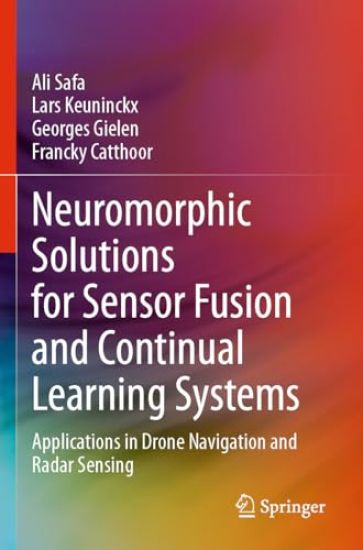
Neuromorphic Solutions for Sensor Fusion and Continual Learning Systems

Neuromorphic Solutions for Sensor Fusion and Continual Learning Systems

Ali Safa; Lars Keuninckx; Georges Gielen; Francky Catthoor

Springer International Publishing AG
2025
nidottu
This book provides novel theoretical foundations and experimental demonstrations of Spiking Neural Networks (SNNs) in tasks such as radar gesture recognition for IoT devices and autonomous drone navigation using a fusion of retina-inspired event-based camera and radar sensing. The authors describe important new findings about the Spike-Timing-Dependent Plasticity (STDP) learning rule, which is widely believed to be one of the key learning mechanisms taking place in the brain. Readers will be enabled to create novel classes of edge AI and robotics applications, using highly energy- and area-efficient SNNs
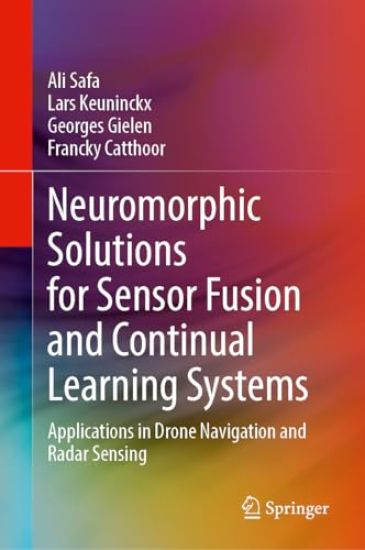
Neuromorphic Solutions for Sensor Fusion and Continual Learning Systems

Neuromorphic Solutions for Sensor Fusion and Continual Learning Systems

Ali Safa; Lars Keuninckx; Georges Gielen; Francky Catthoor

Springer International Publishing AG
2024
sidottu
This book provides novel theoretical foundations and experimental demonstrations of Spiking Neural Networks (SNNs) in tasks such as radar gesture recognition for IoT devices and autonomous drone navigation using a fusion of retina-inspired event-based camera and radar sensing. The authors describe important new findings about the Spike-Timing-Dependent Plasticity (STDP) learning rule, which is widely believed to be one of the key learning mechanisms taking place in the brain. Readers will be enabled to create novel classes of edge AI and robotics applications, using highly energy- and area-efficient SNNs
Time-encoding VCO-ADCs for Integrated Systems-on-Chip

Time-encoding VCO-ADCs for Integrated Systems-on-Chip

Georges Gielen; Luis Hernandez-Corporales; Pieter Rombouts

Springer Nature Switzerland AG
2023
nidottu
This book demonstrates why highly-digital CMOS time-encoding analog-to-digital converters incorporating voltage-controlled oscillators (VCOs) and time-to-digital converters (TDCs) are a good alternative to traditional switched-capacitor S-D modulators for power-efficient sensor, biomedical and communications applications. The authors describe the theoretical foundations and design methodology of such time-based ADCs from the basics to the latest developments. While most analog designers might notice some resemblance to PLL design, the book clearly highlights the differences to standard PLL circuit design and illustrates the design methodology with practical circuit design examples.Describes in detail the design methodology for CMOS time-encoding analog-to-digital converters that can be integrated along with digital logic in a nanometer System on Chip;Assists analog designers with the necessary change in design paradigm, highlighting differences between designing time-based ADCs and traditional analog circuits like switched-capacitor converters and PLLs;Uses a highly-visual, tutorial approach to the topic, including many practical examples of techniques introduced.
Time-encoding VCO-ADCs for Integrated Systems-on-Chip

Time-encoding VCO-ADCs for Integrated Systems-on-Chip

Georges Gielen; Luis Hernandez-Corporales; Pieter Rombouts

Springer Nature Switzerland AG
2022
sidottu
This book demonstrates why highly-digital CMOS time-encoding analog-to-digital converters incorporating voltage-controlled oscillators (VCOs) and time-to-digital converters (TDCs) are a good alternative to traditional switched-capacitor S-D modulators for power-efficient sensor, biomedical and communications applications. The authors describe the theoretical foundations and design methodology of such time-based ADCs from the basics to the latest developments. While most analog designers might notice some resemblance to PLL design, the book clearly highlights the differences to standard PLL circuit design and illustrates the design methodology with practical circuit design examples.Describes in detail the design methodology for CMOS time-encoding analog-to-digital converters that can be integrated along with digital logic in a nanometer System on Chip;Assists analog designers with the necessary change in design paradigm, highlighting differences between designing time-based ADCs and traditional analog circuits like switched-capacitor converters and PLLs;Uses a highly-visual, tutorial approach to the topic, including many practical examples of techniques introduced.
Temperature- and Supply Voltage-Independent Time References for Wireless Sensor Networks

Temperature- and Supply Voltage-Independent Time References for Wireless Sensor Networks

Valentijn De Smedt; Georges Gielen; Wim Dehaene

Springer International Publishing AG
2016
nidottu
This book investigates the possible circuit solutions to overcome the temperature and supply voltage-sensitivity of fully-integrated time references for ultra-low-power communication in wireless sensor networks. The authors provide an elaborate theoretical introduction and literature study to enable full understanding of the design challenges and shortcomings of current oscillator implementations. Furthermore, a closer look to the short-term as well as the long-term frequency stability of integrated oscillators is taken. Next, a design strategy is developed and applied to 5 different oscillator topologies and 1 sensor interface. All 6 implementations are subject to an elaborate study of frequency stability, phase noise and power consumption. In the final chapter all blocks are compared to the state of the art.
Automated Design of Analog and High-frequency Circuits

Automated Design of Analog and High-frequency Circuits

Bo Liu; Georges Gielen; Francisco V. Fernández

Springer-Verlag Berlin and Heidelberg GmbH Co. K
2015
nidottu
Computational intelligence techniques are becoming more and more important for automated problem solving nowadays. Due to the growing complexity of industrial applications and the increasingly tight time-to-market requirements, the time available for thorough problem analysis and development of tailored solution methods is decreasing. There is no doubt that this trend will continue in the foreseeable future. Hence, it is not surprising that robust and general automated problem solving methods with satisfactory performance are needed.
Analog IC Reliability in Nanometer CMOS

Analog IC Reliability in Nanometer CMOS

Elie Maricau; Georges Gielen

Springer-Verlag New York Inc.
2015
nidottu
This book focuses on modeling, simulation and analysis of analog circuit aging. First, all important nanometer CMOS physical effects resulting in circuit unreliability are reviewed. Then, transistor aging compact models for circuit simulation are discussed and several methods for efficient circuit reliability simulation are explained and compared. Ultimately, the impact of transistor aging on analog circuits is studied. Aging-resilient and aging-immune circuits are identified and the impact of technology scaling is discussed. The models and simulation techniques described in the book are intended as an aid for device engineers, circuit designers and the EDA community to understand and to mitigate the impact of aging effects on nanometer CMOS ICs.
Temperature- and Supply Voltage-Independent Time References for Wireless Sensor Networks

Temperature- and Supply Voltage-Independent Time References for Wireless Sensor Networks

Valentijn De Smedt; Georges Gielen; Wim Dehaene

Springer International Publishing AG
2014
sidottu
This book investigates the possible circuit solutions to overcome the temperature and supply voltage-sensitivity of fully-integrated time references for ultra-low-power communication in wireless sensor networks. The authors provide an elaborate theoretical introduction and literature study to enable full understanding of the design challenges and shortcomings of current oscillator implementations. Furthermore, a closer look to the short-term as well as the long-term frequency stability of integrated oscillators is taken. Next, a design strategy is developed and applied to 5 different oscillator topologies and 1 sensor interface. All 6 implementations are subject to an elaborate study of frequency stability, phase noise and power consumption. In the final chapter all blocks are compared to the state of the art.
Automated Design of Analog and High-frequency Circuits

Automated Design of Analog and High-frequency Circuits

Bo Liu; Georges Gielen; Francisco V. Fernández

Springer-Verlag Berlin and Heidelberg GmbH Co. K
2013
sidottu
Computational intelligence techniques are becoming more and more important for automated problem solving nowadays. Due to the growing complexity of industrial applications and the increasingly tight time-to-market requirements, the time available for thorough problem analysis and development of tailored solution methods is decreasing. There is no doubt that this trend will continue in the foreseeable future. Hence, it is not surprising that robust and general automated problem solving methods with satisfactory performance are needed.
Analog IC Reliability in Nanometer CMOS

Analog IC Reliability in Nanometer CMOS

Elie Maricau; Georges Gielen

Springer-Verlag New York Inc.
2013
sidottu
This book focuses on modeling, simulation and analysis of analog circuit aging. First, all important nanometer CMOS physical effects resulting in circuit unreliability are reviewed. Then, transistor aging compact models for circuit simulation are discussed and several methods for efficient circuit reliability simulation are explained and compared. Ultimately, the impact of transistor aging on analog circuits is studied. Aging-resilient and aging-immune circuits are identified and the impact of technology scaling is discussed. The models and simulation techniques described in the book are intended as an aid for device engineers, circuit designers and the EDA community to understand and to mitigate the impact of aging effects on nanometer CMOS ICs.
Symbolic Analysis for Automated Design of Analog Integrated Circuits

Symbolic Analysis for Automated Design of Analog Integrated Circuits

Georges Gielen; Willy M.C. Sansen

Springer-Verlag New York Inc.
2012
nidottu
It is a great honor to provide a few words of introduction for Dr. Georges Gielen's and Prof. Willy Sansen's book "Symbolic analysis for automated design of analog integrated circuits". The symbolic analysis method presented in this book represents a significant step forward in the area of analog circuit design. As demonstrated in this book, symbolic analysis opens up new possibilities for the development of computer-aided design (CAD) tools that can analyze an analog circuit topology and automatically size the components for a given set of specifications. Symbolic analysis even has the potential to improve the training of young analog circuit designers and to guide more experienced designers through second-order phenomena such as distortion. This book can also serve as an excellent reference for researchers in the analog circuit design area and creators of CAD tools, as it provides a comprehensive overview and comparison of various approaches for analog circuit design automation and an extensive bibliography. The world is essentially analog in nature, hence most electronic systems involve both analog and digital circuitry. As the number of transistors that can be integrated on a single integrated circuit (IC) substrate steadily increases over time, an ever increasing number of systems will be implemented with one, or a few, very complex ICs because of their lower production costs.
Systematic Design of Analog IP Blocks

Systematic Design of Analog IP Blocks

Jan Vandenbussche; Georges Gielen; Michiel Steyaert

Springer-Verlag New York Inc.
2012
nidottu
Systematic Design of Analog IP Blocks introduces a design methodology that can help to bridge the productivity gap. Two different types of designs, depending on the design challenge, have been identified: commodity IP and star IP. Each category requires a different approach to boost design productivity. Commodity IP blocks are well suited to be automated in an analog synthesis environment and provided as soft IP. The design knowledge is usually common knowledge, and reuse is high accounting for the setup time needed for the analog library. Star IP still changes as technology evolves and the design cost can only be reduced by following a systematic design approach supported by point tools to relieve the designer from error-prone, repetitive tasks, allowing him/her to focus on new ideas to push the limits of the design. To validate the presented methodologies, three different industrial-strength applications have been selected and designed accordingly.