Kirjojen hintavertailu. Mukana 12 657 676 kirjaa ja 12 kauppaa.

Kirjailija

Gerald B. Folland

Kirjat ja teokset yhdessä paikassa: 11 kirjaa, julkaisuja vuosilta 1972-2025, suosituimpien joukossa The Heisenberg Group. Vertaile teosten hintoja ja tarkista saatavuus suomalaisista kirjakaupoista.

11 kirjaa

Kirjojen julkaisuhaarukka 1972-2025.

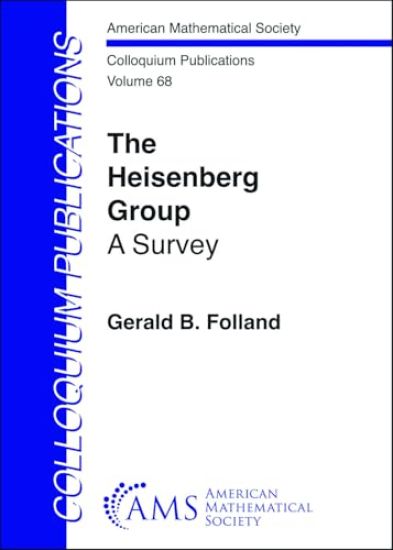
The Heisenberg Group

The Heisenberg Group

Gerald B. Folland

AMERICAN MATHEMATICAL SOCIETY
2025
sidottu
Over the past hundred years, the Heisenberg group has been recognized as an important object in several areas of mathematics, including group representation theory, mathematical physics, complex analysis in several variables, partial differential equations, and differential geometry. This book presents a concise and readable introduction to all these aspects, together with brief descriptions of further research in the area over the past few decades. The author also provides copious references. Prerequisites for the potential reader are a graduate-level course in modern real analysis, plus the rudiments of functional analysis, Fourier analysis, differential geometry, and Lie groups.
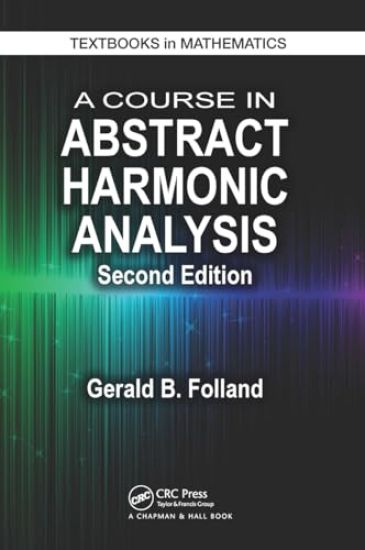
A Course in Abstract Harmonic Analysis

A Course in Abstract Harmonic Analysis

Gerald B. Folland

TAYLOR FRANCIS LTD
2024
nidottu
A Course in Abstract Harmonic Analysis is an introduction to that part of analysis on locally compact groups that can be done with minimal assumptions on the nature of the group. As a generalization of classical Fourier analysis, this abstract theory creates a foundation for a great deal of modern analysis, and it contains a number of elegant results and techniques that are of interest in their own right. This book develops the abstract theory along with a well-chosen selection of concrete examples that exemplify the results and show the breadth of their applicability. After a preliminary chapter containing the necessary background material on Banach algebras and spectral theory, the text sets out the general theory of locally compact groups and their unitary representations, followed by a development of the more specific theory of analysis on Abelian groups and compact groups. There is an extensive chapter on the theory of induced representations and its applications, and the book concludes with a more informal exposition on the theory of representations of non-Abelian, non-compact groups.Featuring extensive updates and new examples, the Second Edition:Adds a short section on von Neumann algebrasIncludes Mark Kac’s simple proof of a restricted form of Wiener’s theoremExplains the relation between SU(2) and SO(3) in terms of quaternions, an elegant method that brings SO(4) into the picture with little effortDiscusses representations of the discrete Heisenberg group and its central quotients, illustrating the Mackey machine for regular semi-direct products and the pathological phenomena for nonregular onesA Course in Abstract Harmonic Analysis, Second Edition serves as an entrée to advanced mathematics, presenting the essentials of harmonic analysis on locally compact groups in a concise and accessible form.
A Course in Abstract Harmonic Analysis

A Course in Abstract Harmonic Analysis

Gerald B. Folland

Productivity Press
2015
sidottu
A Course in Abstract Harmonic Analysis is an introduction to that part of analysis on locally compact groups that can be done with minimal assumptions on the nature of the group. As a generalization of classical Fourier analysis, this abstract theory creates a foundation for a great deal of modern analysis, and it contains a number of elegant results and techniques that are of interest in their own right. This book develops the abstract theory along with a well-chosen selection of concrete examples that exemplify the results and show the breadth of their applicability. After a preliminary chapter containing the necessary background material on Banach algebras and spectral theory, the text sets out the general theory of locally compact groups and their unitary representations, followed by a development of the more specific theory of analysis on Abelian groups and compact groups. There is an extensive chapter on the theory of induced representations and its applications, and the book concludes with a more informal exposition on the theory of representations of non-Abelian, non-compact groups.Featuring extensive updates and new examples, the Second Edition:Adds a short section on von Neumann algebrasIncludes Mark Kac’s simple proof of a restricted form of Wiener’s theoremExplains the relation between SU(2) and SO(3) in terms of quaternions, an elegant method that brings SO(4) into the picture with little effortDiscusses representations of the discrete Heisenberg group and its central quotients, illustrating the Mackey machine for regular semi-direct products and the pathological phenomena for nonregular onesA Course in Abstract Harmonic Analysis, Second Edition serves as an entrée to advanced mathematics, presenting the essentials of harmonic analysis on locally compact groups in a concise and accessible form.
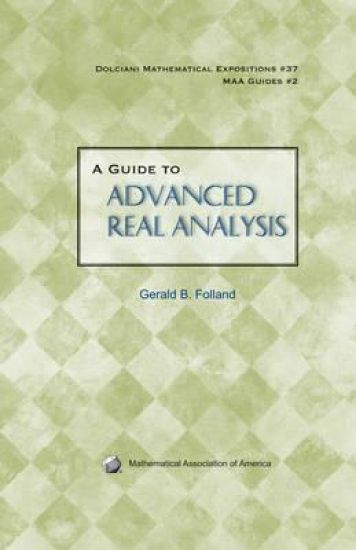
A Guide to Advanced Real Analysis

A Guide to Advanced Real Analysis

Gerald B. Folland

Mathematical Association of America
2009
sidottu
This concise guide to real analysis covers the core material of a graduate level real analysis course. On the abstract level, it covers the theory of measure and integration and the basics of point set topology, functional analysis, and the most important types of function spaces. On the more concrete level, it also deals with the applications of these general theories to analysis on Euclidean space: the Lebesgue integral, Hausdorff measure, convolutions, Fourier series and transforms, and distributions. The relevant definitions and major theorems are stated in detail. Proofs, however, are generally presented only as sketches, in such a way that the key ideas are explained but the technical details are omitted. In this way a large amount of material is presented in a concise and readable form. The prerequisite is a familiarity with classical real-variable theory.
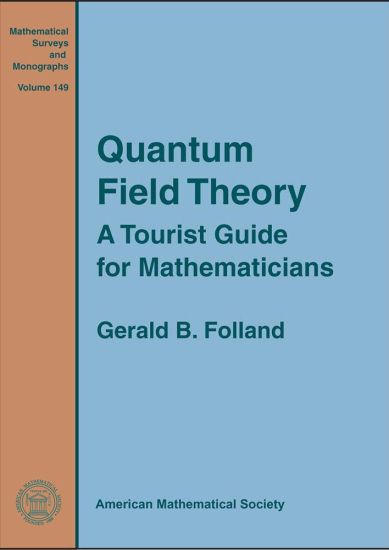
Quantum Field Theory

Quantum Field Theory

Gerald B. Folland

American Mathematical Society
2008
nidottu
Quantum field theory has been a great success for physics, but it is difficult for mathematicians to learn because it is mathematically incomplete. Folland, who is a mathematician, has spent considerable time digesting the physical theory and sorting out the mathematical issues in it. Fortunately for mathematicians, Folland is a gifted expositor.The purpose of this book is to present the elements of quantum field theory, with the goal of understanding the behavior of elementary particles rather than building formal mathematical structures, in a form that will be comprehensible to mathematicians. Rigorous definitions and arguments are presented as far as they are available, but the text proceeds on a more informal level when necessary, with due care in identifying the difficulties.The book begins with a review of classical physics and quantum mechanics, then proceeds through the construction of free quantum fields to the perturbation-theoretic development of interacting field theory and renormalization theory, with emphasis on quantum electrodynamics. The final two chapters present the functional integral approach and the elements of gauge field theory, including the Salam-Weinberg model of electromagnetic and weak interactions.
Real Analysis

Real Analysis

Gerald B. Folland

John Wiley Sons Inc
1999
sidottu
An in-depth look at real analysis and its applications-now expanded and revised. This new edition of the widely used analysis book continues to cover real analysis in greater detail and at a more advanced level than most books on the subject. Encompassing several subjects that underlie much of modern analysis, the book focuses on measure and integration theory, point set topology, and the basics of functional analysis. It illustrates the use of the general theories and introduces readers to other branches of analysis such as Fourier analysis, distribution theory, and probability theory. This edition is bolstered in content as well as in scope-extending its usefulness to students outside of pure analysis as well as those interested in dynamical systems. The numerous exercises, extensive bibliography, and review chapter on sets and metric spaces make Real Analysis: Modern Techniques and Their Applications, Second Edition invaluable for students in graduate-level analysis courses. New features include: * Revised material on the n-dimensional Lebesgue integral. * An improved proof of Tychonoff's theorem. * Expanded material on Fourier analysis. * A newly written chapter devoted to distributions and differential equations. * Updated material on Hausdorff dimension and fractal dimension.
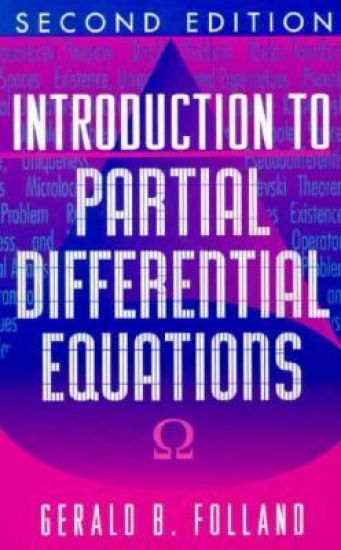
Introduction to Partial Differential Equations

Introduction to Partial Differential Equations

Gerald B. Folland

Princeton University Press
1995
sidottu
The second edition of Introduction to Partial Differential Equations, which originally appeared in the Princeton series Mathematical Notes, serves as a text for mathematics students at the intermediate graduate level. The goal is to acquaint readers with the fundamental classical results of partial differential equations and to guide them into some aspects of the modern theory to the point where they will be equipped to read advanced treatises and research papers. This book includes many more exercises than the first edition, offers a new chapter on pseudodifferential operators, and contains additional material throughout. The first five chapters of the book deal with classical theory: first-order equations, local existence theorems, and an extensive discussion of the fundamental differential equations of mathematical physics. The techniques of modern analysis, such as distributions and Hilbert spaces, are used wherever appropriate to illuminate these long-studied topics. The last three chapters introduce the modern theory: Sobolev spaces, elliptic boundary value problems, and pseudodifferential operators.
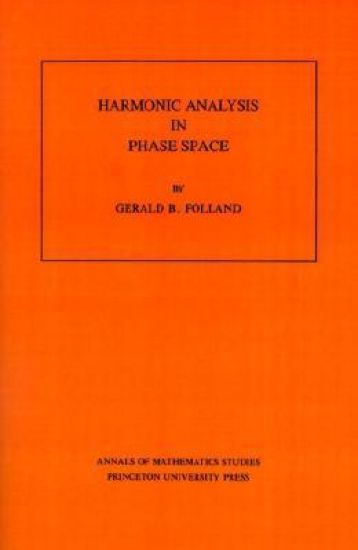
Harmonic Analysis in Phase Space

Harmonic Analysis in Phase Space

Gerald B. Folland

Princeton University Press
1989
pokkari
This book provides the first coherent account of the area of analysis that involves the Heisenberg group, quantization, the Weyl calculus, the metaplectic representation, wave packets, and related concepts. This circle of ideas comes principally from mathematical physics, partial differential equations, and Fourier analysis, and it illuminates all these subjects. The principal features of the book are as follows: a thorough treatment of the representations of the Heisenberg group, their associated integral transforms, and the metaplectic representation; an exposition of the Weyl calculus of pseudodifferential operators, with emphasis on ideas coming from harmonic analysis and physics; a discussion of wave packet transforms and their applications; and a new development of Howe's theory of the oscillator semigroup.
Hardy Spaces on Homogeneous Groups

Hardy Spaces on Homogeneous Groups

Gerald B. Folland; Elias M. Stein

Princeton University Press
1982
pokkari
The object of this monograph is to give an exposition of the real-variable theory of Hardy spaces (HP spaces). This theory has attracted considerable attention in recent years because it led to a better understanding in Rn of such related topics as singular integrals, multiplier operators, maximal functions, and real-variable methods generally. Because of its fruitful development, a systematic exposition of some of the main parts of the theory is now desirable. In addition to this exposition, these notes contain a recasting of the theory in the more general setting where the underlying Rn is replaced by a homogeneous group. The justification for this wider scope comes from two sources: 1) the theory of semi-simple Lie groups and symmetric spaces, where such homogeneous groups arise naturally as "boundaries," and 2) certain classes of non-elliptic differential equations (in particular those connected with several complex variables), where the model cases occur on homogeneous groups. The example which has been most widely studied in recent years is that of the Heisenberg group.
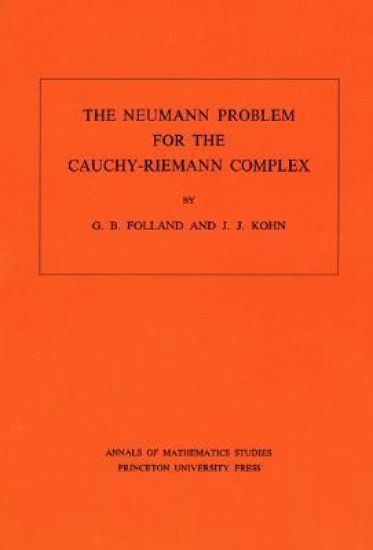
The Neumann Problem for the Cauchy-Riemann Complex

The Neumann Problem for the Cauchy-Riemann Complex

Gerald B. Folland; Joseph John Kohn

Princeton University Press
1972
pokkari
Part explanation of important recent work, and part introduction to some of the techniques of modern partial differential equations, this monograph is a self-contained exposition of the Neumann problem for the Cauchy-Riemann complex and certain of its applications. The authors prove the main existence and regularity theorems in detail, assuming only a knowledge of the basic theory of differentiable manifolds and operators on Hilbert space. They discuss applications to the theory of several complex variables, examine the associated complex on the boundary, and outline other techniques relevant to these problems. In an appendix they develop the functional analysis of differential operators in terms of Sobolev spaces, to the extent it is required for the monograph.