Kirjojen hintavertailu. Mukana 12 595 353 kirjaa ja 12 kauppaa.

Kirjailija

Gerald Baier

Kirjat ja teokset yhdessä paikassa: 7 kirjaa, julkaisuja vuosilta 2006-2026, suosituimpien joukossa The Canadian Regime. Vertaile teosten hintoja ja tarkista saatavuus suomalaisista kirjakaupoista.

7 kirjaa

Kirjojen julkaisuhaarukka 2006-2026.

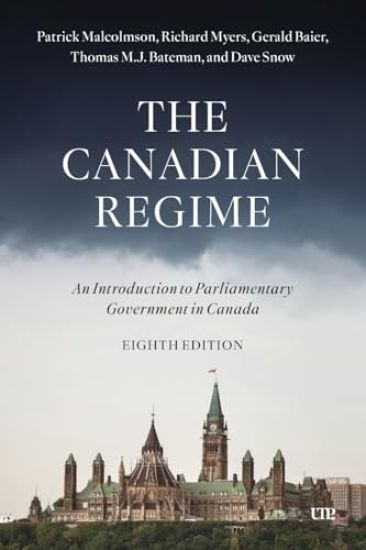
The Canadian Regime

The Canadian Regime

Patrick Malcolmson; Richard Myers; Gerald Baier; Thomas Bateman; Dave Snow

UNIVERSITY OF TORONTO PRESS
2026
pokkari
Using a historical-institutional approach, The Canadian Regime introduces students to the idea of the “regime” as a lens through which they can understand how institutions interact with the basic principles of the political order. The authors explain how the Canadian liberal democratic regime was founded on the fundamental principles of liberty and equality and discuss the ways in which Canada’s institutions have developed and operate in accordance with these principles. They also examine how the regime has failed to be inclusive of Indigenous peoples in significant respects, and how reforms to Canada’s governing institutions challenge historical assumptions concerning parliamentary government and federalism. This vital text has been updated to include the results of the 2025 federal election and now features a new companion website which offers digital teaching resources to support instructors and engage students. The Canadian Regime continues to provide an accessible introduction to Canadian politics, encouraging students to understand and appreciate the country’s unique governmental structures.

Pivot or Pirouette?

Pivot or Pirouette?

Tom Flanagan; Gerald Baier; R. Kenneth Carty

University of British Columbia Press
2022
pokkari
Pivot or Pirouette? covers both the backstory and the aftermath of the strangest election in Canadian history, as told by an insider who was involved in the events before, during, and after the ballots were cast.In the early 1990s, a pan-Canadian coalition of Tory voters had been splintered by constitutional politics. Discontented voters flocked to new regional parties; the Conservatives attempted to turn the tide by choosing the first female prime minister, but their efforts fell flat. In the 1993 election, the party was reduced to two seats, the separatist Bloc Québécois became the official opposition, and the Reform Party swept the West. Although the shocking results seemed pivotal, ultimately the pivot turned into a full pirouette as Canadian politics returned to historical norms: new parties shake up the system but are eventually absorbed into it, bringing innovation but not transformation. You can't understand modern Canadian politics without understanding the 1993 election.
The Canadian Regime

The Canadian Regime

Patrick Malcolmson; Richard Myers; Gerald Baier; Tom Bateman

University of Toronto Press
2021
pokkari
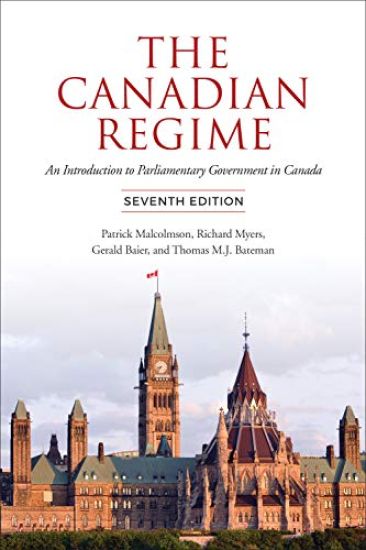
Using a traditional historical-institutional approach, The Canadian Regime introduces students to the idea of the regime, which is a lens through which they can see how institutions interact with the basic principles of the political order. The authors explain how the Canadian liberal democratic regime was founded on the fundamental principles of liberty, equality, and consent and discuss the ways in which Canada’s institutions have developed and operate in accordance with these principles. The authors also examine how the regime has at times failed to follow these principles, particularly with respect to Canada’s Indigenous peoples in Canada, and how reforms to Canada’s governing institutions challenge historical assumptions concerning parliamentary government and federalism. Now in its seventh edition, The Canadian Regime continues to provide the most accessible introduction to Canadian politics, making Canada’s unique government and systems clear to students. This edition is updated with the results of the 2019 federal election.
The Canadian Regime

The Canadian Regime

Patrick Malcolmson; Richard Myers; Gerald Baier; Tom Bateman

University of Toronto Press
2021
sidottu
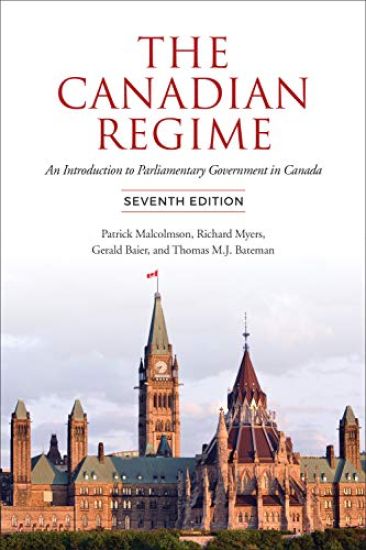
Using a traditional historical-institutional approach, The Canadian Regime introduces students to the idea of the regime, which is a lens through which they can see how institutions interact with the basic principles of the political order. The authors explain how the Canadian liberal democratic regime was founded on the fundamental principles of liberty, equality, and consent and discuss the ways in which Canada’s institutions have developed and operate in accordance with these principles. The authors also examine how the regime has at times failed to follow these principles, particularly with respect to Canada’s Indigenous peoples in Canada, and how reforms to Canada’s governing institutions challenge historical assumptions concerning parliamentary government and federalism. Now in its seventh edition, The Canadian Regime continues to provide the most accessible introduction to Canadian politics, making Canada’s unique government and systems clear to students. This edition is updated with the results of the 2019 federal election.
Contested Federalism

Contested Federalism

Douglas Brown; Herman Bakvis; Gerald Baier

Oxford University Press, Canada
2019
nidottu
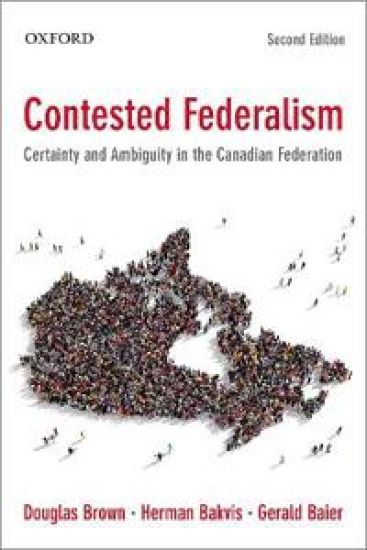
The most comprehensive and critical look at Canadian federalism This restructured and thoroughly updated exploration of Canadian federalism explores the tensions and conflicts within Canada's governance system and the adaptations required for federalism to work. Focusing on three areas - basic federal and intergovernmental structure; the constitutional and institutional framework of the federation; and federal governance - this text is an engaging and balanced treatment of federalism in Canada.
Courts and Federalism

Courts and Federalism

Gerald Baier

University of British Columbia Press
2007
pokkari
Courts and Federalism examines recent developments in thejudicial review of federalism in the United States, Australia, andCanada. Through detailed surveys of these three countries, Gerald Baierclearly demonstrates that understanding judicial doctrine is key tounderstanding judicial power in a federation. Baier offers overwhelmingevidence of doctrine's formative role in division-of-powerdisputes and its positive contribution to the operation of a federalsystem. Courts and Federalism urges political scientists totake courts and judicial reasoning more seriously in their accounts offederal government. Courts and Federalism will appeal to readers interested inthe comparative study of law and government as well as the interactionof law and federalism in contemporary society.
Courts and Federalism

Courts and Federalism

Gerald Baier

University of British Columbia Press
2006
sidottu
Courts and Federalism examines recent developments in thejudicial review of federalism in the United States, Australia, andCanada. Through detailed surveys of these three countries, Gerald Baierclearly demonstrates that understanding judicial doctrine is key tounderstanding judicial power in a federation. Baier offers overwhelmingevidence of doctrine's formative role in division-of-powerdisputes and its positive contribution to the operation of a federalsystem. Courts and Federalism urges political scientists totake courts and judicial reasoning more seriously in their accounts offederal government. Courts and Federalism will appeal to readers interested inthe comparative study of law and government as well as the interactionof law and federalism in contemporary society.