Kirjojen hintavertailu. Mukana 12 595 353 kirjaa ja 12 kauppaa.

Kirjailija

Gerald Farin

Kirjat ja teokset yhdessä paikassa: 10 kirjaa, julkaisuja vuosilta 1998-2024, suosituimpien joukossa Mathematical Principles for Scientific Computing and Visualization. Vertaile teosten hintoja ja tarkista saatavuus suomalaisista kirjakaupoista.

10 kirjaa

Kirjojen julkaisuhaarukka 1998-2024.

Practical Linear Algebra

Practical Linear Algebra

Gerald Farin; Dianne Hansford

TAYLOR FRANCIS LTD
2024
nidottu
Linear algebra is growing in importance. 3D entertainment, animations in movies and video games are developed using linear algebra. Animated characters are generated using equations straight out of this book. Linear algebra is used to extract knowledge from the massive amounts of data generated from modern technology.The Fourth Edition of this popular text introduces linear algebra in a comprehensive, geometric, and algorithmic way. The authors start with the fundamentals in 2D and 3D, then move on to higher dimensions, expanding on the fundamentals and introducing new topics, which are necessary for many real-life applications and the development of abstract thought. Applications are introduced to motivate topics.The subtitle, A Geometry Toolbox, hints at the book’s geometric approach, which is supported by many sketches and figures. Furthermore, the book covers applications of triangles, polygons, conics, and curves. Examples demonstrate each topic in action. This practical approach to a linear algebra course, whether through classroom instruction or self-study, is unique to this book. New to the Fourth Edition: Ten new application sections. A new section on change of basis. This concept now appears in several places. Chapters 14-16 on higher dimensions are notably revised. A deeper look at polynomials in the gallery of spaces. Introduces the QR decomposition and its relevance to least squares. Similarity and diagonalization are given more attention, as are eigenfunctions. A longer thread on least squares, running from orthogonal projections to a solution via SVD and the pseudoinverse. More applications for PCA have been added. More examples, exercises, and more on the kernel and general linear spaces. A list of applications has been added in Appendix A.The book gives instructors the option of tailoring the course for the primary interests of their students: mathematics, engineering, science, computer graphics, and geometric modeling.
Practical Linear Algebra

Practical Linear Algebra

Gerald Farin; Dianne Hansford

CRC Press
2021
sidottu
Linear algebra is growing in importance. 3D entertainment, animations in movies and video games are developed using linear algebra. Animated characters are generated using equations straight out of this book. Linear algebra is used to extract knowledge from the massive amounts of data generated from modern technology.The Fourth Edition of this popular text introduces linear algebra in a comprehensive, geometric, and algorithmic way. The authors start with the fundamentals in 2D and 3D, then move on to higher dimensions, expanding on the fundamentals and introducing new topics, which are necessary for many real-life applications and the development of abstract thought. Applications are introduced to motivate topics.The subtitle, A Geometry Toolbox, hints at the book’s geometric approach, which is supported by many sketches and figures. Furthermore, the book covers applications of triangles, polygons, conics, and curves. Examples demonstrate each topic in action. This practical approach to a linear algebra course, whether through classroom instruction or self-study, is unique to this book. New to the Fourth Edition: Ten new application sections. A new section on change of basis. This concept now appears in several places. Chapters 14-16 on higher dimensions are notably revised. A deeper look at polynomials in the gallery of spaces. Introduces the QR decomposition and its relevance to least squares. Similarity and diagonalization are given more attention, as are eigenfunctions. A longer thread on least squares, running from orthogonal projections to a solution via SVD and the pseudoinverse. More applications for PCA have been added. More examples, exercises, and more on the kernel and general linear spaces. A list of applications has been added in Appendix A.The book gives instructors the option of tailoring the course for the primary interests of their students: mathematics, engineering, science, computer graphics, and geometric modeling.
Mathematical Principles for Scientific Computing and Visualization
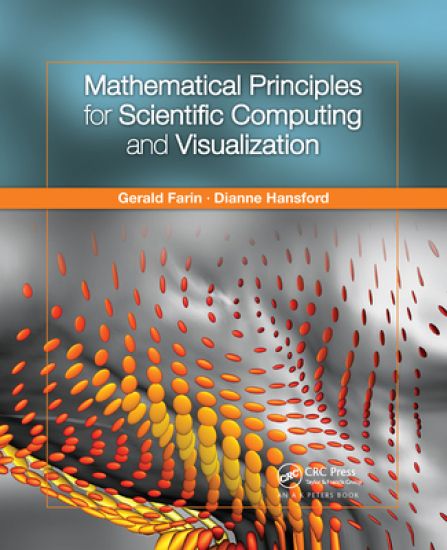
This non-traditional introduction to the mathematics of scientific computation describes the principles behind the major methods, from statistics, applied mathematics, scientific visualization, and elsewhere, in a way that is accessible to a large part of the scientific community. Introductory material includes computational basics, a review of coordinate systems, an introduction to facets (planes and triangle meshes) and an introduction to computer graphics. The scientific computing part of the book covers topics in numerical linear algebra (basics, solving linear system, eigen-problems, SVD, and PCA) and numerical calculus (basics, data fitting, dynamic processes, root finding, and multivariate functions). The visualization component of the book is separated into three parts: empirical data, scalar values over 2D data, and volumes.
The Essentials of CAGD

The Essentials of CAGD

Gerald Farin; Dianne Hansford

CRC Press
2019
nidottu
Putting the G into CAGD, the authors provide a much-needed practical and basic introduction to computer-aided geometric design. This book will help readers understand and use the elements of computer-aided geometric design, curves and surfaces, without the mathematical baggage that is necessary only for more advanced work. Though only minimal background in mathematics is needed to understand the bookís concepts, the book covers an amazing array of topics such as Bezier and B-spline curves and their corresponding surfaces, subdivision surfaces, and NURBS (Non-Uniform Rational B-Splines). Also included are techniques such as interpolation and least squares methods.
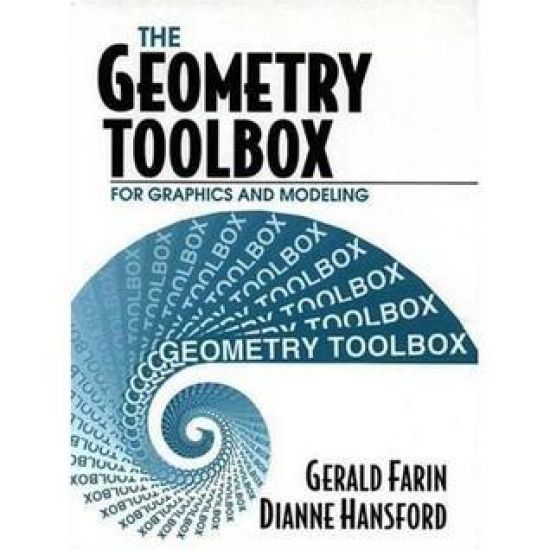
The Geometry Toolbox for Graphics and Modeling

The Geometry Toolbox for Graphics and Modeling

Gerald Farin; Dianne Hansford

CRC Press
2019
nidottu
The Geometry Toolbox takes a novel and particularly visual approach to teaching the basic concepts of two- and three-dimensional geometry. It explains the geometry essential for today's computer modeling, computer graphics, and animation systems. While the basic theory is completely covered, the emphasis of the book is not on abstract proofs but rather on examples and algorithms. The Geometry Toolbox is the ideal text for professionals who want to get acquainted with the latest geometric tools. The chapters on basic curves and surfaces form an ideal stepping stone into the world of graphics and modeling. It is also a unique textbook for a modern introduction to linear algebra and matrix theory.
Mathematical Principles for Scientific Computing and Visualization
This non-traditional introduction to the mathematics of scientific computation describes the principles behind the major methods, from statistics, applied mathematics, scientific visualization, and elsewhere, in a way that is accessible to a large part of the scientific community. Introductory material includes computational basics, a review of coordinate systems, an introduction to facets (planes and triangle meshes) and an introduction to computer graphics. The scientific computing part of the book covers topics in numerical linear algebra (basics, solving linear system, eigen-problems, SVD, and PCA) and numerical calculus (basics, data fitting, dynamic processes, root finding, and multivariate functions). The visualization component of the book is separated into three parts: empirical data, scalar values over 2D data, and volumes.
Curves and Surfaces for CAGD

Curves and Surfaces for CAGD

Gerald Farin

Morgan Kaufmann Publishers In
2001
sidottu
This fifth edition has been fully updated to cover the many advances made in CAGD and curve and surface theory since 1997, when the fourth edition appeared. Material has been restructured into theory and applications chapters. The theory material has been streamlined using the blossoming approach; the applications material includes least squares techniques in addition to the traditional interpolation methods. In all other respects, it is, thankfully, the same. This means you get the informal, friendly style and unique approach that has made Curves and Surfaces for CAGD: A Practical Guide a true classic. The book's unified treatment of all significant methods of curve and surface design is heavily focused on the movement from theory to application. The author provides complete C implementations of many of the theories he discusses, ranging from the traditional to the leading-edge. You'll gain a deep, practical understanding of their advantages, disadvantages, and interrelationships, and in the process you'll see why this book has emerged as a proven resource for thousands of other professionals and academics.
The Essentials of CAGD

The Essentials of CAGD

Gerald Farin; Dianne Hansford

A K Peters
2000
sidottu
Putting the G into CAGD, the authors provide a much-needed practical and basic introduction to computer-aided geometric design. This book will help readers understand and use the elements of computer-aided geometric design, curves and surfaces, without the mathematical baggage that is necessary only for more advanced work. Though only minimal background in mathematics is needed to understand the bookís concepts, the book covers an amazing array of topics such as Bezier and B-spline curves and their corresponding surfaces, subdivision surfaces, and NURBS (Non-Uniform Rational B-Splines). Also included are techniques such as interpolation and least squares methods.
NURBS for Curve & Surface Design

NURBS for Curve & Surface Design

Gerald Farin

A K Peters
1999
sidottu
Non-Uniform Rational B-Splines have become the de facto standard in CAD/CAM and computer graphics. This well-known book covers NURBS from their geometric beginnings to their industrial applications. The second edition incorporates new results and a chapter on Pythagorean curves, a development that shows promise in applications such as NC machining or robot motion control. Includes more than fifty new figures.
The Geometry Toolbox for Graphics and Modeling

The Geometry Toolbox for Graphics and Modeling

Gerald Farin; Dianne Hansford

A K Peters
1998
sidottu
The Geometry Toolbox takes a novel and particularly visual approach to teaching the basic concepts of two- and three-dimensional geometry. It explains the geometry essential for today's computer modeling, computer graphics, and animation systems. While the basic theory is completely covered, the emphasis of the book is not on abstract proofs but rather on examples and algorithms. The Geometry Toolbox is the ideal text for professionals who want to get acquainted with the latest geometric tools. The chapters on basic curves and surfaces form an ideal stepping stone into the world of graphics and modeling. It is also a unique textbook for a modern introduction to linear algebra and matrix theory.