Kirjojen hintavertailu. Mukana 12 595 353 kirjaa ja 12 kauppaa.

Kirjailija

Gerald Markowitz

Kirjat ja teokset yhdessä paikassa: 8 kirjaa, julkaisuja vuosilta 1999-2024, suosituimpien joukossa Children, Race, and Power. Vertaile teosten hintoja ja tarkista saatavuus suomalaisista kirjakaupoista.

8 kirjaa

Kirjojen julkaisuhaarukka 1999-2024.

Building the Worlds That Kill Us

Building the Worlds That Kill Us

David Rosner; Gerald Markowitz

Columbia University Press
2024
pokkari
Across American history, the question of whose lives are long and healthy and whose lives are short and sick has always been shaped by the social and economic order. From the dispossession of Indigenous people and the horrors of slavery to infectious diseases spreading in overcrowded tenements and the vast environmental contamination caused by industrialization, and through climate change and pandemics in the twenty-first century, those in power have left others behind.Through the lens of death and disease, Building the Worlds That Kill Us provides a new way of understanding the history of the United States from the colonial era to the present. David Rosner and Gerald Markowitz demonstrate that the changing rates and kinds of illnesses reflect social, political, and economic structures and inequalities of race, class, and gender. These deep inequities determine the disparate health experiences of rich and poor, Black and white, men and women, immigrant and native-born, boss and worker, Indigenous and settler. This book underscores that powerful people and institutions have always seen some lives as more valuable than others, and it emphasizes how those who have been most affected by the disparities in rates of disease and death have challenged and changed these systems. Ultimately, this history shows that unequal outcomes are a choice—and we can instead collectively make decisions that foster life and health.

Building the Worlds That Kill Us

Building the Worlds That Kill Us

David Rosner; Gerald Markowitz

Columbia University Press
2024
sidottu
Across American history, the question of whose lives are long and healthy and whose lives are short and sick has always been shaped by the social and economic order. From the dispossession of Indigenous people and the horrors of slavery to infectious diseases spreading in overcrowded tenements and the vast environmental contamination caused by industrialization, and through climate change and pandemics in the twenty-first century, those in power have left others behind.Through the lens of death and disease, Building the Worlds That Kill Us provides a new way of understanding the history of the United States from the colonial era to the present. David Rosner and Gerald Markowitz demonstrate that the changing rates and kinds of illnesses reflect social, political, and economic structures and inequalities of race, class, and gender. These deep inequities determine the disparate health experiences of rich and poor, Black and white, men and women, immigrant and native-born, boss and worker, Indigenous and settler. This book underscores that powerful people and institutions have always seen some lives as more valuable than others, and it emphasizes how those who have been most affected by the disparities in rates of disease and death have challenged and changed these systems. Ultimately, this history shows that unequal outcomes are a choice—and we can instead collectively make decisions that foster life and health.

Children, Race, and Power

Children, Race, and Power

Gerald Markowitz; David Rosner

Routledge
2017
sidottu
A portrait of two important black social scientists and a broader history of race relations, this important work captures the vitality and chaos of post-war politics in New York, recasting the story of the civil rights movement.
Lead Wars

Lead Wars

Gerald Markowitz; David Rosner

University of California Press
2014
pokkari
In this incisive examination of lead poisoning during the past half century, Gerald Markowitz and David Rosner focus on one of the most contentious and bitter battles in the history of public health. Lead Wars details how the nature of the epidemic has changed and highlights the dilemmas public health agencies face today in terms of prevention strategies and chronic illness linked to low levels of toxic exposure. The authors use the opinion by Maryland's Court of Appeals - which considered whether researchers at Johns Hopkins University's prestigious Kennedy Krieger Institute (KKI) engaged in unethical research on 108 African-American children - as a springboard to ask fundamental questions about the practice and future of public health. Lead Wars chronicles the obstacles faced by public health workers in the conservative, pro-business, anti-regulatory climate that took off in the Reagan years and that stymied efforts to eliminate lead from the environments and the bodies of American children.
Deceit and Denial

Deceit and Denial

Gerald Markowitz; David Rosner

University of California Press
2013
pokkari
"Deceit and Denial" details the attempts by the chemical and lead industries to deceive Americans about the dangers that their deadly products present to workers, the public, and consumers. Gerald Markowitz and David Rosner pursued evidence steadily and relentlessly, interviewed the important players, investigated untapped sources, and uncovered a bruising story of cynical and cruel disregard for health and human rights. This resulting expose is full of startling revelations, provocative arguments, and disturbing conclusions - all based on remarkable research and information gleaned from secret industry documents. This book reveals for the first time the public relations campaign that the lead industry undertook to convince Americans to use its deadly product to paint walls, toys, furniture, and other objects in America's homes, despite a wealth of information that children were at risk for serious brain damage and death from ingesting this poison. This book highlights the immediate dangers ordinary citizens face because of the relentless failure of industrial polluters to warn, inform, and protect their workers and neighbors. It offers a historical analysis of how corporate control over scientific research has undermined the process of proving the links between toxic chemicals and disease. The authors also describe the wisdom, courage, and determination of workers and community members who continue to voice their concerns in spite of vicious opposition. Readable, ground-breaking, and revelatory, "Deceit and Denial" provides crucial answers to questions of dangerous environmental degradation, escalating corporate greed, and governmental disregard for its citizens' safety and health. After eleven years, Markowitz and Rosner update their work with a new epilogue that outlines the attempts these industries have made to undermine and create doubt about the accuracy of the information in this book.
Are We Ready?

Are We Ready?

David Rosner; Gerald Markowitz

University of California Press
2006
pokkari
Re-assesses the impact on the nation's public health infrastructure of September 11th, the anthrax attacks that followed, and preparations for a possible smallpox attack, in a study of the political, cultural, and organizational aspects of the crisis and the nation's ability to withstand another devastating attack. Simultaneous.
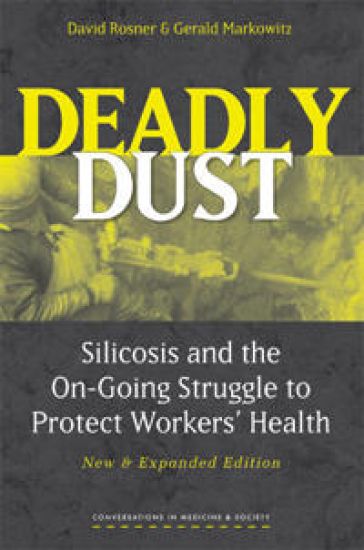
Deadly Dust

Deadly Dust

David Rosner; Gerald Markowitz

The University of Michigan Press
2006
nidottu
During the Depression, silicosis, an industrial lung disease, emerged as a national social crisis. Experts estimated that hundreds of thousands of workers were at risk of disease, disability, and death by inhaling silica in mines, foundries, and quarries. By the 1950s, however, silicosis was nearly forgotten by the media and health professionals. Asking what makes a health threat a public issue, David Rosner and Gerald Markowitz examine how a culture defines disease and how disease itself is understood at different moments in history. They also explore the interlocking relationships of public health, labor, business, and government to discuss who should assume responsibility for occupational disease.
Children, Race, and Power

Children, Race, and Power

Gerald Markowitz; David Rosner

Routledge
1999
nidottu
A portrait of two important black social scientists and a broader history of race relations, this important work captures the vitality and chaos of post-war politics in New York, recasting the story of the civil rights movement.