Kirjojen hintavertailu. Mukana 12 657 676 kirjaa ja 12 kauppaa.

Kirjailija

Gerard O'Regan

Kirjat ja teokset yhdessä paikassa: 32 kirjaa, julkaisuja vuosilta 2002-2026, suosituimpien joukossa Introduction to Software Process Improvement. Vertaile teosten hintoja ja tarkista saatavuus suomalaisista kirjakaupoista.

Mukana myös kirjoitusasut: Gerard O’Regan

32 kirjaa

Kirjojen julkaisuhaarukka 2002-2026.

A Guide to Business Mathematics

A Guide to Business Mathematics

Gerard O'Regan

TAYLOR FRANCIS LTD
2022
sidottu
The success of business today is dependent on the knowledge and expertise of its employees. The need for mathematics arises naturally in business such as in the work of the actuary in an insurance company, the financial mathematics required in the day-to-day work of the banker and the need to analyse data to extract useful information to enable the business to make the right decisions to be successful.A Guide to Business Mathematics provides a valuable self-study guide to business practitioners, business students and the general reader to enable them to gain an appropriate insight into the mathematics used in business. This book offers an accessible introduction to essential mathematics for the business field.A wide selection of topics is discussed with the mathematical material presented in a reader-friendly way. The business context motivates the presentation. The author uses modelling and applications to motivate the material, demonstrating how mathematics is used in the financial sector. In addition to the role of the actuary and the banker, the book covers operations research including game theory, trade discounts and the fundamentals of statistics and probability.The book is also a guide to using metrics to manage and measure performance, and business economics. Foundations on algebra, number theory, sequences and series, matrix theory and calculus are included as is a complete chapter on using software.Features• Discusses simple interest and its application to promissory notes/treasury bills.• Discusses compound interest with applications to present and future values.• Introduces the banking field including loans, annuities and the spot/forward FX market.• Discusses trade discounts and markups/markdowns.• Introduces the insurance field and the role of the actuary.• Introduces the fields of data analytics and operations research.• Discusses business metrics and problem solving.• Introduces matrices and their applications.• Discusses calculus and its applications.• Discusses basic financial statements such as balance sheet, profit and loss and cash account.• Reviews a selection of software to support business mathematics.This broad-ranging text gives the reader a flavour of the applications of mathematics to the business field and stimulates further study in the subject. As such, it will be of great benefit to business students, while also capturing the interest of the more casual reader.About the AuthorDr. Gerard O'Regan is an Assistant Professor in Mathematics at the University of Central Asia in Kyrgyzstan. His research interests include software quality and software process improvement, mathematical approaches to software quality, and the history of computing. He is the author of several books in the Mathematics and Computing fields.
A Guide to Business Mathematics

A Guide to Business Mathematics

Gerard O'Regan

TAYLOR FRANCIS LTD
2022
nidottu
The success of business today is dependent on the knowledge and expertise of its employees. The need for mathematics arises naturally in business such as in the work of the actuary in an insurance company, the financial mathematics required in the day-to-day work of the banker and the need to analyse data to extract useful information to enable the business to make the right decisions to be successful.A Guide to Business Mathematics provides a valuable self-study guide to business practitioners, business students and the general reader to enable them to gain an appropriate insight into the mathematics used in business. This book offers an accessible introduction to essential mathematics for the business field.A wide selection of topics is discussed with the mathematical material presented in a reader-friendly way. The business context motivates the presentation. The author uses modelling and applications to motivate the material, demonstrating how mathematics is used in the financial sector. In addition to the role of the actuary and the banker, the book covers operations research including game theory, trade discounts and the fundamentals of statistics and probability.The book is also a guide to using metrics to manage and measure performance, and business economics. Foundations on algebra, number theory, sequences and series, matrix theory and calculus are included as is a complete chapter on using software.Features• Discusses simple interest and its application to promissory notes/treasury bills.• Discusses compound interest with applications to present and future values.• Introduces the banking field including loans, annuities and the spot/forward FX market.• Discusses trade discounts and markups/markdowns.• Introduces the insurance field and the role of the actuary.• Introduces the fields of data analytics and operations research.• Discusses business metrics and problem solving.• Introduces matrices and their applications.• Discusses calculus and its applications.• Discusses basic financial statements such as balance sheet, profit and loss and cash account.• Reviews a selection of software to support business mathematics.This broad-ranging text gives the reader a flavour of the applications of mathematics to the business field and stimulates further study in the subject. As such, it will be of great benefit to business students, while also capturing the interest of the more casual reader.About the AuthorDr. Gerard O'Regan is an Assistant Professor in Mathematics at the University of Central Asia in Kyrgyzstan. His research interests include software quality and software process improvement, mathematical approaches to software quality, and the history of computing. He is the author of several books in the Mathematics and Computing fields.
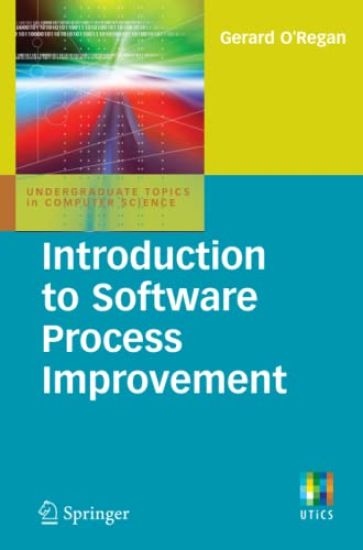
Introduction to Software Process Improvement

Introduction to Software Process Improvement

Gerard O'Regan

Springer London Ltd
2010
nidottu
This textbook is a systematic guide to the steps in setting up a Capability Maturity Model Integration (CMMI) improvement initiative. Readers will learn the project management practices necessary to deliver high-quality software solutions to the customer on time and on budget. The text also highlights how software process improvement can achieve specific business goals to provide a tangible return on investment. Topics and features: supplies review questions, summaries and key topics for each chapter, as well as a glossary of acronyms; describes the CMMI model thoroughly, detailing the five maturity levels; provides a broad overview of software engineering; reviews the activities and teams required to set up a CMMI improvement initiative; examines in detail the implementation of CMMI in a typical organization at each of the maturity levels; investigates the various tools that support organizations in improving their software engineering maturity; discusses the SCAMPI appraisal methodology.
Guide to Software Project Management

Guide to Software Project Management

Gerard O'Regan

Springer International Publishing AG
2025
nidottu
This essential textbook presents an overview of software project management in an ethical and responsible software engineering environment. The book covers the essentials of software project management, and highlights the importance of ethics and professional responsibility as part of the skill set of the modern project manager. Topics and features: Presents a solid overview of software project managementDiscusses professional and ethical responsibilities of project managersPresents an overview of ethical software engineeringReviews project planning and scheduling, project monitoring and control, risk management and project closureDiscusses quality management of software projectsPresents an overview of legal and ethical aspects of outsourcingDiscusses project management for both traditional and Agile projectsReviews a selection of tools & metrics to support project managementDiscusses best practice (Prince 2, PMP and CMMI) to improve project managementIncludes key learning topics, summaries, and review questions in each chapter, together with a useful glossary This practical and easy-to-follow textbook/reference is ideal for computer science students seeking to understand software project management. The text also serves as a self-study primer for software engineers, project managers and software managers. Dr. Gerard O’Regan is an international lecturer in Maths/Computing with research interests in software quality, software process improvement, mathematical approaches to software quality, and the history of computing. He is the author of several books with Springer, including Concise Guide to Software Engineering, Ethical and Legal Aspects of Computing, and A Brief History of Computing.
Mathematical Foundations of Software Engineering

Mathematical Foundations of Software Engineering

Gerard O'Regan

Springer International Publishing AG
2024
nidottu
This textbook presents an introduction to the mathematical foundations of software engineering. It presents the rich applications of mathematics in areas such as error-correcting codes, cryptography, the safety and security critical fields, the banking and insurance fields, as well as traditional engineering applications. Topics and features:Addresses core mathematics for critical thinking and problem solvingDiscusses propositional and predicate logic and various proof techniques to demonstrate the correctness of a logical argument.Examines number theory and its applications to cryptographyConsiders the underlying mathematics of error-correcting codesDiscusses graph theory and its applications to modelling networksReviews tools to support software engineering mathematics, including automated and interactive theorem provers and model checkingDiscusses financial software engineering, including simple and compound interest, probability and statistics, and operations researchDiscusses software reliability and dependability and explains formal methods used to derive a program from its specificationDiscusses calculus, matrices, vectors, complex numbers, and quaternions, as well as applications to graphics and roboticsIncludes key learning topics, summaries, and review questions in each chapter, together with a useful glossaryThis practical and easy-to-follow textbook/reference is ideal for computer science students seeking to learn how mathematics can assist them in building high-quality and reliable software on time and on budget. The text also serves as an excellent self-study primer for software engineers, quality professionals, and software managers.
Ethical and Legal Aspects of Computing

Ethical and Legal Aspects of Computing

Gerard O'Regan

Springer International Publishing AG
2024
nidottu
This textbook presents an overview of the critically important ethical and legal issues that arise in the computing field and provides a professional perspective from software engineering. The author gained exposure to these aspects of computing while working as a software engineer at Motorola in Ireland, where he coordinated the patent programme and worked with several software suppliers. Topics and features: Presents a broad overview of ethics and the lawIncludes key learning topics, summaries, and review questions in each chapter, together with a useful glossaryDiscusses the professional responsibility of computer professionalsExplores ethics in various civilisations and religious traditionsDiscusses ethical software engineering and ethical outsourcingConsiders what is fair and ethical in data scienceDescribes ethical challenges that arise in social media and the AI fieldReviews intellectual property including patents, copyright and trademarks This practical and easy-to-follow textbook/reference is ideal for computer science students seeking to understand legal and ethical aspects of computing. The text also serves as a concise self-study primer for software engineers and software managers.
Mathematical Foundations of Software Engineering

Mathematical Foundations of Software Engineering

Gerard O'Regan

Springer International Publishing AG
2023
sidottu
This textbook presents an introduction to the mathematical foundations of software engineering. It presents the rich applications of mathematics in areas such as error-correcting codes, cryptography, the safety and security critical fields, the banking and insurance fields, as well as traditional engineering applications. Topics and features:Addresses core mathematics for critical thinking and problem solvingDiscusses propositional and predicate logic and various proof techniques to demonstrate the correctness of a logical argument.Examines number theory and its applications to cryptographyConsiders the underlying mathematics of error-correcting codesDiscusses graph theory and its applications to modelling networksReviews tools to support software engineering mathematics, including automated and interactive theorem provers and model checkingDiscusses financial software engineering, including simple and compound interest, probability and statistics, and operations researchDiscusses software reliability and dependability and explains formal methods used to derive a program from its specificationDiscusses calculus, matrices, vectors, complex numbers, and quaternions, as well as applications to graphics and roboticsIncludes key learning topics, summaries, and review questions in each chapter, together with a useful glossaryThis practical and easy-to-follow textbook/reference is ideal for computer science students seeking to learn how mathematics can assist them in building high-quality and reliable software on time and on budget. The text also serves as an excellent self-study primer for software engineers, quality professionals, and software managers.
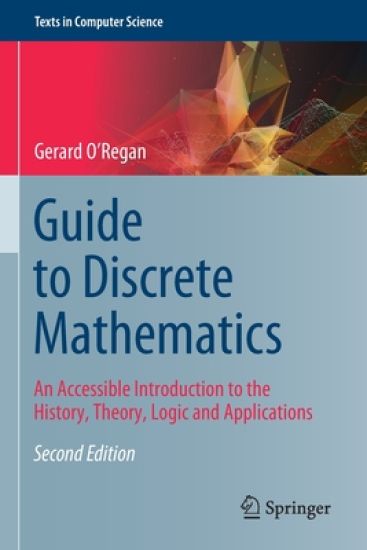
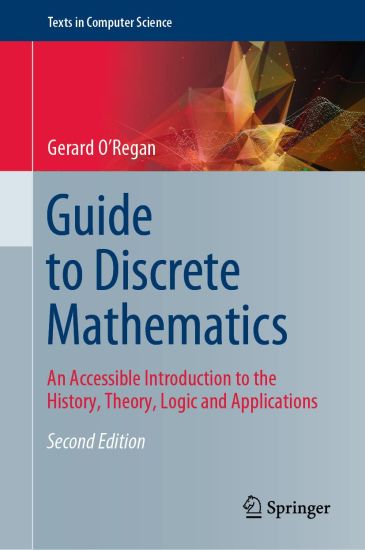
Guide to Discrete Mathematics

Guide to Discrete Mathematics

Gerard O'Regan

Springer Nature Switzerland AG
2022
nidottu
This stimulating textbook presents a broad and accessible guide to the fundamentals of discrete mathematics, highlighting how the techniques may be applied to various exciting areas in computing. The text is designed to motivate and inspire the reader, encouraging further study in this important skill. Features: This book provides an introduction to the building blocks of discrete mathematics, including sets, relations and functions; describes the basics of number theory, the techniques of induction and recursion, and the applications of mathematical sequences, series, permutations, and combinations; presents the essentials of algebra; explains the fundamentals of automata theory, matrices, graph theory, cryptography, coding theory, language theory, and the concepts of computability and decidability; reviews the history of logic, discussing propositional and predicate logic, as well as advanced topics such as the nature of theorem proving; examines the field of software engineering, including software reliability and dependability and describes formal methods; investigates probability and statistics and presents an overview of operations research and financial mathematics.
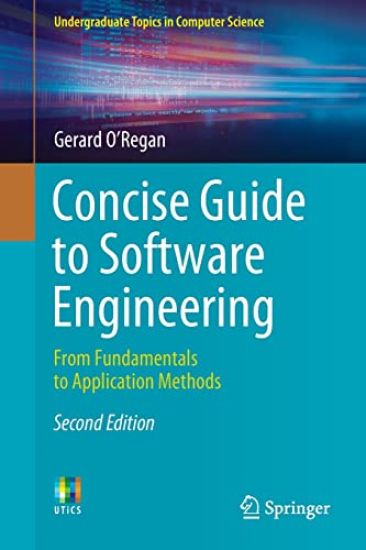
Concise Guide to Software Engineering

Concise Guide to Software Engineering

Gerard O'Regan

Springer International Publishing AG
2022
nidottu
This textbook presents a concise introduction to the fundamental principles of software engineering, together with practical guidance on how to apply the theory in a real-world, industrial environment. The wide-ranging coverage encompasses all areas of software design, management, and quality.Topics and features: presents a broad overview of software engineering, including software lifecycles and phases in software development, and project management for software engineering; examines the areas of requirements engineering, software configuration management, software inspections, software testing, software quality assurance, and process quality; covers topics on software metrics and problem solving, software reliability and dependability, and software design and development, including Agile approaches; explains formal methods, a set of mathematical techniques to specify and derive a program from its specification, introducing the Z specification language; discusses software process improvement, describing the CMMI model, and introduces UML, a visual modelling language for software systems; reviews a range of tools to support various activities in software engineering, and offers advice on the selection and management of a software supplier; describes such innovations in the field of software as distributed systems, service-oriented architecture, software as a service, cloud computing, and embedded systems; includes key learning topics, summaries and review questions in each chapter, together with a useful glossary.This practical and easy-to-follow textbook/reference is ideal for computer science students seeking to learn how to build high quality and reliable software on time and on budget. The text also serves as a self-study primer for software engineers, quality professionals, and software managers.
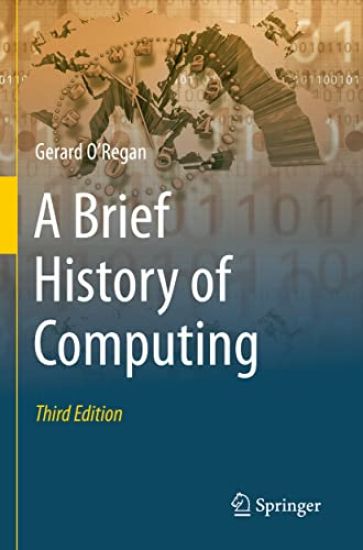
A Brief History of Computing

A Brief History of Computing

Gerard O'Regan

Springer Nature Switzerland AG
2022
nidottu
This lively and fascinating text traces the key developments in computation – from 3000 B.C. to the present day – in an easy-to-follow and concise manner. Topics and features: ideal for self-study, offering many pedagogical features such as chapter-opening key topics, chapter introductions and summaries, exercises, and a glossary; presents detailed information on major figures in computing, such as Boole, Babbage, Shannon, Turing, Zuse and Von Neumann; discusses the earliest computers developed in the United States, Germany and Britain; discusses the development of the IBM 360 family of computers and its importance; discusses the invention of the transistor and integrated circuit; discusses the birth of the software industry and the evolution of human-computer interaction; reviews the history of programming languages, operating systems and software engineering; discusses the progress of artificial intelligence; discusses the invention of the microprocessor and the development of home and personal computers; examines the impact on society of the introduction of the personal computer, the World Wide Web, and the development of mobile phone technology; discusses smart phones and social media and the challenge of fake news; reviews a miscellany of innovations in the computing field such as cloud computing, the Internet of Things, and Quantum Computing; discusses legal aspects of computing and the professional responsibilities of computer professionals.
Guide to Discrete Mathematics

Guide to Discrete Mathematics

Gerard O'Regan

Springer Nature Switzerland AG
2021
sidottu
This stimulating textbook presents a broad and accessible guide to the fundamentals of discrete mathematics, highlighting how the techniques may be applied to various exciting areas in computing. The text is designed to motivate and inspire the reader, encouraging further study in this important skill. Features: This book provides an introduction to the building blocks of discrete mathematics, including sets, relations and functions; describes the basics of number theory, the techniques of induction and recursion, and the applications of mathematical sequences, series, permutations, and combinations; presents the essentials of algebra; explains the fundamentals of automata theory, matrices, graph theory, cryptography, coding theory, language theory, and the concepts of computability and decidability; reviews the history of logic, discussing propositional and predicate logic, as well as advanced topics such as the nature of theorem proving; examines the field of software engineering, including software reliability and dependability and describes formal methods; investigates probability and statistics and presents an overview of operations research and financial mathematics.
A Brief History of Computing

A Brief History of Computing

Gerard O'Regan

Springer Nature Switzerland AG
2021
sidottu
This lively and fascinating text traces the key developments in computation – from 3000 B.C. to the present day – in an easy-to-follow and concise manner. Topics and features: ideal for self-study, offering many pedagogical features such as chapter-opening key topics, chapter introductions and summaries, exercises, and a glossary; presents detailed information on major figures in computing, such as Boole, Babbage, Shannon, Turing, Zuse and Von Neumann; discusses the earliest computers developed in the United States, Germany and Britain; discusses the development of the IBM 360 family of computers and its importance; discusses the invention of the transistor and integrated circuit; discusses the birth of the software industry and the evolution of human-computer interaction; reviews the history of programming languages, operating systems and software engineering; discusses the progress of artificial intelligence; discusses the invention of the microprocessor and the development of home and personal computers; examines the impact on society of the introduction of the personal computer, the World Wide Web, and the development of mobile phone technology; discusses smart phones and social media and the challenge of fake news; reviews a miscellany of innovations in the computing field such as cloud computing, the Internet of Things, and Quantum Computing; discusses legal aspects of computing and the professional responsibilities of computer professionals.
Mathematics in Computing

Mathematics in Computing

Gerard O’Regan

Springer Nature Switzerland AG
2020
nidottu
This illuminating textbook provides a concise review of the core concepts in mathematics essential to computer scientists. Emphasis is placed on the practical computing applications enabled by seemingly abstract mathematical ideas, presented within their historical context. The text spans a broad selection of key topics, ranging from the use of finite field theory to correct code and the role of number theory in cryptography, to the value of graph theory when modelling networks and the importance of formal methods for safety critical systems.This fully updated new edition has been expanded with a more comprehensive treatment of algorithms, logic, automata theory, model checking, software reliability and dependability, algebra, sequences and series, and mathematical induction.Topics and features: includes numerous pedagogical features, such as chapter-opening key topics, chapter introductions and summaries, review questions, and a glossary; describes the historical contributions of such prominent figures as Leibniz, Babbage, Boole, and von Neumann; introduces the fundamental mathematical concepts of sets, relations and functions, along with the basics of number theory, algebra, algorithms, and matrices; explores arithmetic and geometric sequences and series, mathematical induction and recursion, graph theory, computability and decidability, and automata theory; reviews the core issues of coding theory, language theory, software engineering, and software reliability, as well as formal methods and model checking; covers key topics on logic, from ancient Greek contributions to modern applications in AI, and discusses the nature of mathematical proof and theorem proving; presents a short introduction to probability and statistics, complex numbers and quaternions, and calculus.This engaging and easy-to-understand book will appeal to students of computer science wishing for an overview of the mathematics used in computing, and to mathematicianscurious about how their subject is applied in the field of computer science. The book will also capture the interest of the motivated general reader.
Concise Guide to Software Testing

Concise Guide to Software Testing

Gerard O'Regan

Springer Nature Switzerland AG
2019
nidottu
This practically-focused textbook provides a concise and accessible introduction to the field of software testing, explaining the fundamental principles and offering guidance on applying the theory in an industrial environment.Topics and features: presents a brief history of software quality and its influential pioneers, as well as a discussion of the various software lifecycles used in software development; describes the fundamentals of testing in traditional software engineering, and the role that static testing plays in building quality into a product; explains the process of software test planning, test analysis and design, and test management; discusses test outsourcing, and test metrics and problem solving; reviews the tools available to support software testing activities, and the benefits of a software process improvement initiative; examines testing in the Agile world, and the verification of safety critical systems; considers the legal and ethical aspects of software testing, and the importance of software configuration management; provides key learning topics and review questions in every chapter, and supplies a helpful glossary at the end of the book.This easy-to-follow guide is an essential resource for undergraduate students of computer science seeking to learn about software testing, and how to build high quality and reliable software on time and on budget. The work will also be of interest to industrialists including software engineers, software testers, quality professionals and software managers, as well as the motivated general reader.
The Innovation in Computing Companion

The Innovation in Computing Companion

Gerard O’Regan

Springer Nature Switzerland AG
2018
nidottu
This encyclopedic reference provides a concise and engaging overview of the groundbreaking inventions and conceptual innovations that have shaped the field of computing, and the technology that runs the modern world. Each alphabetically-ordered entry presents a brief account of a pivotal innovation and the great minds behind it, selected from a wide range of diverse topics.Topics and features:Describes the development of Babbage’s computing machines, Leibniz’s binary arithmetic, Boole’s symbolic logic, and Von Neumann architectureReviews a range of historical analog and digital computers, significant mainframes and minicomputers, and pioneering home and personal computersDiscusses a selection of programming languages and operating systems, along with key concepts in software engineering and commercial computingExamines the invention of the transistor, the integrated circuit, and the microprocessorRelates the history of such developments in personal computing as the mouse, the GUI, Atari video games, and Microsoft OfficeSurveys innovations in communications, covering mobile phones, WiFi, the Internet and World Wide Web, e-commerce, smartphones, social media, and GPSPresents coverage of topics on artificial intelligence, the ATM, digital photography and digital music, robotics, and WikipediaContains self-test quizzes and a helpful glossaryThis enjoyable compendium will appeal to the general reader curious about the intellectual milestones that led to the digital age, as well as to the student of computer science seeking a primer on the history of their field.Dr. Gerard O'Regan is a CMMI software process improvement consultant with research interests including software quality and software process improvement, mathematical approaches to software quality, and the history of computing. He is the author of such Springer titles as World of Computing, Concise Guide to Formal Methods, Concise Guide to Software Engineering, and Guide to Discrete Mathematics.
Guide to Discrete Mathematics

Guide to Discrete Mathematics

Gerard O'Regan

Springer International Publishing AG
2018
nidottu
This stimulating textbook presents a broad and accessible guide to the fundamentals of discrete mathematics, highlighting how the techniques may be applied to various exciting areas in computing. The text is designed to motivate and inspire the reader, encouraging further study in this important skill. Features: provides an introduction to the building blocks of discrete mathematics, including sets, relations and functions; describes the basics of number theory, the techniques of induction and recursion, and the applications of mathematical sequences, series, permutations, and combinations; presents the essentials of algebra; explains the fundamentals of automata theory, matrices, graph theory, cryptography, coding theory, language theory, and the concepts of computability and decidability; reviews the history of logic, discussing propositional and predicate logic, as well as advanced topics; examines the field of software engineering, describing formal methods; investigates probability and statistics.
World of Computing

World of Computing

Gerard O'Regan

Springer International Publishing AG
2018
nidottu
This engaging work provides a concise introduction to the exciting world of computing, encompassing the theory, technology, history, and societal impact of computer software and computing devices. Spanning topics from global conflict to home gaming, international business, and human communication, this text reviews the key concepts unpinning the technology which has shaped the modern world.Topics and features: introduces the foundations of computing, the fundamentals of algorithms, and the essential concepts from mathematics and logic used in computer science; presents a concise history of computing, discussing the historical figures who made important contributions, and the machines which formed major milestones; examines the fields of human-computer interaction, and software engineering; provides accessible introductions to the core aspects of programming languages, operating systems, and databases; describes the Internet revolution, the invention of the smartphone, and the rise of social media, as well as the Internet of Things and cryptocurrencies; explores legal and ethical aspects of computing, including issues of hacking and cybercrime, and the nature of online privacy, free speech and censorship; discusses such innovations as distributed systems, service-oriented architecture, software as a service, cloud computing, and embedded systems; includes key learning topics and review questions in every chapter, and a helpful glossary.Offering an enjoyable overview of the fascinating and broad-ranging field of computing, this easy-to-understand primer introduces the general reader to the ideas on which the digital world was built, and the historical developments that helped to form the modern age.