Kirjojen hintavertailu. Mukana 12 595 353 kirjaa ja 12 kauppaa.
Kirjailija
Gerd Gigerenzer
Kirjat ja teokset yhdessä paikassa: 30 kirjaa, julkaisuja vuosilta 1990-2025, suosituimpien joukossa Ecological Rationality. Vertaile teosten hintoja ja tarkista saatavuus suomalaisista kirjakaupoista.
"More information is always better, and full information is best. More computation is always better, and optimization is best." More-is-better ideals such as these have long shaped our vision of rationality. Yet humans and other animals typically rely on simple heuristics to solve adaptive problems, focusing on one or a few important cues and ignoring the rest, and shortcutting computation rather than striving for as much as possible. In this book, we argue that in an uncertain world, more information and computation are not always better, and we ask when, and why, less can be more. The answers to these questions constitute the idea of ecological rationality: how we are able to achieve intelligence in the world by using simple heuristics matched to the environments we face, exploiting the structures inherent in our physical, biological, social, and cultural surroundings.
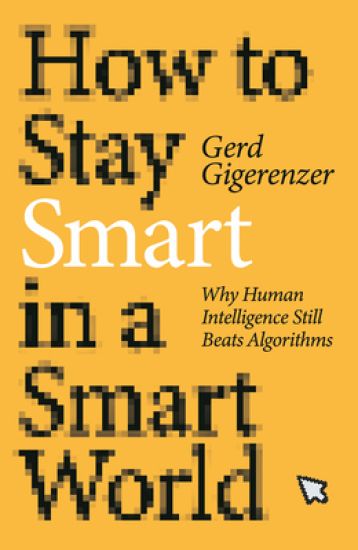
How to stay in charge in a world populated by algorithms that beat us in chess, find us romantic partners, and tell us to "turn right in 500 yards." Doomsday prophets of technology predict that robots will take over the world, leaving humans behind in the dust. Tech industry boosters think replacing people with software might make the world a better place--while tech industry critics warn darkly about surveillance capitalism. Despite their differing views of the future, they all seem to agree: machines will soon do everything better than humans. In How to Stay Smart in a Smart World, Gerd Gigerenzer shows why that's not true, and tells us how we can stay in charge in a world populated by algorithms. Machines powered by artificial intelligence are good at some things (playing chess), but not others (life-and-death decisions, or anything involving uncertainty). Gigerenzer explains why algorithms often fail at finding us romantic partners (love is not chess), why self-driving cars fall prey to the Russian Tank Fallacy, and how judges and police rely increasingly on nontransparent "black box" algorithms to predict whether a criminal defendant will reoffend or show up in court. He invokes Black Mirror, considers the privacy paradox (people want privacy but give their data away), and explains that social media get us hooked by programming intermittent reinforcement in the form of the "like" button. We shouldn't trust smart technology unconditionally, Gigerenzer tells us, but we shouldn't fear it unthinkingly, either.
People often confuse intuition with a sixth sense or the arbitrary judgments of inept decision makers. In this book, Gerd Gigerenzer analyzes the war on intuition in the social sciences beginning with gendered perceptions of intuition as female, followed by opposition between biased intuition and logical rationality, popularized in two-system theories. Technological paternalism amplifies these views, arguing that human intuition should be replaced by perfect algorithms. In opposition to these beliefs, this book proposes that intuition is a form of unconscious intelligence based on years of experience that evolved to deal with uncertain and dynamic situations where logic and big data algorithms are of little benefit. Gigerenzer introduces the scientific study of intuition and shows that intuition is not irrational caprice but is instead based on smart heuristics. Researchers, students, and general readers with an interest in decision making, heuristics and biases, cognitive psychology, and behavioral public policy will benefit.
People often confuse intuition with a sixth sense or the arbitrary judgments of inept decision makers. In this book, Gerd Gigerenzer analyzes the war on intuition in the social sciences beginning with gendered perceptions of intuition as female, followed by opposition between biased intuition and logical rationality, popularized in two-system theories. Technological paternalism amplifies these views, arguing that human intuition should be replaced by perfect algorithms. In opposition to these beliefs, this book proposes that intuition is a form of unconscious intelligence based on years of experience that evolved to deal with uncertain and dynamic situations where logic and big data algorithms are of little benefit. Gigerenzer introduces the scientific study of intuition and shows that intuition is not irrational caprice but is instead based on smart heuristics. Researchers, students, and general readers with an interest in decision making, heuristics and biases, cognitive psychology, and behavioral public policy will benefit.
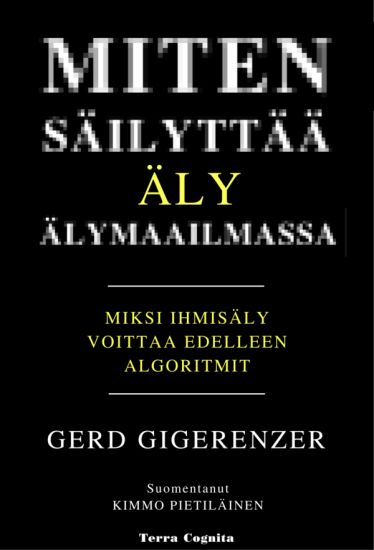
Miten hallitsemme elämäämme, kun algoritmit voittavat meidät shakissa, valitsevat kumppanimme ja kertovat, minne on käännyttävä seuraavaksi?Teknointoilijat ja -kauppiaat maalailevat tulevaisuudestamme ruusuisia kuvia ja pessimistit ennustavat kaiken romahtavan.Maineikas psykologi Gerd Gigerenzer kertoo tässä kirjassa, miten ja miksi algoritmit eivät ole niin pahoja tai hyviä kuin luullaan ja miten ne usein epäonnistuvat ennustuksissaan. Hän ohjaa meidät näkemään, miten mustan laatikon ratkaisut levittäytyvät, mikä on yksityisyysparadoksi, miten sosiaalinen media ohjaa meitä tykkäyspainikkeella ja ennen kaikkea, ettei älytekonologiaan tule luottaa sokeasti, mutta sitä ei myöskään tule pelätä.Gerd Gigerenzeriltä on ilmestynyt suomeksi aiemmin teos Riskitietoisuus.
How to stay in charge in a world populated by algorithms that beat us in chess, find us romantic partners, and tell us to "turn right in 500 yards." Doomsday prophets of technology predict that robots will take over the world, leaving humans behind in the dust. Tech industry boosters think replacing people with software might make the world a better place--while tech industry critics warn darkly about surveillance capitalism. Despite their differing views of the future, they all agree: machines will soon do everything better than humans. In How to Stay Smart in a Smart World, Gerd Gigerenzer shows why that's not true, and tells us how we can stay in charge in a world populated by algorithms. Machines powered by artificial intelligence are good at some things (playing chess), but not others (life-and-death decisions, or anything involving uncertainty). Gigerenzer explains why algorithms often fail at finding us romantic partners (love is not chess), why self-driving cars fall prey to the Russian Tank Fallacy, and how judges and police rely increasingly on nontransparent "black box" algorithms to predict whether a criminal defendant will reoffend or show up in court. He invokes Black Mirror, considers the privacy paradox (people want privacy, but give their data away), and explains that social media get us hooked by programming intermittent reinforcement in the form of the "like" button. We shouldn't trust smart technology unconditionally, Gigerenzer tells us, but we shouldn't fear it unthinkingly, either.
Originally published in 1987, this title is about theory construction in psychology. Where theories come from, as opposed to how they become established, was almost a no-man’s land in the history and philosophy of science at the time. The authors argue that in the science of mind, theories are particularly likely to come from tools, and they are especially concerned with the emergence of the metaphor of the mind as an intuitive statistician.In the first chapter, the authors discuss the rise of the inference revolution, which institutionalized those statistical tools that later became theories of cognitive processes. In each of the four following chapters they treat one major topic of cognitive psychology and show to what degree statistical concepts transformed their understanding of those topics.
How do people make decisions when time is limited, information unreliable, and the future uncertain? Based on the work of Nobel laureate Herbert Simon and with the help of colleagues around the world, the Adaptive Behavior and Cognition (ABC) Group at the Max Planck Institute for Human Development in Berlin has developed a research program on simple heuristics, also known as fast and frugal heuristics. In the social sciences, heuristics have been believed to be generally inferior to complex methods for inference, or even irrational. Although this may be true in "small worlds " where everything is known for certain, we show that in the actual world in which we live, full of uncertainties and surprises, heuristics are indispensable and often more accurate than complex methods. Contrary to a deeply entrenched belief, complex problems do not necessitate complex computations. Less can be more. Simple heuristics exploit the information structure of the environment, and thus embody ecological rather than logical rationality. Simon (1999) applauded this new program as a "revolution in cognitive science, striking a great blow for sanity in the approach to human rationality. " By providing a fresh look at how the mind works as well as the nature of rationality, the simple heuristics program has stimulated a large body of research, led to fascinating applications in diverse fields from law to medicine to business to sports, and instigated controversial debates in psychology, philosophy, and economics. In a single volume, the present reader compiles key articles that have been published in journals across many disciplines. These articles present theory, real-world applications, and a sample of the large number of existing experimental studies that provide evidence for people's adaptive use of heuristics.
Originally published in 1987, this title is about theory construction in psychology. Where theories come from, as opposed to how they become established, was almost a no-man’s land in the history and philosophy of science at the time. The authors argue that in the science of mind, theories are particularly likely to come from tools, and they are especially concerned with the emergence of the metaphor of the mind as an intuitive statistician.In the first chapter, the authors discuss the rise of the inference revolution, which institutionalized those statistical tools that later became theories of cognitive processes. In each of the four following chapters they treat one major topic of cognitive psychology and show to what degree statistical concepts transformed their understanding of those topics.
Statistical illiteracy can have an enormously negative impact on decision making. This volume of collected papers brings together applied and theoretical research on risks and decision making across the fields of medicine, psychology, and economics. Collectively, the essays demonstrate why the frame in which statistics are communicated is essential for broader understanding and sound decision making, and that understanding risks and uncertainty has wide-reaching implications for daily life. Gerd Gigerenzer provides a lucid review and catalog of concrete instances of heuristics, or rules of thumb, that people and animals rely on to make decisions under uncertainty, explaining why these are very often more rational than probability models. After a critical look at behavioral theories that do not model actual psychological processes, the book concludes with a call for a "heuristic revolution" that will enable us to understand the ecological rationality of both statistics and heuristics, and bring a dose of sanity to the study of rationality.
A fascinating, practical guide to making better decisions with our money, health and personal lives from Gerd Gigerenzer, the author of Reckoning with Risk.Numbers don't lie - but they often mislead us. From health risks to financial decisions, we often find it hard to make decisions because the statistics have been presented to us by 'experts' who misinterpret the data themselves. Here Gerd Gigerenzer shows how we can all use simple rules to become better-informed, risk-savvy citizens. 'Important, Gigerenzer draws valuable lessons . . . his clear explanations will be a great help to all' Omar Malik, Times Higher Education'Gerd Gigerenzer argues that when it comes to taking risks in life, we are often much better off following our instincts than expert advice' Oliver Burkeman, Guardian'Things will only get better, he shows, when specialists, particularly doctors and investment advisers, improve on their appalling record of analysing and communicating risks in their fields' Clive Cookson, Financial Times, Books of the Year'Gigerenzer is brilliant' Steven PinkerGerd Gigerenzer is Director of the Center for Adaptive Behavior and Cognition at the Max Planck Institute for Human Development in Berlin and former Professor of Psychology at the University of Chicago. He is the author of several books on heuristics and decision making, including Reckoning with Risk.
A new eye-opener on how we can make better decisions--by the author of Gut Feelings In this age of big data we often trust that expert analysis--whether it's about next year's stock market or a person's risk of getting cancer--is accurate. But, as risk expert Gerd Gigerenzer reveals in his latest book, Risk Savvy, most of us, including doctors, lawyers, and financial advisors, often misunderstand statistics, leaving us misinformed and vulnerable to exploitation. Yet there's hope. In Risk Savvy, Gigerenzer gives us an essential guide to the science of good decision making, showing how ordinary people can make better decisions for their money, their health, and their families. Here, Gigerenzer delivers the surprising conclusion that the best results often come from considering less information and listening to your gut.
Suuraineiston ja supertietokoneiden aikakaudellamme uskomme, että osaamme ennustaa tulevaisuutta tarkemmin kuin koskaan aikaisemmin. Riskin arvioinnin tunnustettu tuntija Gerd Gigerenzer kuitenkin osoittaa, että enemmän informaatiota ei aina johda parempaan päätökseen. Oikeastaan yhä monimutkaisemmaksi käyvässä elämässämme se usein johtaa huonoihin päätöksiin.Hämmästyttävästi tosimaailmassa parhaat tulokset saadaan usein yksinkertaisilla menetelmillä, jotka perustuvat informaation karsimiseen ja vaistoon.Riskitietoisuus ohjaa hyvän päätöksenteon tieteeseen ja osoittaa kädestä pitäen, miksi vähemmän informaatiota on usein parempi vaihtoehto. Se näyttää esimerkein, miten niin monet asiantuntijoina pidetyt, kuten lääkärit, asianajajat, rahoitusneuvojat ja virkamiehet eivät ymmärrä tilastoja ja todennäköisyyksiä. Viime kädessä he ovat sekä väärin informoituja että alttiita johdattelulle.Tilanne ei kuitenkaan ole toivoton, kuten Riskitietoisuuden esimerkit osoittavat. Se näyttää, miten jo yksinkertaisilla nyrkkisäännöillä jokainen osaa tehdä elämäänsä parantavia hyviä päätöksiä.