Kirjojen hintavertailu. Mukana 12 126 310 kirjaa ja 12 kauppaa.

Kirjailija

Gerhard Sorger

Kirjat ja teokset yhdessä paikassa: 2 kirjaa, julkaisuja vuosilta 2000-2015, suosituimpien joukossa Dynamic Economic Analysis. Vertaile teosten hintoja ja tarkista saatavuus suomalaisista kirjakaupoista.

2 kirjaa

Kirjojen julkaisuhaarukka 2000-2015.

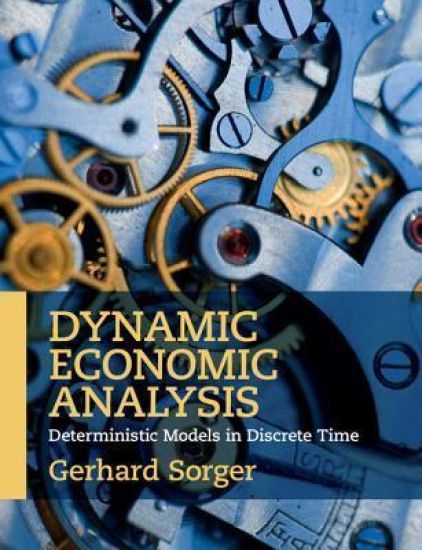
Dynamic Economic Analysis

Dynamic Economic Analysis

Gerhard Sorger

Cambridge University Press
2015
pokkari
Focusing on deterministic models in discrete time, this concise yet rigorous textbook provides a clear and systematic introduction to the theory and application of dynamic economic models. It guides students through the most popular model structures and solution concepts, from the simplest dynamic economic models through to complex problems of optimal policy design in dynamic general equilibrium frameworks. Chapters feature theorems and practical hints, and seventy-five worked examples highlight the various methods and results that can be applied in dynamic economic models. Notation and formulation is uniform throughout, so students can easily discern the similarities and differences between various model classes. Chapters include more than sixty exercises for students to self-test their analytical skills, and password-protected solutions are available for instructors on the companion website. Assuming no prior knowledge of dynamic economic analysis or dynamic optimization, this textbook is ideal for advanced students in economics.
Differential Games in Economics and Management Science

Differential Games in Economics and Management Science

Engelbert J. Dockner; Steffen Jorgensen; Ngo Van Long; Gerhard Sorger

Cambridge University Press
2000
pokkari
A comprehensive, self-contained survey of the theory and applications of differential games, one of the most commonly used tools for modelling and analysing economics and management problems which are characterised by both multiperiod and strategic decision making. Although no prior knowledge of game theory is required, a basic knowledge of linear algebra, ordinary differential equations, mathematical programming and probability theory is necessary. Part One presents the theory of differential games, starting with the basic concepts of game theory and going on to cover control theoretic models, Markovian equilibria with simultaneous play, differential games with hierarchical play, trigger strategy equilibria, differential games with special structures, and stochastic differential games. Part Two offers applications to capital accumulation games, industrial organization and oligopoly games, marketing, resources and environmental economics.