Kirjojen hintavertailu. Mukana 12 595 353 kirjaa ja 12 kauppaa.

Kirjailija

Gian-Carlo Rota

Kirjat ja teokset yhdessä paikassa: 9 kirjaa, julkaisuja vuosilta 1989-2012, suosituimpien joukossa Essays on the Future. Vertaile teosten hintoja ja tarkista saatavuus suomalaisista kirjakaupoista.

9 kirjaa

Kirjojen julkaisuhaarukka 1989-2012.

Essays on the Future

Essays on the Future

Siegfried Hecker; Gian-Carlo Rota

Springer-Verlag New York Inc.
2012
nidottu
The present work represents a unique undertaking in scientific publishing to honor Nick Metropolis, who passed away in October, 1999. Nick was the last survivor of the Manhattan Project that began during World War II in Los Alamos and later became the Los Alamos National Laboratory. In this volume, some of the leading scientists and humanists of our time have contributed essays related to their respective disciplines exploring various aspects of future developments in science, technology, and society. Speculations on the future developments of science and society, philosophy, national security, nuclear power, pure and applied mathematics, physics and biology, particle physics, computing, information science, among many others, are included. Contributors include: H. Agnew * R. Ashenhurst * K. Baclawski * G. Baker * N. Balazs * J.A. Freed * R. Hamming * M. Hawrylycz * O. Judd * D. Kleitman * M. Krieger * N. Krikorian * P. Lax * J.D. Louck * T. Puck * M. Raju * R. Richtmyer * J. Schwartz * R. Sokolowski * E. Teller * M. Waterman
Combinatorics: The Rota Way

Combinatorics: The Rota Way

Joseph P. S. Kung; Gian-Carlo Rota; Catherine H. Yan

Cambridge University Press
2009
sidottu
Gian-Carlo Rota was one of the most original and colourful mathematicians of the 20th century. His work on the foundations of combinatorics focused on the algebraic structures that lie behind diverse combinatorial areas, and created a new area of algebraic combinatorics. Written by two of his former students, this book is based on notes from his influential graduate courses and on face-to-face discussions. Topics include sets and valuations, partially ordered sets, distributive lattices, partitions and entropy, matching theory, free matrices, doubly stochastic matrices, Moebius functions, chains and antichains, Sperner theory, commuting equivalence relations and linear lattices, modular and geometric lattices, valuation rings, generating functions, umbral calculus, symmetric functions, Baxter algebras, unimodality of sequences, and location of zeros of polynomials. Many exercises and research problems are included, and unexplored areas of possible research are discussed. A must-have for all students and researchers in combinatorics and related areas.
Indiscrete Thoughts

Indiscrete Thoughts

Gian-Carlo Rota

Birkhauser Boston Inc
2008
nidottu
Indiscrete Thoughts gives a glimpse into a world that has seldom been described that of science and technology as seen through the eyes of a mathematician. The era covered by this book, 1950 to 1990, was surely one of the golden ages of science as well as the American university. Cherished myths are debunked along the way as Gian-Carlo Rota takes pleasure in portraying, warts and all, some of the great scientific personalities of the period —Stanislav Ulam (who, together with Edward Teller, signed the patent application for the hydrogen bomb), Solomon Lefschetz (Chairman in the 50s of the Princeton mathematics department), William Feller (one of the founders of modern probability theory), Jack Schwartz (one of the founders of computer science), and many others. Rota is not afraid of controversy. Some readers may even consider these essays indiscreet. After the publication of the essay “The Pernicious Influence of Mathematics upon Philosophy” (reprinted six times in five languages) the author was blacklisted in analytical philosophy circles. Indiscrete Thoughts should become an instant classic and the subject of debate for decades to come.
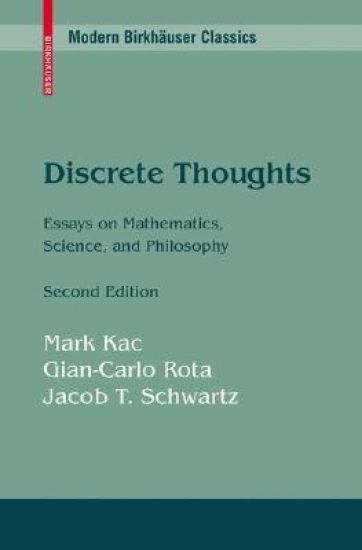
Discrete Thoughts

Discrete Thoughts

Mark Kac; Gian-Carlo Rota; Jacob T. Schwartz

Birkhauser Boston Inc
2008
nidottu
as anywhere today, it is becoming more d- ficult to tell the truth. To be sure, our store of accurate facts is more plentiful now than it has ever been, and the minutest details of history are being thoroughly recorded. Scientists, - men and scholars vie with each other in publishing excruciatingly definitive accounts of all that happens on the natural, political and historical scenes. Unfortunately, telling the truth is not quite the same thing as reciting a rosary of facts. Jos6 Ortega y Gasset, in an adm- able lesson summarized by Antonio Machado's three-line poem, prophetically warned us that the reason people so often lie is that they lack imagination: they don't realize that the truth, too, is a matter of invention. Sometime, in a future that is knocking at our door, we shall have to retrain ourselves or our children to properly tell the truth. The exercise will be particularly painful in mathematics. The enrapturing discoveries of our field systematically conceal, like footprints erased in the sand, the analogical train of thought that is the authentic life of mathematics. Shocking as it may be to a conservative logician, the day will come when currently MATHEMATICS, IN vague concepts such as motivation and purpose will be made formal and accepted as constituents of a revamped logic, where they will at last be allotted the equal status they deserve, si- by-side with axioms and theorems.
Essays on the Future

Essays on the Future

Siegfried Hecker; Gian-Carlo Rota

Birkhauser Boston Inc
2000
sidottu
The present work represents a unique undertaking in scientific publishing to honor Nick Metropolis, who passed away in October, 1999. Nick was the last survivor of the Manhattan Project that began during World War II in Los Alamos and later became the Los Alamos National Laboratory. In this volume, some of the leading scientists and humanists of our time have contributed essays related to their respective disciplines exploring various aspects of future developments in science, technology, and society. Speculations on the future developments of science and society, philosophy, national security, nuclear power, pure and applied mathematics, physics and biology, particle physics, computing, information science, among many others, are included. Contributors include: H. Agnew * R. Ashenhurst * K. Baclawski * G. Baker * N. Balazs * J.A. Freed * R. Hamming * M. Hawrylycz * O. Judd * D. Kleitman * M. Krieger * N. Krikorian * P. Lax * J.D. Louck * T. Puck * M. Raju * R. Richtmyer * J. Schwartz * R. Sokolowski * E. Teller * M. Waterman
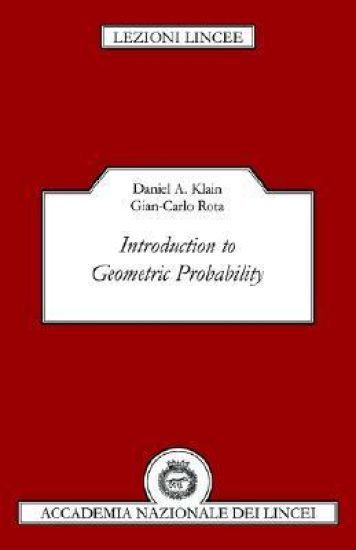
Introduction to Geometric Probability

Introduction to Geometric Probability

Daniel A. Klain; Gian-Carlo Rota

Cambridge University Press
1997
pokkari
The purpose of this book is to present the three basic ideas of geometrical probability, also known as integral geometry, in their natural framework. In this way, the relationship between the subject and enumerative combinatorics is more transparent, and the analogies can be more productively understood. The first of the three ideas is invariant measures on polyconvex sets. The authors then prove the fundamental lemma of integral geometry, namely the kinematic formula. Finally the analogues between invariant measures and finite partially ordered sets are investigated, yielding insights into Hecke algebras, Schubert varieties and the quantum world, as viewed by mathematicians. Geometers and combinatorialists will find this a most stimulating and fruitful story.
Introduction to Geometric Probability

Introduction to Geometric Probability

Daniel A. Klain; Gian-Carlo Rota

Cambridge University Press
1997
sidottu
The purpose of this book is to present the three basic ideas of geometrical probability, also known as integral geometry, in their natural framework. In this way, the relationship between the subject and enumerative combinatorics is more transparent, and the analogies can be more productively understood. The first of the three ideas is invariant measures on polyconvex sets. The authors then prove the fundamental lemma of integral geometry, namely the kinematic formula. Finally the analogues between invariant measures and finite partially ordered sets are investigated, yielding insights into Hecke algebras, Schubert varieties and the quantum world, as viewed by mathematicians. Geometers and combinatorialists will find this a most stimulating and fruitful story.
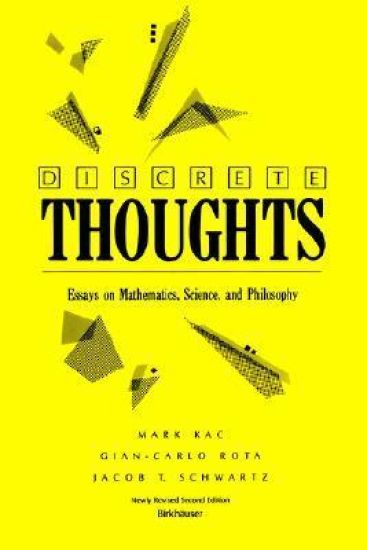
Discrete Thoughts

Discrete Thoughts

Mark Kac; Gian-Carlo Rota; Jacob T. Schwartz

Birkhauser Boston Inc
1993
nidottu
as anywhere today, it is becoming more d- ficult to tell the truth. To be sure, our store of accurate facts is more plentiful now than it has ever been, and the minutest details of history are being thoroughly recorded. Scientists, - men and scholars vie with each other in publishing excruciatingly definitive accounts of all that happens on the natural, political and historical scenes. Unfortunately, telling the truth is not quite the same thing as reciting a rosary of facts. Jos6 Ortega y Gasset, in an adm- able lesson summarized by Antonio Machado's three-line poem, prophetically warned us that the reason people so often lie is that they lack imagination: they don't realize that the truth, too, is a matter of invention. Sometime, in a future that is knocking at our door, we shall have to retrain ourselves or our children to properly tell the truth. The exercise will be particularly painful in mathematics. The enrapturing discoveries of our field systematically conceal, like footprints erased in the sand, the analogical train of thought that is the authentic life of mathematics. Shocking as it may be to a conservative logician, the day will come when currently MATHEMATICS, IN vague concepts such as motivation and purpose will be made formal and accepted as constituents of a revamped logic, where they will at last be allotted the equal status they deserve, si- by-side with axioms and theorems.
Ordinary Differential Equations

Ordinary Differential Equations

Garrett Birkhoff; Gian-Carlo Rota

John Wiley Sons Inc
1989
nidottu
A carefully revised edition of the well-respected ODE text, whose unique treatment provides a smooth transition to critical understanding of proofs of basic theorems. First chapters present a rigorous treatment of background material; middle chapters deal in detail with systems of nonlinear differential equations; final chapters are devoted to the study of second-order linear differential equations. The power of the theory of ODE is illustrated throughout by deriving the properties of important special functions, such as Bessel functions, hypergeometric functions, and the more common orthogonal polynomials, from their defining differential equations and boundary conditions. Contains several hundred exercises. Prerequisite is a first course in ODE.