Kirjojen hintavertailu. Mukana 12 493 502 kirjaa ja 12 kauppaa.

Kirjailija

Giancarlo Corsi

Kirjat ja teokset yhdessä paikassa: 3 kirjaa, julkaisuja vuosilta 2008-2021, suosituimpien joukossa Niklas Luhmann. Vertaile teosten hintoja ja tarkista saatavuus suomalaisista kirjakaupoista.

3 kirjaa

Kirjojen julkaisuhaarukka 2008-2021.

Niklas Luhmann

Niklas Luhmann

Claudio Baraldi; Giancarlo Corsi

Springer International Publishing AG
2016
nidottu
This book provides an insight into the ideas of one of the world’s greatest sociologists: Niklas Luhmann. It explains, in clear and concise language, the basic concepts of Social Systems Theory and their application to the specific case of the Education System, which was considered by Luhmann as a primary subsystem of modern society. It illustrates the complex and sophisticated thinking that characterises Luhmann’s work and explains that Luhmann’s theory has given an important and original contribution to the study of education from a sociological point of view. His contribution has some resonance in recent social constructionist and relational approaches to education, as well as in studies of educational interaction. In addition, research methodologies, in particular mixed methods strategies, draw heavily on epistemological issues. The book finally argues that educationists can appreciate the extent of Luhmann’s contribution to the field of education, although their perspective cannot be fully harmonised with, nor reduced to, the sociological one. This divergence of perspectives can stimulate pedagogy to call into question its conceptual framework as well its approach to social situations in the classroom.
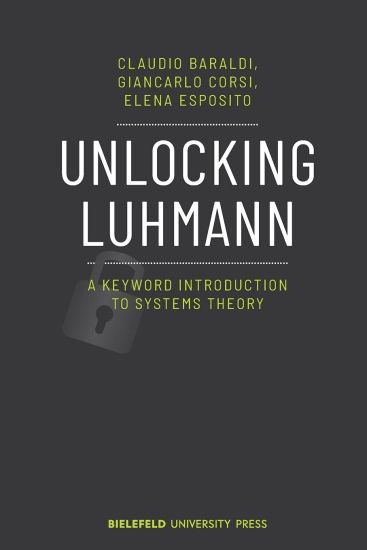
Unlocking Luhmann – A Keyword Introduction to Systems Theory

Unlocking Luhmann – A Keyword Introduction to Systems Theory

Claudio Baraldi; Giancarlo Corsi; Elena Esposito

Transcript Verlag
2021
nidottu
Luhmann's theory is fascinating and complex. It offers incomparably enlightening insights, references and research opportunities, but reveals its utility only after a quite high competence threshold. Using the reticular form of the glossary, this book makes the theory accessible while maintaining its complexity. Without being obstructed by knowledge gaps or by references to concepts presented elsewhere, readers inside and outside sociology get the required support to explore sociological systems theory and to engage with it. Luhmann himself, in his introduction, praises the form of the glossary to cope with the challenges of the theoretical description of our highly complex society.